
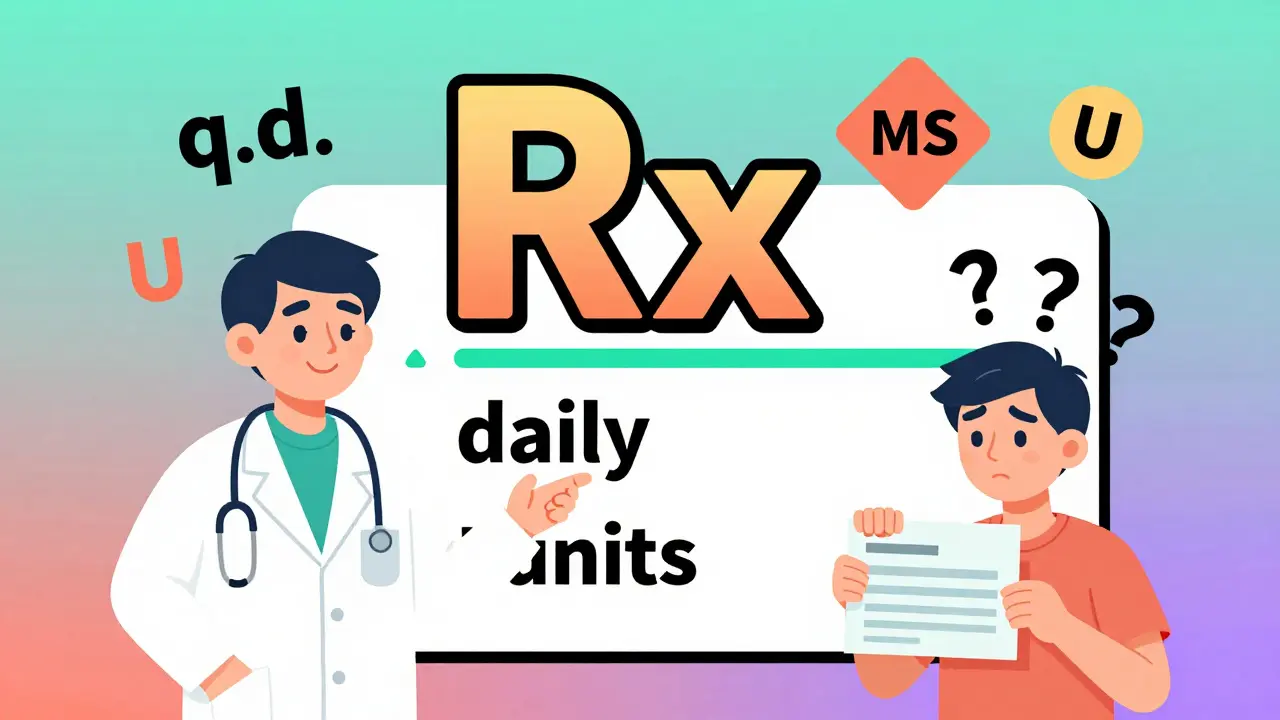
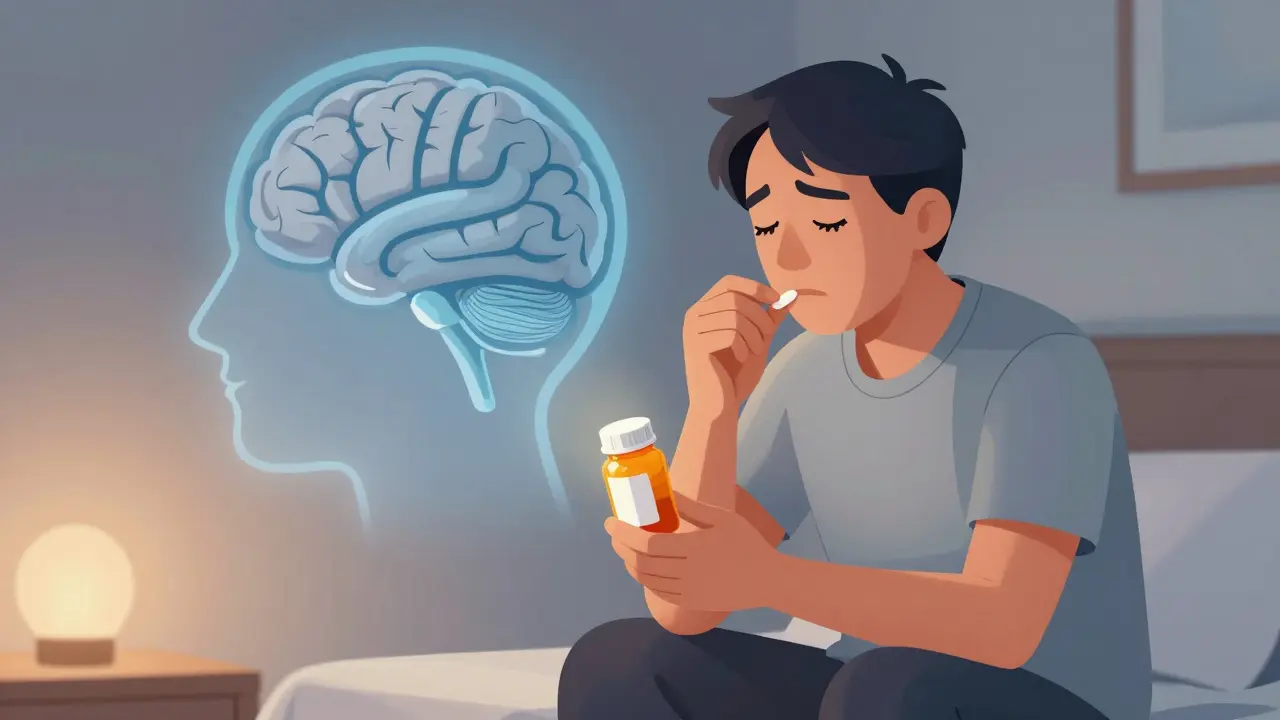
Ever looked at your prescription label and felt like you’re reading a secret code? That little Rx at the top? Or q.d., b.i.d., or a.d. on the instructions? You’re not alone. These abbreviations aren’t meant to confuse you - they were designed to save time for doctors and pharmacists. But when they’re misunderstood, they can lead to dangerous mistakes. In fact, nearly 7% of all medication errors in U.S. hospitals come from misread abbreviations, according to the Institute for Safe Medication Practices. And it’s not just hospitals - community pharmacies see these errors daily, especially when eye, ear, or dosage instructions get mixed up.
What Does Rx Actually Mean?
The Rx symbol is the most recognizable part of any prescription. It’s not a random design. It comes from the Latin word recipe, which means "take." Back in the 1500s, doctors wrote prescriptions in Latin so they’d be understood across Europe. Even today, you’ll still see it on every script - whether handwritten or digital. But here’s the catch: while Rx is universally accepted, many other Latin abbreviations are being phased out because they’re too easy to misread.
Common Prescription Abbreviations and What They Really Mean
Let’s break down the most common ones you’ll see on your label - and why some of them are being replaced.
- q.d. or QD - means "daily." But this one is risky. It looks like q.i.d. (four times a day), and people often misread it. That’s why most pharmacies now write "daily" instead.
- b.i.d. - "twice a day." Still widely used, but some places now say "every 12 hours" to avoid confusion.
- t.i.d. - "three times a day." Sometimes written as "every 8 hours," especially for antibiotics.
- q.i.d. - "four times a day." Less common now because it’s easy to confuse with b.i.d. or q.d.
- p.o. - "by mouth." This one’s safe and still used because there’s no clear alternative that’s shorter.
- SC, SQ, or SubQ - "subcutaneous," meaning under the skin. But some nurses have mistaken it for SL (sublingual), leading to dangerous errors. Many hospitals now require "under the skin."
- o.d. - "right eye." Sounds simple, right? But it’s been confused with "overdose" - and that’s led to people getting eye drops in the wrong eye, or even the wrong medication entirely.
- o.s. - "left eye." Same problem. And a.d. (right ear) and a.s. (left ear) cause similar mix-ups with ear drops.
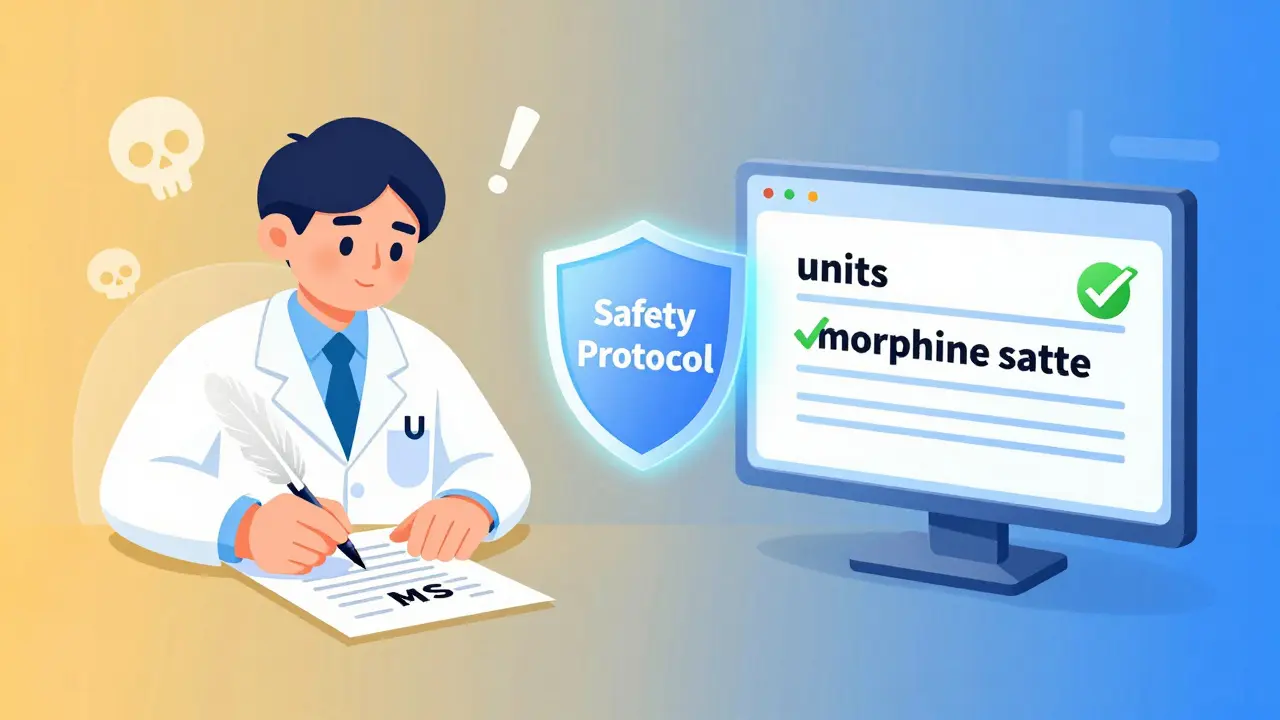
- U - "units." This one’s dangerous. It looks like a "4," or gets mistaken for "IV." The Joint Commission banned it in 2004. Now, it must be spelled out: "units."
- MS - could mean morphine sulfate or magnesium sulfate. One is a strong painkiller. The other treats low magnesium. Mixing them up can be deadly. Most pharmacies now require the full name.
- OTC - "over-the-counter." This one’s fine. You’ll see it on bottles to show you don’t need a prescription.
Why Are These Abbreviations Being Phased Out?
It’s not about tradition - it’s about safety. A 2023 report from the American Hospital Association found over 14,000 incidents linked to bad abbreviations in just one year. The biggest offenders?
- OD misread as "overdose" - 2,147 cases
- SC read as SL - 1,873 cases where insulin was given under the tongue instead of under the skin
- 1.0 mg misread as 10 mg - 1,562 cases from missing the decimal point
These aren’t hypothetical risks. They’re real events that have led to hospitalizations, long-term harm, and even deaths. That’s why the Joint Commission, WHO, and U.S. Pharmacopeia now require plain English on all prescriptions. The goal isn’t to make doctors write more - it’s to make sure no one gets hurt because of a sloppy note.
What’s Changing in 2025?
By the end of 2025, the FDA will require all drug labels to eliminate 12 high-risk abbreviations, including U, IU, q.d., and MS. Hospitals and pharmacies have been preparing for this. In fact, 92% of U.S. hospitals now use electronic prescribing systems that automatically block dangerous abbreviations before they’re written.
But here’s the problem: not every doctor uses the same system. Some still write paper scripts or use old templates. That’s why community pharmacists still see risky abbreviations every week. A 2023 survey found that 68% of community pharmacies get at least one prescription with a banned abbreviation each week. The most common? U for units, MS for morphine sulfate, and q.d. for daily.
Australia, Canada, and the UK have already moved to English-only prescriptions. The UK saw a 29% drop in dispensing errors after banning Latin abbreviations in 2019. In Australia, the Therapeutic Goods Administration now requires all prescriptions to use "daily," "twice daily," and "subcutaneous" - no exceptions.
How Pharmacies Are Protecting You
You might not realize it, but your pharmacist is doing a lot of work behind the scenes to catch mistakes. Here’s how:
- Automated flags - When a script comes in with q.d. or U, the system pops up a warning: "Replace with 'daily' or 'units'."
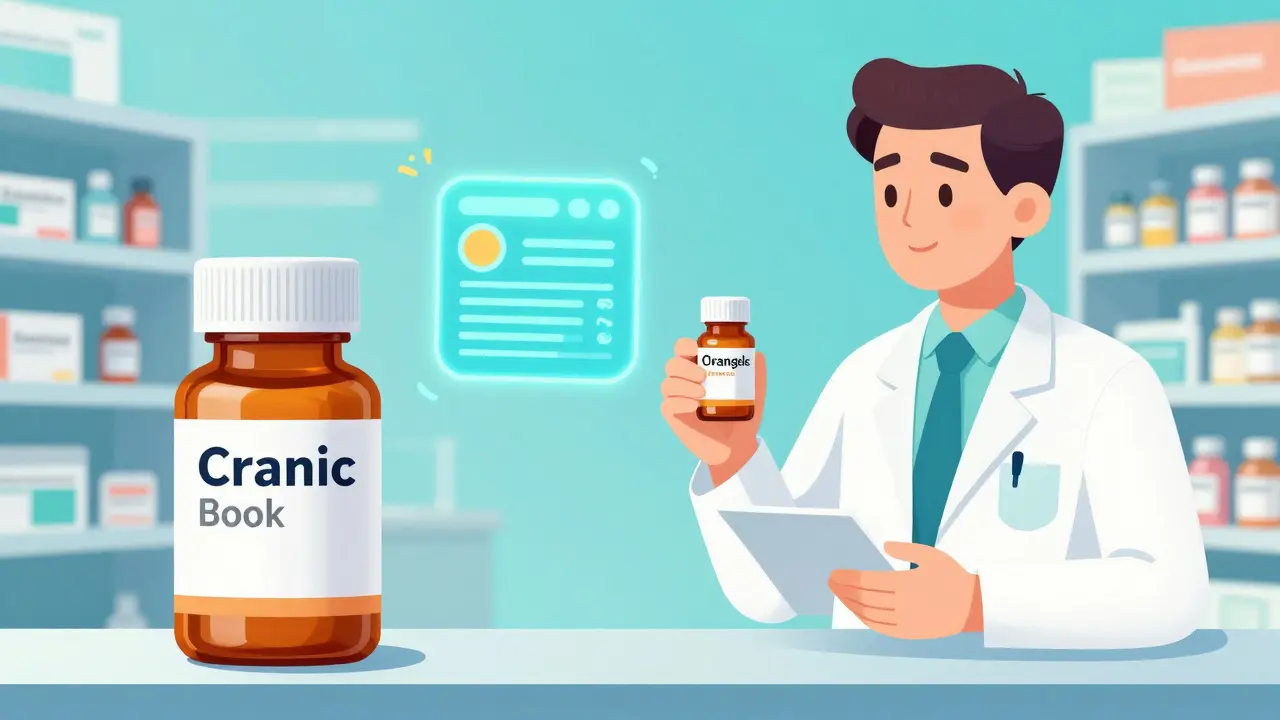
- Pharmacist review - Every prescription at CVS, Walgreens, and Walmart is checked by a pharmacist before it’s filled. If something looks off, they call the doctor.
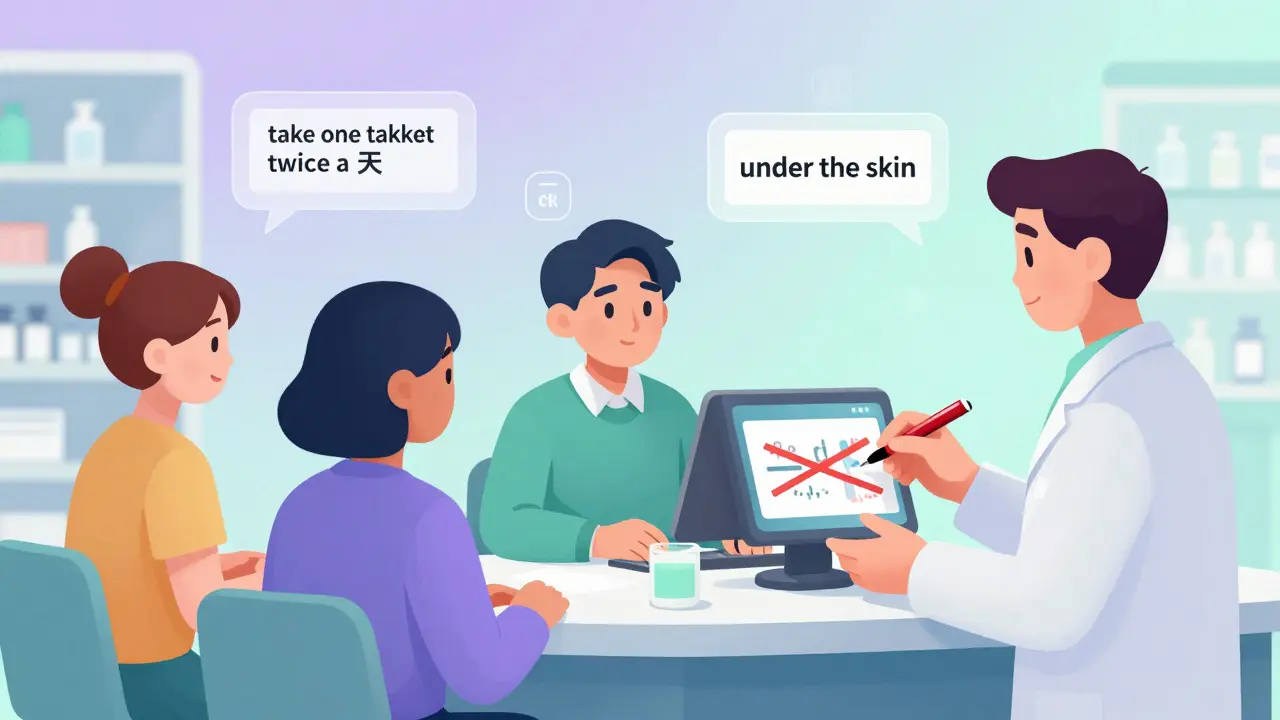
- Plain English labels - Your label won’t say b.i.d.. It’ll say "take twice a day." That’s not just for you - it’s to avoid confusion even if someone else reads it.
Some pharmacies even have a "double-check" step for high-risk meds like insulin, blood thinners, or opioids. That means two people verify the dose and instructions before you walk out the door.
What You Can Do to Stay Safe
You don’t need to memorize every abbreviation. But you can protect yourself with three simple steps:
- Ask - If you see anything you don’t understand on your label, ask your pharmacist. Say: "Can you explain this in plain English?" They’re trained to help.
- Check - Compare your label to the prescription slip. Does "take one pill daily" match what the doctor wrote? If it says "q.d." and your label says "daily," that’s good. If it says "q.d." and your label says "twice a day," speak up.
- Report - If you notice a dangerous abbreviation on a prescription (like U or MS), tell your pharmacist. They can contact the doctor to fix it before you take the medicine.
And if you’re helping a parent, grandparent, or someone with memory issues, read their labels out loud with them. Many people don’t realize how easy it is to misread a tiny "q.d." as "q.i.d." - especially in low light or with poor eyesight.
The Future of Prescription Labels
By 2027, experts predict 95% of prescriptions will be completely free of Latin abbreviations. AI-powered systems like IBM Watson Health’s MedSafety AI are already converting every o.d. to "right eye," every U to "units," and every MS to "morphine sulfate" - with 99.2% accuracy.
That doesn’t mean doctors are being punished for using old habits. It means the system is finally catching up to modern safety standards. The goal isn’t to make prescriptions longer - it’s to make them clearer. And that’s something every patient deserves.
Next time you pick up a prescription, take a second to read the label. If it says "daily," "twice a day," or "under the skin," you’re seeing the result of years of safety improvements. And if you’re still unsure? Ask. It’s your right - and it could save your life.



Sally Denham-Vaughan
January 1, 2026 AT 14:17My grandma almost took her insulin sublingually because the script said 'SC' and she thought it was 'SL'. Pharmacist caught it-saved her life. Seriously, why do we still let these abbreviations exist? Just say 'under the skin' already.
Ann Romine
January 2, 2026 AT 04:51I used to work in a pharmacy and saw the 'U' for units mistake way too often. One guy thought he was getting 4 units of insulin but it was 40. He ended up in the ER. The system’s getting better, but people still write it by hand. It’s scary.
Richard Thomas
January 2, 2026 AT 14:30There’s something deeply ironic about using Latin abbreviations in a system that’s supposed to be about clarity and accessibility. We’ve moved past the Renaissance, yet we’re still clinging to a dead language’s shorthand because ‘it’s tradition.’ But tradition doesn’t save lives-precision does. The fact that we’re only now mandating plain English feels less like progress and more like damage control after decades of preventable harm. It’s not about making doctors write more; it’s about making patients live longer.
Andy Heinlein
January 3, 2026 AT 01:41Yessss! I’ve been yelling this from the rooftops since my mom got her meds mixed up. I swear, if I see one more 'q.d.' on a label I’m gonna scream. Why not just say 'once a day'? It’s not that hard. Also, can we please retire 'MS' for morphine? I once saw a chart where it got confused with magnesium sulfate and the nurse almost gave it to a kid with seizures. 😳
Todd Nickel
January 4, 2026 AT 15:16The data cited here is accurate and well-sourced. The Joint Commission’s 2004 ban on 'U' for units was a landmark moment, yet implementation has been uneven across institutions. Electronic prescribing systems reduce error rates by 30–50%, but legacy paper prescriptions remain a vector for harm, particularly in rural clinics and urgent care centers. The 68% figure for community pharmacies receiving banned abbreviations weekly is alarming but unsurprising. Standardization is not merely a clinical imperative-it’s a civil right.
Heather Josey
January 5, 2026 AT 16:51This is exactly the kind of public health education we need more of. Thank you for breaking this down so clearly. I’ve worked in healthcare for 18 years, and I still get startled when I see 'o.d.' on a script. It’s not just about patients-it’s about pharmacists, nurses, and doctors too. We’re all human. We all misread things. Let’s stop relying on guesswork.
Olukayode Oguntulu
January 5, 2026 AT 23:50Oh, so now we’re infantilizing physicians by forcing them to write in kindergarten English? How quaint. The Latin abbreviations were a mark of professional literacy. The real problem is not the symbols-it’s the erosion of medical education and the rise of the ‘I Google my diagnosis’ culture. If you can’t decode a prescription, maybe you shouldn’t be taking one.
jaspreet sandhu
January 7, 2026 AT 15:46USA always overreacts. In India, we use 'qd', 'bid', 'tid' for decades. No one dies. People here make a big deal out of everything. Even 'U' for units-everyone knows what it means. Why change? Just teach people to read better. This is Western overcaution turning into bureaucracy.
Alex Warden
January 8, 2026 AT 12:12Why are we letting foreign countries dictate how we write prescriptions? UK banned Latin? So what? We’re America. We don’t follow their rules. Also, if you can’t read 'q.d.', maybe you shouldn’t be allowed to drive or use a smartphone. This is pure virtue signaling disguised as safety.
Kristen Russell
January 9, 2026 AT 22:48Just ask. That’s it. That’s the whole thing. No memorizing. No panic. Just say, 'Can you say that again?'
Bryan Anderson
January 9, 2026 AT 23:33I appreciate how thoroughly this was laid out. As someone who regularly helps elderly relatives manage medications, I’ve seen firsthand how confusing these symbols can be. The shift to plain language isn’t just safer-it’s more humane. Thank you for highlighting the pharmacist’s role too. They’re the unsung heroes here.
Liam George
January 11, 2026 AT 16:04Let me guess-the FDA, WHO, and 'experts' are all in on this. You think this is about safety? Nah. It’s about control. They want you dependent on the system. They want you scared of your own prescriptions. They want you to trust the pharmacist more than your own eyes. And they’re using 'misread abbreviations' as a scare tactic to push AI into your medicine. Watch what happens next-your pills will be tracked, your dosing monitored, your 'errors' flagged by algorithms. This isn’t safety. It’s surveillance dressed in white coats.
sharad vyas
January 13, 2026 AT 07:05In India, we often use Hindi or regional language labels alongside English. But I agree-clarity matters more than tradition. My father once took 'q.i.d.' as 'q.d.' and overdosed on antibiotics. We were lucky. Language should serve people, not confuse them. Simple words save lives.
Bill Medley
January 14, 2026 AT 00:29Standardization of pharmaceutical nomenclature is a necessary evolution in patient safety protocols. The empirical evidence supporting the elimination of ambiguous abbreviations is both robust and unequivocal. Continued use of nonstandard notation constitutes a breach of the duty of care.