
For years, fish oil supplements have been marketed as a must-take pill for a healthy heart. You’ve probably seen them on pharmacy shelves, in ads, or recommended by well-meaning friends. But here’s the truth: the science has changed. A lot. And what worked a decade ago might not hold up today. So if you’re wondering whether fish oil actually protects your heart, you’re not alone. Let’s cut through the noise and look at what the data really says.
What Are Omega-3s, and Where Do They Come From?
Omega-3 fatty acids are a type of fat your body can’t make on its own. That means you need to get them from food or supplements. The two most important kinds for heart health are EPA (eicosapentaenoic acid) and DHA (docosahexaenoic acid). These are mostly found in fatty fish - think salmon, mackerel, sardines, and herring. Your body can also turn a plant-based omega-3 called ALA (from flaxseeds, chia seeds, walnuts) into EPA and DHA, but it’s a very inefficient process - less than 5% gets converted.
Most fish oil supplements contain a mix of EPA and DHA. But here’s the twist: not all omega-3s are created equal. The type, dose, and even the form of the supplement matters a lot more than most people realize.
The Big Studies: Contradictory Results
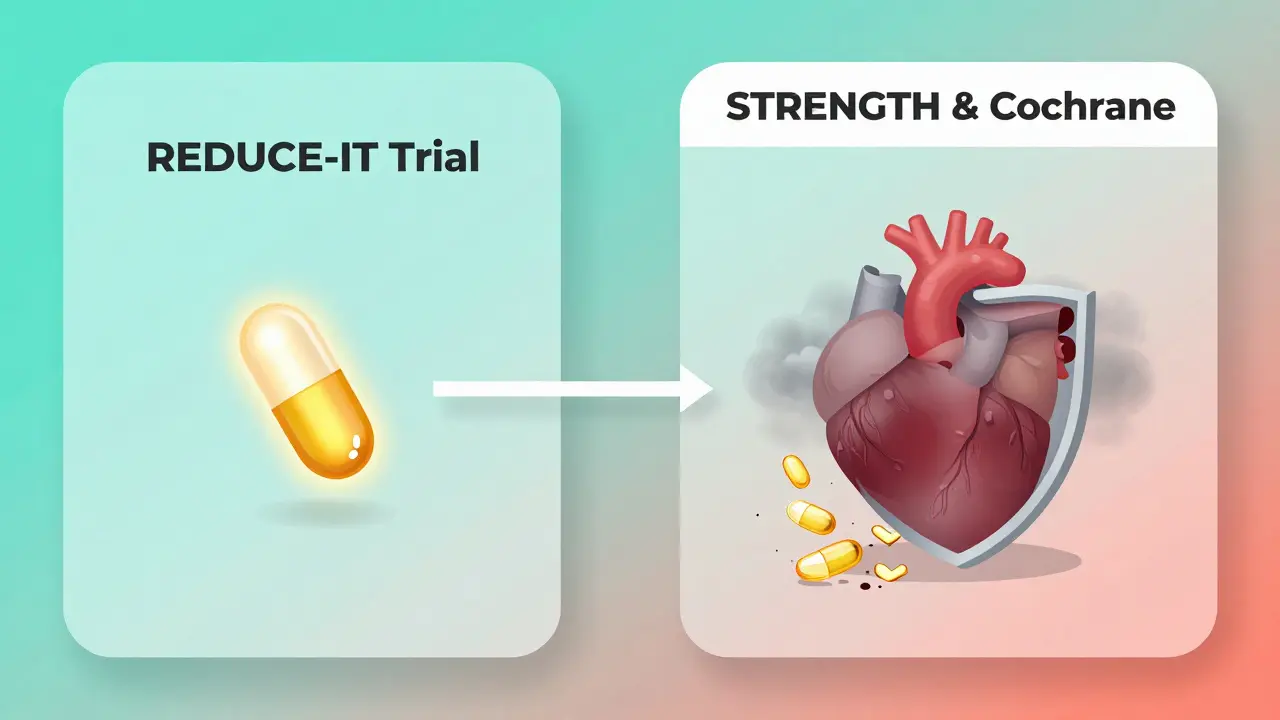
In 2018, the REDUCE-IT trial shook up the medical world. It studied over 8,000 people with high triglycerides and existing heart disease or diabetes. They were given 4 grams a day of a purified form of EPA called icosapent ethyl (brand name Vascepa). The results? A 25% drop in heart attacks, strokes, and heart-related deaths compared to a placebo. It was the clearest sign yet that high-dose EPA could help.
But then came the STRENGTH trial - same dose, same high-risk group, but with a combo of EPA and DHA. This time? No benefit. The trial was stopped early because it showed nothing. Why? Scientists still aren’t sure. One theory is that DHA might cancel out some of EPA’s benefits. Another is that the formulation used in STRENGTH was less stable and broke down in the body faster.
Then there’s the 2023 Cochrane review - the biggest analysis ever, looking at 79 studies with over 112,000 people. It found little to no effect from omega-3 supplements on heart attacks, strokes, or death. This included both prescription and over-the-counter products. The takeaway? For the average person, popping a daily fish oil pill likely doesn’t make a measurable difference.
Who Actually Benefits?
The evidence isn’t black and white. It’s more like a map with zones of benefit.
People with very high triglycerides (over 500 mg/dL): Prescription omega-3s like Lovaza or Vascepa are FDA-approved here. These aren’t just supplements - they’re drugs. They can cut triglycerides by 25-30%. That matters because high triglycerides are an independent risk factor for heart disease.
People who already have heart disease or diabetes and have elevated triglycerides (150-499 mg/dL): The REDUCE-IT trial showed clear benefit from 4 grams of EPA daily. That’s why many cardiologists still prescribe Vascepa for this group - especially if they’re already on statins.
African American adults: The VITAL trial found a 28% lower risk of heart attacks in this group, even with a lower dose (1 gram daily). Researchers think this might be linked to genetic differences in how the body processes omega-3s. This is one of the few clear population-specific benefits.
For everyone else - healthy people with normal cholesterol and triglycerides - the data doesn’t support daily fish oil. The American Heart Association’s 2019 advisory said it clearly: supplements don’t prevent first heart attacks. And they don’t replace statins, blood pressure meds, or lifestyle changes.
Prescription vs. Over-the-Counter: A Huge Difference
Most people buy fish oil at the drugstore. A typical capsule has 300-500 mg of combined EPA and DHA. To match the dose used in REDUCE-IT (4 grams), you’d need to swallow 8-12 capsules a day. That’s expensive, messy, and hard to stick with.
Prescription omega-3s like Vascepa contain 1 gram of EPA per capsule. You take two a day. That’s it. They’re also purified to remove contaminants and are tightly regulated. Over-the-counter supplements? Not so much. A 2023 Consumer Reports test found 12 out of 35 popular brands had oxidation levels above international safety limits. That means the oil was going rancid - and rancid omega-3s might do more harm than good.
Cost matters too. Vascepa can run $300 a month with insurance. OTC fish oil? $10-$50 a month. But if you’re in the group that benefits, the prescription is the only option backed by solid evidence.
What About Eating Fish Instead?
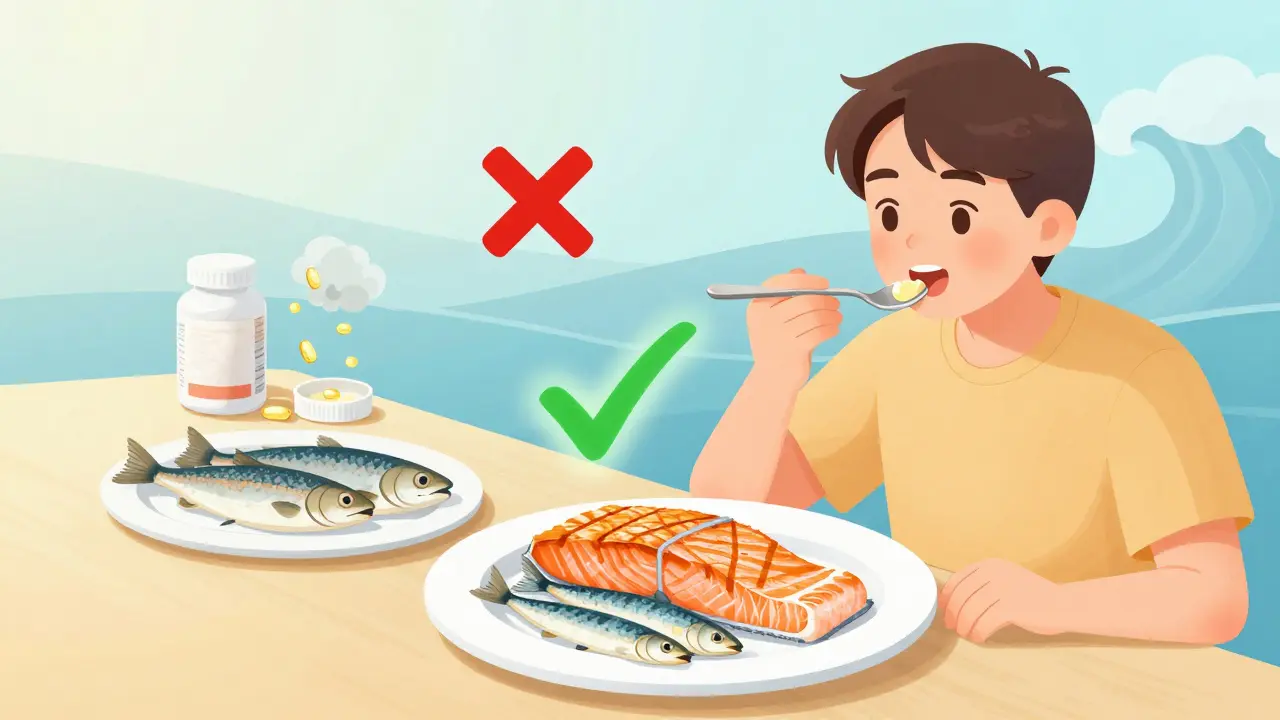
The American Heart Association still recommends eating two servings of fatty fish per week. That’s about 500 mg of EPA and DHA daily - the amount most healthy people need. Salmon, sardines, trout, and anchovies are top choices. This approach gives you omega-3s plus protein, vitamin D, and other nutrients - without the risk of oxidation or inconsistent dosing.
And here’s the kicker: people who eat fish regularly have lower rates of heart disease. That’s not because of a magic pill. It’s because they’re replacing less healthy foods - like processed meats or fried snacks - with nutrient-rich options.

Side Effects and Risks
Fish oil isn’t risk-free. At high doses (over 3 grams daily), some people experience:
- Fishy aftertaste or burping (reported by 32% of users)
- Stomach upset, nausea, or diarrhea (27%)
- Increased risk of atrial fibrillation (a type of irregular heartbeat) - a 0.4% absolute increase in high-dose users
- Potential for bleeding, especially if you’re also on blood thinners like warfarin or aspirin
Mercury is rarely an issue with reputable brands. Most test below 0.1 ppm - well under the FDA’s 1 ppm limit. But oxidation? That’s the hidden problem. If your fish oil smells off or tastes rancid, toss it. Store it in the fridge to slow degradation.
What Do Experts Really Think?
There’s a split in the medical community.
Dr. Deepak Bhatt, lead researcher of REDUCE-IT, says high-dose EPA is a game-changer for high-risk patients. He calls it "robust evidence."
But Dr. Lee Hooper, who led the 2023 Cochrane review, says the "most trustworthy studies" show little to no benefit. She argues that for most people, supplements are a waste of money.
Dr. Robert Eckel, former AHA president, is blunt: "I don’t think the data indicate fish oil supplementation is needed under most circumstances."
The AHA’s current stance? It’s nuanced. They don’t recommend supplements for general prevention. But they do say 1 gram daily may reduce deaths from coronary heart disease and sudden cardiac arrest - especially in people with existing heart disease.
What Should You Do?
Here’s a simple guide:
- If you have heart disease or diabetes and your triglycerides are above 150 mg/dL - talk to your doctor about Vascepa. This is the only situation where high-dose EPA has strong proof of benefit.
- If you’re healthy and eat fish twice a week - you probably don’t need a supplement.
- If you’re vegetarian or don’t eat fish - consider an algae-based DHA/EPA supplement. It’s plant-derived and avoids the fishy aftertaste.
- If you’re taking OTC fish oil - check the label. Are you getting at least 500 mg of EPA+DHA per serving? Is it third-party tested (look for USP, NSF, or ConsumerLab seals)? Is it stored in a dark bottle? If not, you might be better off skipping it.
- Never replace proven treatments (statins, blood pressure meds, exercise) with fish oil.
The bottom line? Fish oil isn’t a magic bullet. It’s not useless either. It’s a tool - and like any tool, it only works for the right job. For most people, the best heart protection still comes from food, movement, and not smoking. For a small group with specific risk factors, a prescription EPA supplement might be worth it.
And if you’re unsure? Get your triglycerides checked. That number tells you more about whether fish oil could help you than any ad ever could.
Do fish oil supplements prevent heart attacks?
For most healthy people, no. Large studies like the 2023 Cochrane review show little to no effect on preventing heart attacks in the general population. However, in people with high triglycerides and existing heart disease, high-dose prescription EPA (Vascepa) has been shown to reduce heart attacks by 25%. The VITAL trial also found a 28% reduction in heart attacks among African American adults taking 1 gram daily.
Is prescription fish oil better than over-the-counter?
Yes, for people who need high doses. Prescription omega-3s like Vascepa contain purified, high-dose EPA (1 gram per capsule) and are regulated by the FDA. Over-the-counter supplements typically contain 300-500 mg of combined EPA and DHA per capsule, require multiple daily doses to reach therapeutic levels, and are not tightly regulated. A 2023 Consumer Reports test found 12 out of 35 OTC brands had rancid oil, which could be harmful.
Can I get enough omega-3s from food instead of supplements?
Yes, and it’s often better. The American Heart Association recommends two 3.5-ounce servings of fatty fish (like salmon, mackerel, or sardines) per week. This provides about 500 mg of EPA and DHA daily - enough for most people. Fish also delivers protein, vitamin D, and other nutrients that supplements don’t. For people who don’t eat fish, algae-based supplements are a good plant-based alternative.
Does fish oil lower cholesterol?
Fish oil doesn’t lower LDL ("bad") cholesterol. In fact, some people see a slight increase. But it does lower triglycerides - a different type of fat - by 25-30% at doses of 2-4 grams daily. High triglycerides are a known risk factor for heart disease, so reducing them matters. That’s why prescription omega-3s are approved for treating severe hypertriglyceridemia (≥500 mg/dL).
Are there risks to taking fish oil every day?
At high doses (over 3 grams daily), fish oil can increase the risk of atrial fibrillation (an irregular heartbeat) by about 0.4% absolute risk. It may also increase bleeding risk if you’re on blood thinners. Common side effects include fishy burps, stomach upset, and diarrhea. Quality matters too - rancid supplements can be harmful. Always choose third-party tested brands and store them in the fridge.




Randall Walker
March 10, 2026 AT 06:36Miranda Varn-Harper
March 12, 2026 AT 05:31Alexander Erb
March 14, 2026 AT 01:32Donnie DeMarco
March 15, 2026 AT 13:22Tom Bolt
March 17, 2026 AT 08:00Shourya Tanay
March 18, 2026 AT 12:48Mike Winter
March 19, 2026 AT 00:19LiV Beau
March 20, 2026 AT 02:37Adam Kleinberg
March 20, 2026 AT 07:04Denise Jordan
March 21, 2026 AT 11:20Gene Forte
March 22, 2026 AT 22:26Kenneth Zieden-Weber
March 23, 2026 AT 15:18Chris Bird
March 24, 2026 AT 20:35David L. Thomas
March 26, 2026 AT 14:41Bridgette Pulliam
March 27, 2026 AT 14:19