

When someone is 70 or older, getting health information isn’t just about what’s written-it’s about whether they can understand it. Too many older adults are given brochures, forms, or app notifications that look clear to a 30-year-old but leave them confused, anxious, or even scared. The truth? Most medical materials aren’t made for them. And that’s not just inconvenient-it’s dangerous.
One in five U.S. adults reads at or below a 3rd-grade level. For seniors, that number is even higher. A 2003 study from the CDC found that 71% of adults over 60 struggled with basic printed health materials. By 2023, that problem hadn’t gone away. In fact, 63% of older adults still say they have trouble understanding medication labels, and over half admit they never ask for help because they’re embarrassed. That’s why senior patient education isn’t about making things smaller or simpler-it’s about redesigning how information is shared.
What Makes Good Senior Patient Education Materials?
Good materials for older adults don’t just use plain language-they’re built around how aging changes the way people see, hear, think, and remember.
First, font size matters. The National Institute on Aging recommends a minimum of 14-point font. But it’s not just about size-it’s about typeface. Sans-serif fonts like Arial or Verdana are easier to read than Times New Roman. Letters like “l” and “1” or “O” and “0” need to be clearly different. Some materials even add small labels: “m as in Mary” next to the letter “m” to avoid confusion.
Second, color and contrast are critical. A white page with light gray text? That’s a nightmare for someone with cataracts or macular degeneration. High contrast-black text on a bright white background-is the standard. Avoid pastels, gradients, or busy backgrounds. Even the lighting in a doctor’s office matters. A 2022 study found that patients understood instructions 28% better when the room was well-lit with natural-spectrum LED lighting.
Third, content must be short. A 12-page booklet? Most seniors won’t read it all. Effective materials are one page-or two at most. If more detail is needed, use a simple “Learn More” link or QR code that leads to a video. And those videos? They need to be slow-paced, with clear visuals and captions. No fast cuts. No background music. Just a calm voice and clear images.
How Do You Know If It’s Working?
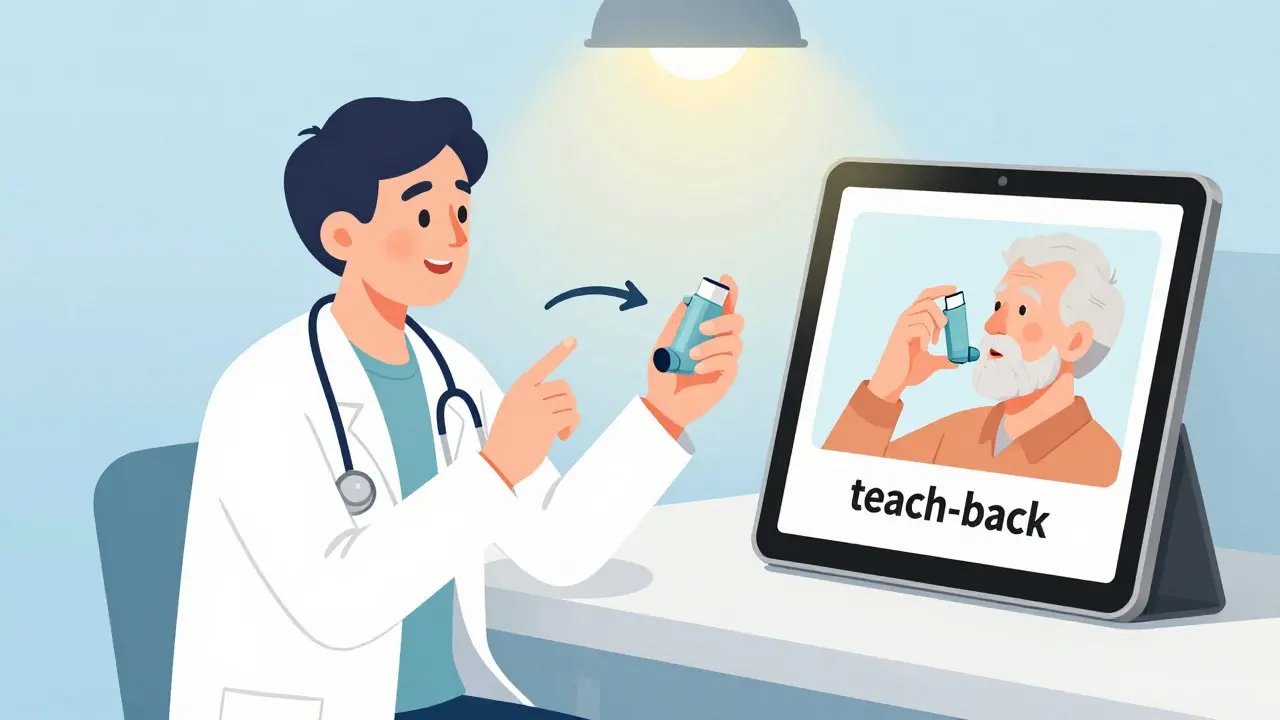
It’s not enough to hand someone a handout. You need to check if they got it. That’s where the “teach-back” method comes in.
Instead of asking, “Do you understand?”-which most people say yes to, even if they don’t-healthcare providers are trained to say: “Can you tell me in your own words how you’ll take this medicine?”
A 2022 study in Patient Education and Counseling found that providers who used teach-back spent just 2.7 extra minutes per visit but improved patient understanding by 31%. That’s not a lot of time, but it makes a huge difference. One nurse in Ohio told her team to use teach-back after every new prescription. Within six months, medication errors among seniors dropped by 40%.
Illustrations help too. A 2023 review of 47 studies found that step-by-step pictures of how to use an inhaler, inject insulin, or take pills improved adherence by 37% compared to text-only instructions. Simple drawings of hands holding pills, arrows showing direction, or color-coded days on a pill box? These aren’t just nice-they’re necessary.
Where to Find Trusted Materials
Not all “senior-friendly” materials are created equal. Some websites use big fonts but still pack in medical jargon. Others use cute clip art that feels condescending. The best resources come from trusted sources that test their materials with real older adults before publishing.
- HealthinAging.org-run by the American Geriatrics Society, this site offers over 1,300 free, easy-to-read guides on topics from diabetes to fall prevention. All materials are reviewed by both medical experts and seniors over 65.
- MedlinePlus-the NIH’s health portal includes a section called “Easy-to-Read Health Information.” It has 217 resources, all checked with the Health Education Materials Assessment Tool (HEMAT). Topics range from Alzheimer’s to heart health.
- National Institute on Aging (NIA)-their “Talking With Your Older Patients” guide is used by clinics nationwide. It includes scripts for doctors, sample handouts, and even audio versions for those with vision loss.
- CDC’s Healthy Aging Program-they publish free downloadable fact sheets on topics like managing multiple medications and preventing falls. All are written at a 3rd-5th grade level.
These aren’t just websites. They’re tools built with feedback from real people. For example, HealthinAging.org tested a new guide on blood pressure with 22 seniors in rural Ohio. One woman said, “I thought ‘systolic’ meant ‘slow.’ Now I know it’s the top number.” That kind of feedback shapes the final product.
Why This Matters More Than You Think
Bad communication doesn’t just make people confused-it makes them sick.
According to the CDC, older adults with low health literacy are 2.3 times more likely to say they’re in poor health. They’re also 1.7 times more likely to have diabetes. And hospital readmissions? They drop by 14.3% when clinics use clear materials and teach-back. That’s over $1,800 saved per patient.
The Agency for Healthcare Research and Quality found that healthcare systems using universal health literacy practices saw a 22% drop in emergency room visits among seniors within 18 months. That’s not just cost savings-it’s fewer scary trips to the ER.
And yet, only 28% of U.S. healthcare systems have fully adopted these practices. Why? Staff time and money. But the cost of not doing it is higher. A 2023 report estimated that poor health literacy costs the U.S. system between $106 billion and $238 billion a year. Most of that comes from seniors.
What’s Changing in 2026?
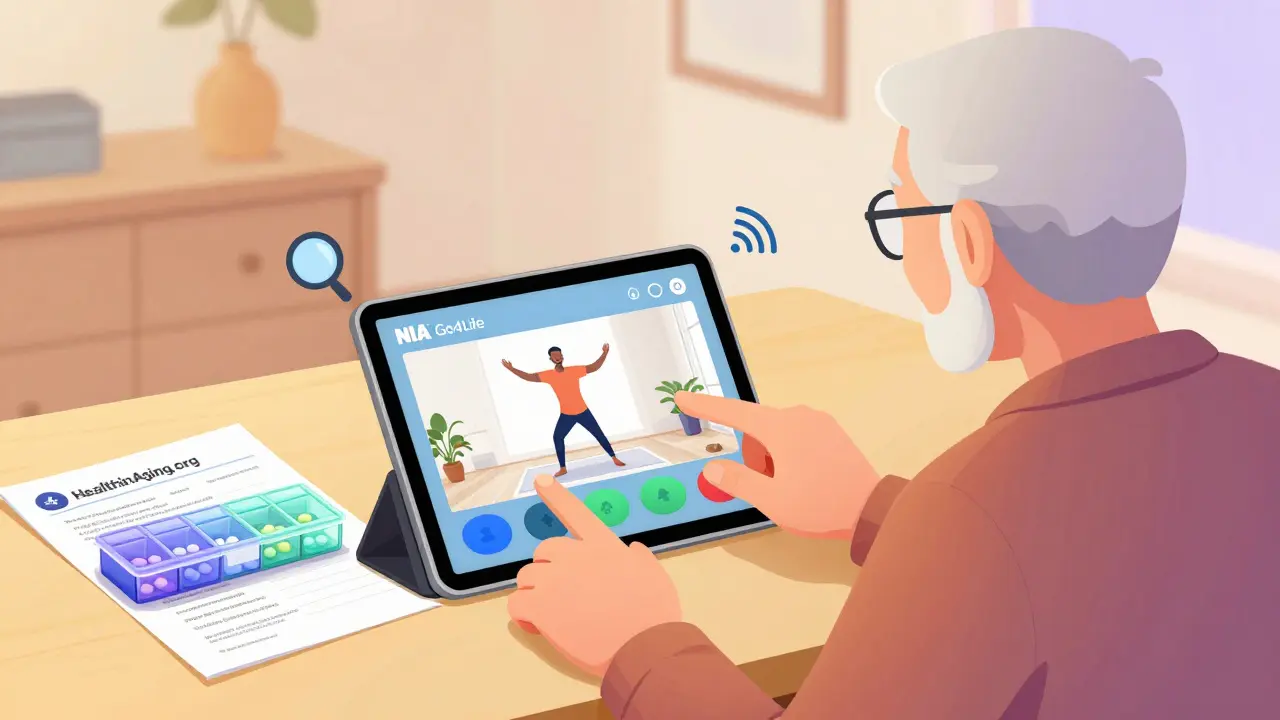
The field is evolving. Voice assistants like Alexa and Google Home are now being used to deliver health reminders in plain language. The NIA launched an updated Go4Life program in January 2024 with voice-guided exercise routines. Some clinics now use tablets with large-touch buttons that play short videos when tapped.
Telehealth is a double-edged sword. While it helps seniors avoid travel, 68% of them now use it-up from 17% in 2019. But if the app is hard to use, they give up. That’s why the CDC now includes digital literacy in their guidelines. Can the senior click the right button? Can they hear the video? Can they pause it? These are now part of patient education.
Even AI is stepping in. A $4.2 million NIH study running through 2026 is testing tools that adjust text size, speaking speed, and image complexity based on how a patient responds. If someone pauses too long on a sentence, the system slows down. If they skip a video, it offers a picture instead.
And the law is catching up. The Plain Language Act of 2010 now applies to all government health materials. By 2026, every medical student in the U.S. must complete 8 hours of health literacy training. That means the next generation of doctors won’t just know how to treat illness-they’ll know how to explain it.
What You Can Do Today
If you’re caring for an older adult, here’s what works:
- Ask for materials in large print or audio format.
- Use the teach-back method: “Can you show me how you’d take this pill?”
- Turn off background noise when explaining something. Silence helps focus.
- Use a pill organizer with big labels and color-coded days.
- Visit HealthinAging.org or MedlinePlus and print out a guide together.
- If they’re confused, don’t say “It’s simple.” Say, “Let’s figure this out together.”
And if you’re a provider? Start small. Pick one patient, one medication, one instruction. Use a big font. Add a drawing. Ask them to repeat it back. You’ll see the difference.
Senior patient education isn’t about dumbing down information. It’s about respecting how people change as they age-and making sure no one is left behind because the paper they were given was too small, too fast, or too confusing.
Helen Brown
March 2, 2026 AT 03:37Sharon Lammas
March 2, 2026 AT 10:35Callum Duffy
March 2, 2026 AT 10:36Chris Beckman
March 3, 2026 AT 02:59Levi Viloria
March 3, 2026 AT 12:08Matt Alexander
March 3, 2026 AT 20:50Gretchen Rivas
March 5, 2026 AT 00:32Stephen Vassilev
March 5, 2026 AT 08:58Mike Dubes
March 5, 2026 AT 16:06John Cyrus
March 6, 2026 AT 02:32John Smith
March 6, 2026 AT 15:21Mariah Carle
March 7, 2026 AT 08:57