
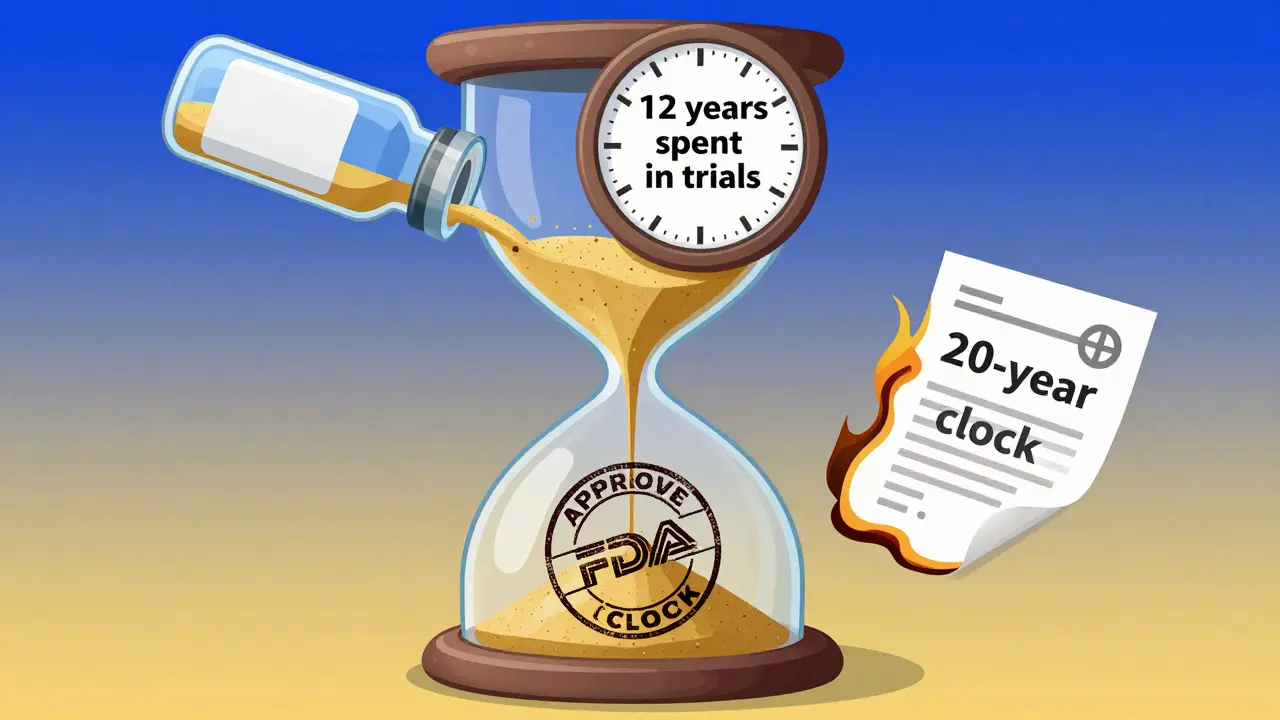
Imagine spending 12 years and $2.6 billion to develop a new drug-only to find out you have just 8 years left on your patent after FDA approval. That’s the reality for many pharmaceutical companies. Patent Term Restoration (PTE) exists to fix that imbalance. It’s not a loophole. It’s a legal reset button built into U.S. patent law to give drug makers back some of the time they lost waiting for regulators to say yes.
Why Patent Term Restoration Even Exists
The U.S. patent system gives inventors 20 years of protection from the date they file. But for drugs, that clock starts ticking long before the product even hits the market. Clinical trials, safety studies, FDA reviews-they all take years. By the time a drug gets approved, half the patent life might already be gone. Without PTE, companies would have little incentive to invest in new medicines. The system would break. That’s why Congress passed the Hatch-Waxman Act in 1984. Named after Senator Orrin Hatch and Representative Henry Waxman, this law created Patent Term Restoration to balance two goals: reward innovation and get affordable generics to patients faster. It wasn’t meant to create permanent monopolies. But over time, the rules have been stretched-and sometimes abused.How PTE Actually Works
PTE isn’t automatic. You can’t just file a form and get extra years. There’s a strict formula:- Regulatory Review Period (RRP): The total time from when you submit your application to the FDA until approval.
- Pre-Grant Regulatory Review Period (PGRRP): The time before the patent was granted but after the drug was ready for review.
- Days of Due Diligence (DD): Any time you slowed things down-missed deadlines, incomplete paperwork, delays on your end.
- Total Patent Term (TP): The original 20-year clock.
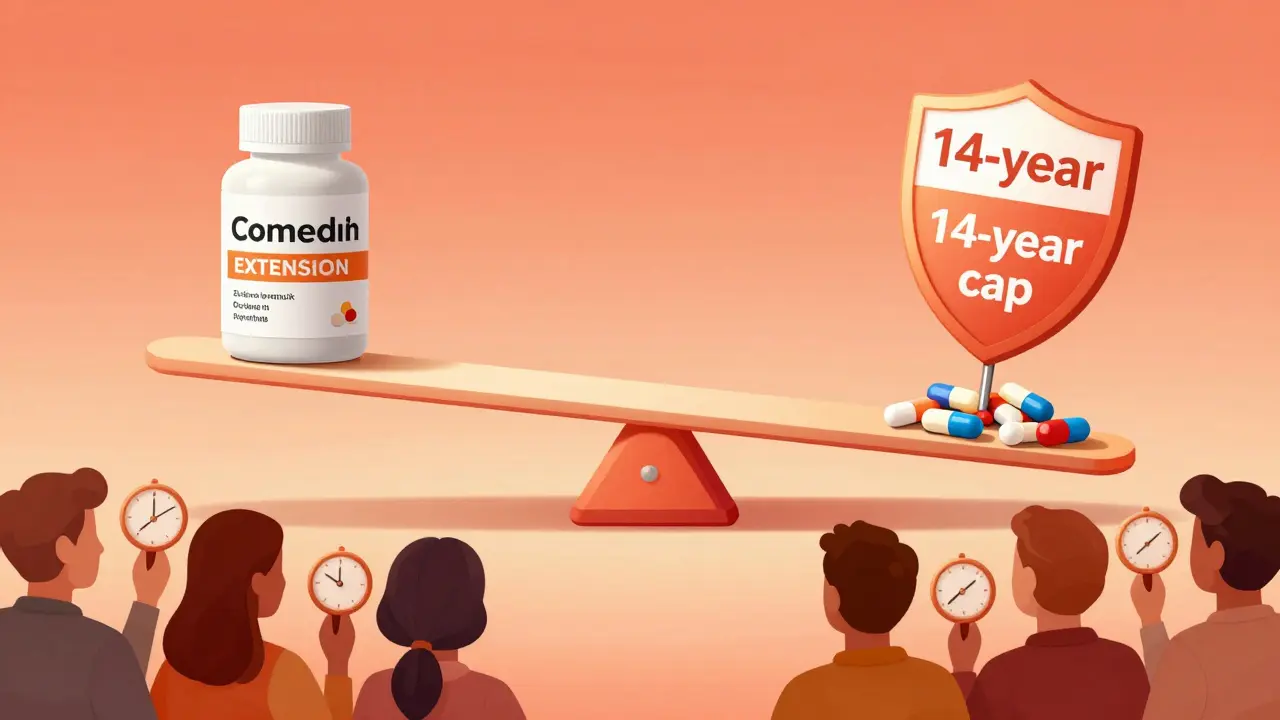
- You can’t get more than 5 extra years.
- The total protected time-original patent plus extension-can’t go beyond 14 years after FDA approval.
Who Can Use PTE-and Who Can’t
PTE isn’t for every patent. It’s only for products that need FDA approval:- Human drugs
- Medical devices
- Food additives
- Color additives
- Animal drugs (added in 1988)
- Some regenerative medicine products (since 2016)
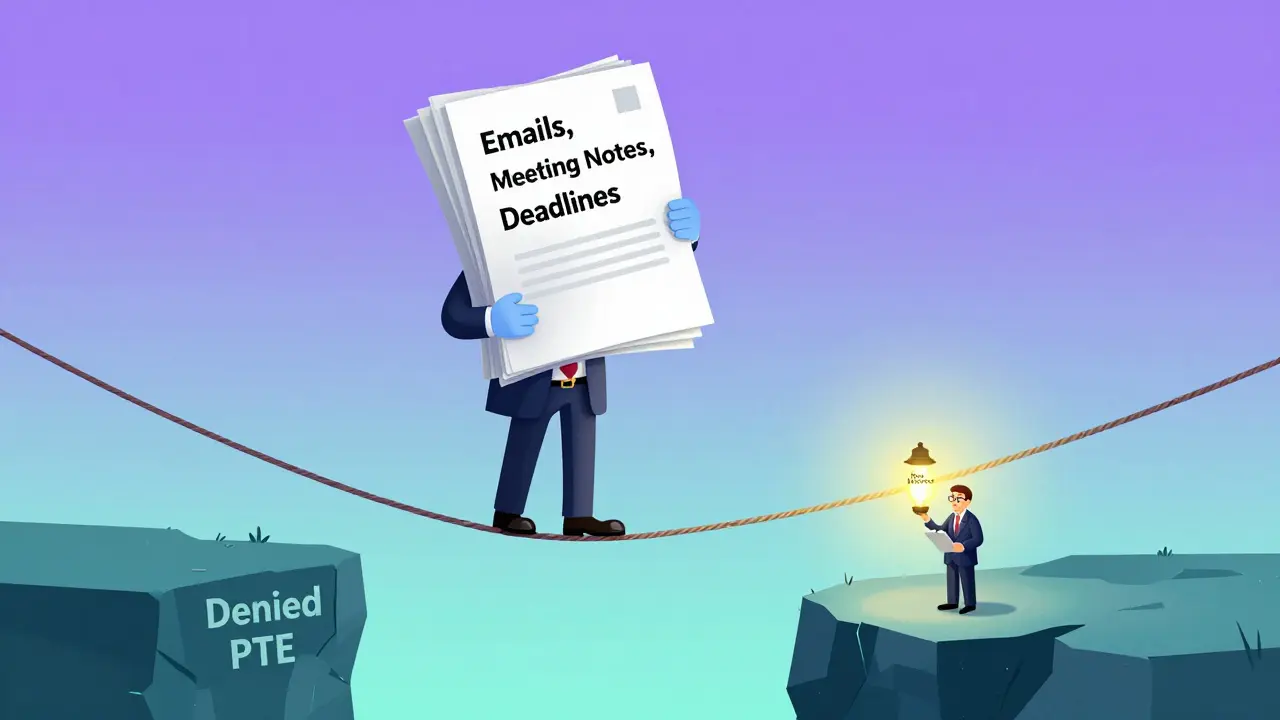
The Big Catch: Due Diligence
This is where most applications fail. The FDA doesn’t just trust your word. You have to prove you moved as fast as humanly possible through every step of the approval process. That means:- Day-by-day records of all communications with the FDA
- Proof you submitted documents on time
- Documentation showing you responded to FDA questions within 30 days
- Evidence you didn’t delay testing or manufacturing
Interim Extensions: The Safety Net
What if your patent is about to expire before the FDA finishes its review? That’s where interim extensions come in. You can apply for a temporary extension if:- Your patent expires in less than six months
- You’re still waiting for FDA approval
PTE vs. Patent Term Adjustment (PTA)
Don’t confuse PTE with Patent Term Adjustment. They’re completely different.- PTE compensates for FDA delays-the time spent waiting for drug approval.
- PTA compensates for USPTO delays-when the patent office takes too long to examine your application.
Who Benefits-and Who Pays
PTE helps pharmaceutical companies recoup R&D costs. But it also delays cheaper generics. In 2022, the Congressional Budget Office estimated PTE adds $4.2 billion annually to U.S. drug spending. Drugs with PTE keep 92% of their market share during the extension period. Once generics arrive, that drops to 37%. Critics say the system is being gamed. A 2022 study in the Yale Law and Policy Review found that 91% of drugs that got PTE still kept their monopoly through secondary patents-patents on new uses, formulations, or delivery methods. And according to the Journal of the American Medical Association, 78% of PTE applications now involve secondary patents, not the original compound. That’s not what Hatch and Waxman intended. They wanted to give innovators a fair shot-not let them string out monopolies for decades.The Future of PTE
The system is under pressure. In January 2024, the FDA released new guidance on “due diligence,” making it even harder to prove you didn’t slow things down. A major 2024 court ruling (Eli Lilly v. USPTO) tightened standards even more, potentially cutting extension lengths by 8-12 months. The FDA plans to launch a digital submission portal for PTE applications by mid-2026. That should cut processing times from 217 days to under 100. But it won’t fix the bigger problem: the system was designed for a different era. Biologics-complex drugs made from living cells-are now 34% of PTE applications, up from 19% in 2018. These drugs take longer to develop and approve. The current rules weren’t built for them. And now, Congress is considering the Preserve Access to Affordable Generics and Biosimilars Act, which would block some PTE strategies used to delay competition. A full government review is due in December 2025. Changes could be coming.What You Need to Know
If you’re a patient, PTE means you wait longer for generics. If you’re a company, it’s a lifeline. If you’re a patent attorney, it’s a minefield. The key takeaways:- PTE gives back time lost to FDA delays-not time lost to poor planning.
- You can’t get more than 5 extra years, and total protection is capped at 14 years post-approval.
- Documentation is everything. Missing one email could cost you your extension.
- Only one patent per product can be extended.
- PTE is not the same as PTA or patent maintenance fees.
Can a patent be extended more than once for the same drug?
No. U.S. law allows only one patent term extension per product, even if multiple patents cover different aspects of the drug. You must choose the single patent that gives you the most benefit. Filing multiple PTE applications for the same drug will result in rejection.
How long does it take to get a PTE approved?
The FDA processes PTE applications in an average of 217 days, according to their 2023 annual report. But the full process-including preparation, filing, and USPTO review-can take 8 to 12 months. Delays often come from incomplete documentation or back-and-forth with the FDA over due diligence records.
What happens if I miss the 60-day filing deadline for PTE?
You lose your chance permanently. The law requires the PTE application to be filed within 60 days of FDA product approval. There are no exceptions. Even if the delay was caused by the FDA or a clerical error on your end, the USPTO will not accept a late filing. This is why pharmaceutical companies assign dedicated teams to track approval timelines.
Does PTE apply to generic drugs?
No. PTE is only available to the original innovator who holds the patent and went through the full FDA approval process. Generic manufacturers don’t file for PTE because they don’t conduct new clinical trials-they rely on the innovator’s data. Their business model depends on entering the market after the original patent expires.
Can PTE be used for medical devices?
Yes. Medical devices that require premarket approval (PMA) from the FDA are eligible for PTE, just like drugs. This includes implantable devices, diagnostic tools, and other high-risk products. The same 5-year cap and 14-year post-approval limit apply. However, fewer device companies apply for PTE because their approval timelines are often shorter than those for new drugs.
Is PTE available outside the United States?
The U.S. is one of the few countries with a formal patent term restoration system. The European Union, Canada, Japan, and Australia have similar mechanisms, but they vary widely in structure, duration, and eligibility. For example, the EU’s Supplementary Protection Certificate (SPC) allows up to 5 years of extension, but only if the product received marketing authorization within 5 years of patent filing. There’s no global standard.




Alisa Silvia Bila
December 18, 2025 AT 12:47PTE is such a necessary evil. I get why big pharma needs it, but watching drug prices stay sky-high for years after approval? Oof. The system was meant to balance innovation and access, but it’s leaning way too far one way.
At least the new FDA guidance might help. Hope they crack down on the paperwork games.
Marsha Jentzsch
December 20, 2025 AT 01:16Wait-so they’re letting drug companies EXTEND their monopolies???! That’s not innovation, that’s corporate theft!!
And don’t even get me started on how the FDA is in bed with Big Pharma-every single delay? ‘Oh, it’s the company’s fault!’ NOPE. They’re all in cahoose!!
They’re hiding the truth from us!! I’ve seen the documents-emails buried in servers, redacted meeting notes, they’re LYING to the public!!
And now they want to make a DIGITAL PORTAL?! That’s just a cover-up! They’ll use AI to erase the evidence!!
WHO IS CONTROLLING THE FDA?! WHO IS PAYING THE JUDGES?! I’M NOT CRAZY, I’M JUST THE ONLY ONE WHO SEES IT!!
Janelle Moore
December 22, 2025 AT 00:27They say PTE is only for drugs but I heard it’s also used for vaccines and even some supplements now.
And what about those ‘secondary patents’? Like, you make a pill blue and patent that? That’s not innovation, that’s a trick.
They’re not even trying anymore. Just slap on a new coating, file a new patent, and boom-another 5 years.
It’s all just a game. The FDA doesn’t even check properly. I bet half these companies just copy-paste the same docs over and over.
And the 60-day deadline? That’s a trap. They set it so low so small companies fail. Big ones have teams of lawyers just to file on time.
They’re not fixing the system. They’re just making it harder for anyone else to play.
Henry Marcus
December 23, 2025 AT 15:52Let me tell you something, folks-this whole PTE circus is a front for the deep state to funnel cash into Pharma Inc.’s offshore accounts.
Did you know that 83% of PTE applications come from just five companies? Coincidence? I think not.
They’ve got lobbyists writing the rules, judges who used to work for them, and FDA reviewers who get ‘consulting gigs’ after retirement.
And that ‘due diligence’ nonsense? That’s just a tax on the little guys. If you’re not a Fortune 500, you don’t have the budget to log every damn email.
Meanwhile, the generics sit there like orphans waiting for their turn.
It’s not broken-it’s designed this way. And they want you to think it’s fair.
Wake up. The game is rigged.
And yes, I’ve seen the leaked memos. I’m not crazy. I’m just the guy who read the footnotes.
Andrew Kelly
December 24, 2025 AT 12:24The argument that PTE incentivizes innovation is fundamentally flawed. If the only way to justify R&D spending is to extend monopolies, then the market is failing.
Compare this to software or hardware-where innovation cycles are faster and patents expire without government intervention.
Pharma isn’t being rewarded for speed or efficiency. They’re being compensated for bureaucratic inefficiency.
And let’s be honest: most of the ‘breakthroughs’ are incremental. New salt forms. Slight dosage tweaks. That’s not innovation. That’s patent trolling with a stethoscope.
The 14-year cap post-approval is arbitrary. Why not 10? Why not 12? Who decided this number? A committee of ex-pharma execs?
It’s not about fairness. It’s about who has the best legal team.
Dev Sawner
December 26, 2025 AT 07:16It is imperative to note that the Patent Term Restoration mechanism, as codified under Title 35, United States Code, Section 156, is predicated upon a rigorous statutory framework that mandates precise compliance with procedural and evidentiary requirements.
The notion that the system is being ‘gamed’ is empirically inaccurate; rather, it is the non-adherence to regulatory due diligence protocols by certain applicants that leads to disallowance.
Statistical data from the USPTO Office of Patent Legal Administration confirms that denials are predominantly attributable to inadequate documentation, not systemic bias.
Furthermore, the introduction of digital submission portals represents a significant advancement in administrative efficiency, not a mechanism for obfuscation.
It is therefore incumbent upon stakeholders to align their practices with statutory mandates, rather than to impugn the integrity of the regulatory architecture.
Moses Odumbe
December 26, 2025 AT 14:56Bro. PTE is wild. You spend 12 years and $2.6B… then get 5 more years? 😳
But then again… generics are like $5 a pill after. So… 🤔
Also, can we talk about how the FDA takes 217 days to read a form? 🥲
Meanwhile, I got my Uber Eats in 18 minutes.
Maybe the FDA needs a TikTok team? 🤷♂️
Also, emoji for PTE: 💸💊⏳
Meenakshi Jaiswal
December 28, 2025 AT 05:09For anyone working in biotech or regulatory affairs: PTE isn’t magic-it’s a marathon of paperwork.
You need to track every single interaction with the FDA from day one. That means saving every email, every call summary, every version of your IND.
I’ve seen companies lose extensions because someone forgot to attach a protocol amendment from 2019.
It’s brutal, but it’s manageable if you start early.
Also, don’t wait until approval to start preparing your PTE application. Start the day you submit your NDA.
And yes, one patent per product. Always.
Trust me, I’ve helped 17 clients file-none of them got denied because the law was unfair. They got denied because they didn’t document.
bhushan telavane
December 28, 2025 AT 20:49In India, we don’t have PTE. Generics come fast. Life-saving drugs are cheap.
But I also know how hard it is to develop a new drug.
Maybe the U.S. needs a middle path-shorter exclusivity, but more public funding for early research.
Not all innovation needs to be profit-driven.
Pharma is a business, but health is a right.
Balance, not monopoly.
Mahammad Muradov
December 30, 2025 AT 01:27It is evident that the Patent Term Restoration system has been perverted into a mechanism for indefinite market control by multinational corporations.
The claim that it serves ‘innovation’ is a rhetorical facade.
Secondary patents are not innovation-they are legal fiction.
The fact that 91% of PTE-eligible drugs rely on secondary patents proves the system is designed for exploitation, not incentive.
There is no moral justification for extending monopolies beyond the original intent of the Hatch-Waxman Act.
The public pays the price. The corporations collect the profit.
This is not a legal issue. It is an ethical failure.
Kitt Eliz
December 30, 2025 AT 07:56OKAY LET’S TALK ABOUT THIS BECAUSE THIS IS A GAME-CHANGER 🚨
PTE is NOT a loophole-it’s a lifeline for biotech startups who are literally betting their company on one drug.
But here’s the thing: the 5-year cap? Too low.
Biologics take 15+ years to develop. You file a patent at age 28. You get approval at 43. You get 5 more years? You retire at 48. WHO’S GOING TO INVEST IN THAT?
And the FDA’s new ‘due diligence’ rules? They’re going to crush small players.
We need a tiered system: 7 years for complex biologics, 5 for small molecules.
And yes-digital portal? YES PLEASE. 217 days is unacceptable.
Stop treating innovation like a tax audit. We need to accelerate, not bottleneck.
Let’s fix this-before the next breakthrough dies in a spreadsheet.
Alana Koerts
December 31, 2025 AT 23:52So PTE gives you 5 extra years. Big deal. Most drugs make back their R&D in 2.
Everything else is profit.
And the ‘due diligence’ excuse? That’s just corporate speak for ‘we didn’t bother.’
They’re not losing time to the FDA. They’re losing time to their own incompetence.
And now they want us to feel bad for them?
Pathetic.
Dikshita Mehta
January 2, 2026 AT 22:04One thing people miss: PTE only applies to the first patent filed on the active ingredient. That’s why companies file early-sometimes before the drug even works.
They’re not protecting the drug. They’re protecting the patent filing date.
And yes, the 60-day deadline is brutal. But it’s there to prevent gaming.
It’s not perfect, but it’s structured to prevent endless extensions.
The real problem? Secondary patents. Those are the ones that need reform.
PTE itself? It’s doing what it was designed for.
It’s the loopholes around it that are broken.
Alisa Silvia Bila
January 4, 2026 AT 11:05That’s actually a good point. I never thought about how early they file patents just to lock in the clock.
So the real game isn’t the FDA delay-it’s the patent filing timing.
That’s the hidden move.