

More than 1.5 billion people worldwide live with some level of hearing loss. For many, hearing aids aren’t just helpful-they’re life-changing. But with so many options now available, choosing the right one can feel overwhelming. Are you better off with an over-the-counter device or a custom-fit prescription model? What does "amplification technology" actually mean? And why does fitting matter more than brand name?
What Are the Main Types of Hearing Aids?
Hearing aids come in five main styles, each designed for different needs, lifestyles, and levels of hearing loss. The right style depends on your ear shape, how much hearing you’ve lost, and how visible you want the device to be.Behind-the-Ear (BTE) models sit behind your ear and connect to a custom earmold inside the ear canal. These are the most powerful and durable. Brands like Phonak’s Naída Lumity L-UP are built for severe to profound hearing loss. They last 1-3 weeks on a single charge and are IP68 waterproof, meaning they can handle sweat, rain, or even accidental drops in water. Their size makes them easier to handle for people with limited dexterity, but they’re more visible than other styles.
Receiver-in-Canal (RIC) devices are smaller and more discreet. The speaker sits directly in the ear canal, connected by a thin wire to the main unit behind the ear. Jabra Enhance Select 700 and Widex MOMENT SmartRIC fall into this category. They offer 24-29 hours of battery life, Bluetooth 5.2 or LE Audio support, and excellent sound clarity. RICs are popular because they strike a balance between power and comfort, making them ideal for mild to moderate hearing loss.
In-the-Ear (ITE) models fill the outer part of the ear. Signia Active Pro IX is a top example, offering 34 hours of battery life and full Bluetooth connectivity. They’re more powerful than smaller styles and include larger controls, which helps if you have trouble with tiny buttons. But they’re more visible and can be affected by earwax buildup.
Completely-in-Canal (CIC) and Invisible-in-Canal (IIC) hearing aids are nearly hidden. Eargo’s designs are the most well-known here. They’re great for people who care about appearance, but their tiny size limits battery life to 16-20 hours and reduces features like directional microphones or volume controls. You’ll need help from someone else to change the battery or clean them.
There’s no "best" style-only the best fit for your life. If you’re active, outdoorsy, or have dexterity issues, BTE or RIC might suit you better. If you’re in professional settings and want something invisible, IIC could be right. But size always comes with trade-offs.
How Does Hearing Aid Fitting Actually Work?
Fitting isn’t just about plugging in a device. It’s a process that ensures the sound is tuned to your unique hearing profile. A poorly fitted hearing aid can make things worse-making voices sound muffled, background noise too loud, or your own voice echoey.If you go through a clinic, the process takes 2-3 weeks and includes at least three appointments. First, you’ll get a full hearing test. Audiologists don’t just check if you can hear tones-they measure how well you understand speech in noise, which is where most people struggle. Then, based on your audiogram, the device is programmed using software that maps specific frequencies to your hearing loss. A 50-year-old with high-frequency loss needs different amplification than a 70-year-old with flat hearing loss.
After the initial fitting, you’ll return for adjustments. Most people need 2-3 tweaks in the first month. Why? Because your brain needs time to relearn how to process amplified sound. It’s not like putting on glasses. Your auditory system has adapted to reduced input, and sudden clarity can feel overwhelming.
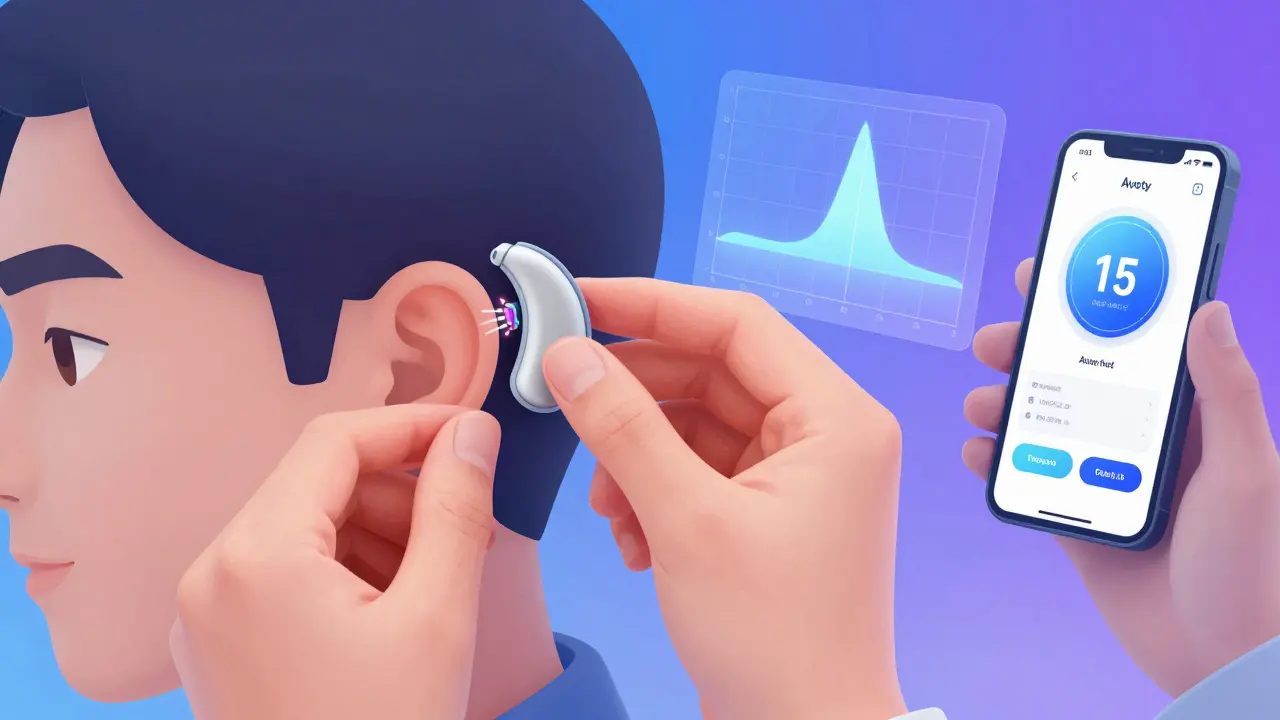
With OTC hearing aids, the fitting is done yourself-usually through a smartphone app. Jabra Enhance Select 700, for example, guides you through a 15-minute hearing test in the app, then auto-adjusts the settings. HearingTracker’s tests show 85% of users complete this successfully on the first try. But here’s the catch: 68% of users in NIH trials ended up with suboptimal amplification because they misjudged their own hearing loss. If you have moderate to severe loss, self-fitting can leave you with too little gain in the frequencies you need most.
One major issue everyone overlooks: earwax. It blocks up to 42% of hearing aids monthly. That’s why cleaning your device weekly with the right tools cuts malfunctions by 67%. If your hearing aid suddenly sounds muffled, don’t assume it’s broken-check the wax filter first.
What Is Modern Amplification Technology?
Today’s hearing aids aren’t just amplifiers. They’re mini-computers that process sound in real time. The real breakthrough isn’t louder sound-it’s smarter sound.Old analog aids simply made everything louder. Modern digital aids use dual-chip architecture to separate speech processing from noise reduction. Phonak’s Audéo Infinio uses this system to reduce sound delay to just 0.4 milliseconds. Compare that to the industry average of 5-7 milliseconds. That tiny difference means your voice doesn’t sound "delayed" when you speak, and conversations feel natural.
Premium models now have 24+ processing channels. Each channel adjusts volume and clarity for a specific frequency range. So if you struggle to hear women’s voices (which sit in higher frequencies), the device boosts those without making traffic noise louder. Starkey’s Edge AI analyzes 290 million data points per second to classify environments-like a restaurant, a car, or a quiet room-and switches presets automatically.
LE Audio is the next big leap. Unlike traditional Bluetooth, LE Audio supports Auracast, a broadcast technology that lets you stream audio from public speakers, TVs, or even restaurant sound systems directly to your hearing aids. A 2025 Reddit thread found that 73% of users with LE Audio devices reported a "huge improvement" in music and group conversations.
Some models now include health monitoring. Starkey’s 2026 roadmap includes blood oxygen tracking and fall detection. This isn’t sci-fi-it’s happening. Hearing aids are becoming wearable health devices.
OTC vs. Prescription: Which One Should You Choose?
The FDA’s 2022 rule opened the door for over-the-counter (OTC) hearing aids. Now, you can buy them at pharmacies, online, or even in big-box stores like Costco. But not all OTCs are created equal.OTC options like Jabra Enhance Select 700 cost between $199 and $1,299 per pair. They’re easy to set up, come with great apps, and offer 24/7 chat support. 89% of users praise their self-fitting experience. But they’re designed only for mild-to-moderate hearing loss. If your audiogram shows a steep drop in high frequencies or you struggle in noisy places, OTC devices often can’t deliver enough power.
Prescription aids from Phonak, Oticon, Widex, and Signia cost $3,500 to $7,500 per pair. Why the jump? They include professional fitting, multiple follow-ups, and advanced features like AI-driven noise suppression, tinnitus masking, and direct streaming from iPhones and Android phones. Phonak holds 22.3% of the global market because they’re trusted by audiologists for complex cases.
Costco offers a middle ground. Their Rexton Reach models cost $1,399-$2,999 and come with in-store audiology support. You get professional help without the luxury price tag.
Here’s a simple rule: If you’re over 50 and have trouble understanding speech in crowds, get tested. If your audiogram shows moderate or worse loss, skip OTC. If you’re younger, have mild loss, and just want to hear the TV better, OTC is fine.
What Users Say: Real Experiences
Real people don’t care about specs-they care about whether their hearing aids work in daily life.Users of the Phonak Naída Lumity L-UP give it 4.6/5 for severe hearing loss. But 34% say it’s too bulky for small ears. That’s a real issue for women or older adults with narrow ear canals.
Eargo gets slammed for battery life. Trustpilot reviews show 62% of complaints say the device lasts less than 16 hours, even though it’s advertised for 20. That’s a problem if you forget to charge it overnight.
One Reddit user in Brisbane wrote: "I switched from my 2020 Widex to the new MOMENT SmartRIC. Suddenly, I could hear my granddaughter’s voice clearly in the park. I didn’t even know I was missing it." That’s the kind of moment these devices are built for.
And then there’s the little hacks people share: Keep silica gel packets in your case to absorb moisture in humid climates like Brisbane. Enable Auracast at restaurants so you can hear your table without asking everyone to repeat themselves. Clean your device every Sunday with the brush and wax loop provided.
What’s Next for Hearing Aids?
The future is here. By 2027, 41% of buyers are expected to choose telehealth fitting over in-clinic visits. That means more convenience, but also more risk if you’re not properly screened.Manufacturers are racing to add health sensors. Starkey’s next-gen models will monitor heart rate, activity levels, and even detect falls-sending alerts to family members. This isn’t a gimmick. For older adults living alone, it could be lifesaving.
Cybersecurity is a growing concern. University of Michigan research found 12% of Bluetooth-enabled hearing aids can be intercepted. That’s rare, but it means you should disable Bluetooth when not in use and update firmware regularly.
By 2050, the WHO predicts 2.5 billion people will have hearing loss. That’s nearly one in three people. Hearing aids won’t just be medical devices-they’ll be everyday tech, like smartwatches. The difference? They’ll help you stay connected to the people who matter most.
Final Thoughts: Don’t Delay
Hearing loss doesn’t happen overnight. It creeps in slowly. You start missing jokes, turning up the TV, or nodding along in conversations you didn’t catch. By the time you notice, your brain has already started to forget how to process sound.Getting help isn’t about admitting you’re old. It’s about staying engaged. Whether you choose an OTC device or a custom-fit model, the most important step is to get tested. You don’t need to spend thousands. But you do need to act before your hearing loss becomes harder to fix.
Don’t wait for someone else to notice. If you’re asking people to repeat themselves more than twice a week, it’s time to look into hearing aids. The technology is better than ever. And the right fit can bring back moments you thought were gone for good.
Can I buy hearing aids without seeing a doctor?
Yes, over-the-counter (OTC) hearing aids are available without a prescription in the U.S. and some other countries. They’re designed for adults with mild-to-moderate hearing loss. But if you have severe loss, sudden hearing changes, or ear pain, you should see an audiologist. OTC devices won’t fix everything-and self-fitting can lead to improper amplification if your hearing loss is more complex than you think.
How long do hearing aid batteries last?
Battery life varies by style and usage. Behind-the-ear (BTE) and receiver-in-canal (RIC) models typically last 16-34 hours on a single charge. Some premium models like the Signia Active Pro IX offer up to 34 hours. Smaller styles like IICs last 16-20 hours. Rechargeable models are now standard, and most take 3-4 hours to fully charge. For extended use, keep a portable charger handy.
What’s the difference between LE Audio and regular Bluetooth in hearing aids?
LE Audio is the next-generation Bluetooth standard for hearing aids. It uses less power, delivers better sound quality, and supports Auracast-a broadcast feature that lets you connect to public audio systems like TVs in airports or sound systems in restaurants. Regular Bluetooth only connects one-to-one, like your phone to your hearing aid. LE Audio lets multiple people listen to the same stream, making group settings much easier.
Do hearing aids work in noisy places?
Yes, but not all models handle noise equally. Premium devices like Phonak Audéo Infinio and Starkey Edge AI use AI to isolate speech and reduce background noise. Lower-end models, especially some OTC options, struggle in crowded places. Lab tests show devices like the Rexton Reach score poorly in noisy environments. If you often eat out, attend meetings, or live in a busy city, invest in a model with multi-microphone tech and AI noise reduction.
How often do I need to replace my hearing aids?
Most hearing aids last 4-7 years. Battery life, wear and tear, and software updates affect longevity. If your device becomes outdated-like lacking Bluetooth or LE Audio-or if your hearing loss progresses, you may need to upgrade sooner. Many people replace them every 5 years to take advantage of new tech, especially if their lifestyle has changed (e.g., starting remote work or traveling more).



Kathy McDaniel
January 28, 2026 AT 10:59just got my first otc aids last month and wow i can hear my cat purring from the other room 😍
Kirstin Santiago
January 29, 2026 AT 02:06really appreciate how this breaks down the tech without making it feel like a sales pitch. i used to think hearing aids were just for old people, but now i see they’re for anyone who wants to stay connected. my mom got a ric last year and she’s finally joining in on family dinners without asking everyone to repeat themselves. small wins matter.
Anjula Jyala
January 30, 2026 AT 22:48OTC devices are a bandaid for lazy audiologists and people who dont want to pay for real care. if your audiogram shows more than 40db loss at 3khz you are not a candidate for consumer grade devices. the brain adapts to auditory deprivation and self fitting only reinforces maladaptive neural pathways. stop self diagnosing and get a real evaluation. this is not a smartphone accessory.
Andrew Clausen
January 31, 2026 AT 11:42you claim LE Audio supports Auracast but fail to mention that only a handful of public venues in the entire U.S. have implemented it. the rest is marketing fluff. also the claim about 0.4ms delay is misleading - that’s only under lab conditions with no competing signals. real world latency is closer to 2.1ms. and dont even get me started on the battery life claims. 34 hours? only if you turn off bluetooth and use it for 2 hours a day. otherwise its 18 max.
John O'Brien
January 31, 2026 AT 22:22anjalas right but also kinda a jerk about it. i got my otc aids from Costco and theyre fine for my mild loss. i dont need a $6k device to hear my wife say "where are my keys". also the wax filter tip? life saver. i clean mine every sunday like clockwork. no more sudden muffled sounds. also auracast at the gym? game changer. i can hear the instructor without cranking the volume on the speakers. no conspiracy here just good tech.
Candice Hartley
February 2, 2026 AT 07:00i had no idea earwax caused 42% of malfunctions 😳 i thought my hearing aids were just broken. now i clean them weekly and they work like new. also the part about brain relearning? that hit home. it took me 3 weeks to stop feeling overwhelmed by sounds. now i hear birds i didnt even know existed. thank you for this.
astrid cook
February 2, 2026 AT 18:57imagine spending thousands on a device that can track your blood oxygen but you still cant hear your grandkids say i love you. this is what happens when tech companies turn medical devices into status symbols. next theyll add a fitness tracker and call it a wellness revolution. meanwhile people are drowning in silence because they were told to "just buy it online". this is a public health crisis disguised as innovation.
Paul Taylor
February 3, 2026 AT 11:38you know what really sucks about all this? the way people treat hearing loss like its a personal failure. my dad waited 7 years to get help because he thought it meant he was old. he finally went in after he missed his own granddaughter saying her first words. the aids changed everything. not because they were fancy or expensive but because he finally listened. and now hes the one reminding everyone to clean their wax filters. so yeah the tech is cool but the real breakthrough is people finally stopping being ashamed. also i use a silica gel packet in my case like the post said. best tip ever. humidity kills these things.
Desaundrea Morton-Pusey
February 4, 2026 AT 04:28why is everyone ignoring the cybersecurity part? your hearing aids are bluetooth connected devices with microphones. someone could listen to your private conversations. the article says 12% are vulnerable. that means your bathroom conversations your medical appointments your arguments with your spouse - all potentially streamable. this isnt sci fi its already happening. and no one is talking about it. why? because the companies dont want you to know. you think they care about your hearing? they care about your data.
Murphy Game
February 4, 2026 AT 22:45the entire hearing aid industry is a scam. the real reason you need professional fittings is because the companies want to lock you into their ecosystem. they sell you the device then charge you $200 a year for software updates. they make you think your hearing is getting worse so you upgrade every 3 years. meanwhile the tech is barely improving. the real solution? get a cheap ear trumpet and stop paying for corporate greed. also auracast? thats just apple and google trying to control audio like they control everything else. dont be their puppet.