
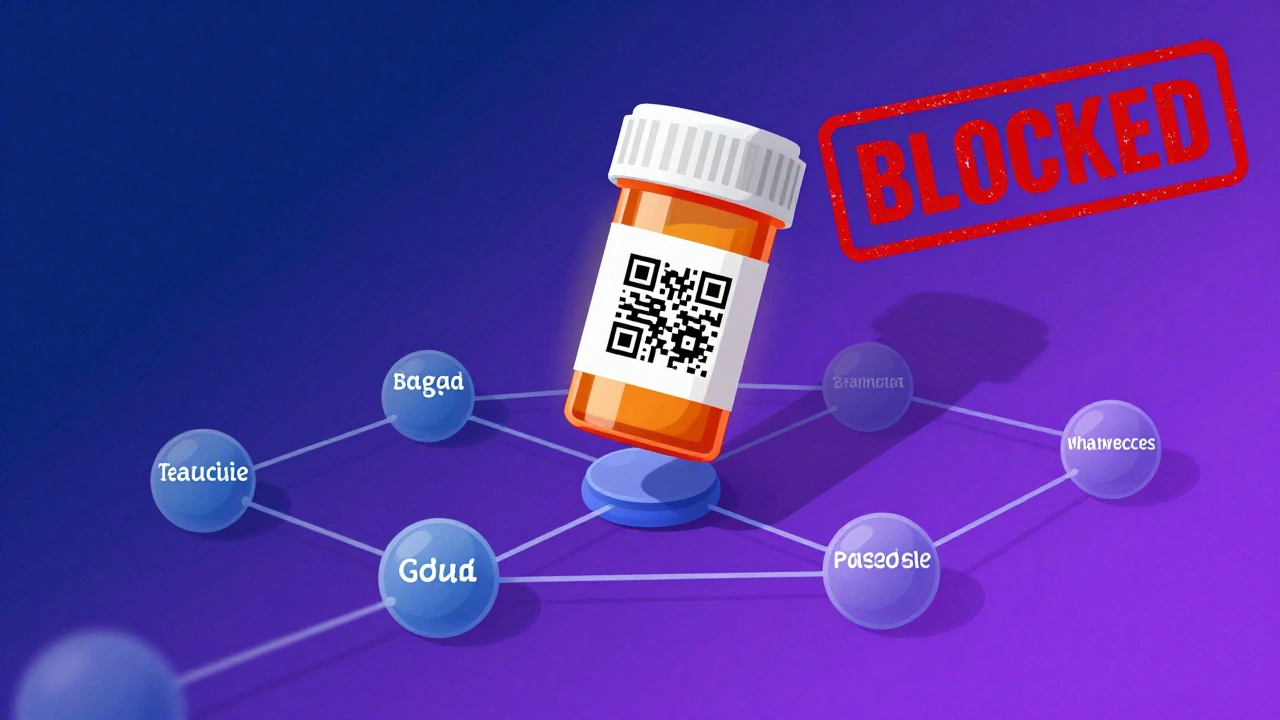
Every year, millions of prescription drugs move through a complex web of manufacturers, wholesalers, pharmacies, and patients. For decades, this system ran on paper records and trust. Then came the counterfeiters - selling fake cancer drugs, diluted antibiotics, and fake opioids that looked real but could kill. In response, the U.S. government created the DSCSA track-and-trace system. By November 27, 2024, every prescription drug package in the U.S. must carry a unique digital fingerprint. If a drug doesn’t match that fingerprint, it gets blocked. This isn’t just bureaucracy. It’s the final line of defense against deadly fake medicine.
What the DSCSA Actually Does
The Drug Supply Chain Security Act (DSCSA) didn’t just add another rule. It rebuilt how drugs move across America. Before DSCSA, each state had its own tracking rules. A drug shipped from Ohio to California might need five different forms, none of them compatible. That chaos made it easy for counterfeiters to slip in. DSCSA replaced all of that with one federal standard: every package gets a unique serial number, tied to its lot number, expiration date, and National Drug Code (NDC). That’s four pieces of data on every bottle, box, or blister pack. These identifiers aren’t just for humans to read. They’re machine-readable barcodes - like QR codes - that scanners at pharmacies and distributors can read in seconds. When a pharmacy receives a shipment, it doesn’t just check the label. It scans each package and sends that data to a system that checks it against the manufacturer’s record. If the serial number doesn’t exist, or if it’s been used before, the system flags it. That’s how fake drugs get caught before they reach a patient’s hands.How It Works: The Three Key Pieces
DSCSA doesn’t rely on one tool. It uses three types of electronic data that travel with every drug shipment:- Transaction Information (TI): This tells you what the product is - the NDC, serial number, lot, and expiration date.
- Transaction History (TH): This shows where the drug has been - every stop from manufacturer to distributor to pharmacy.
- Transaction Statement (TS): This is a digital signature saying the transaction is legal. No statement? The package can’t be accepted.
Why This Beats Old Systems
Before DSCSA, if a drug was found to be fake, recalls were messy. A pharmacy might have to pull every bottle of a certain brand, even if only one batch was bad. That wasted medicine, cost money, and scared patients. With DSCSA, a pharmacy can scan a single package and know exactly which lot it came from. If there’s a problem, they only pull that lot - not the whole shelf. The FDA estimates that DSCSA will reduce counterfeit drugs by 95%. That’s not a guess. It’s based on real data from countries that already use similar systems, like the European Union. In the EU, the Falsified Medicines Directive cut counterfeit drugs by over 80% in the first five years. DSCSA is even more powerful because it doesn’t just require a serial number - it requires full traceability. Every step of the journey is recorded. If a package disappears from the system, someone notices.
Who Has to Follow the Rules?
DSCSA doesn’t just target manufacturers. Everyone in the chain has to play their part:- Manufacturers: Must serialize every package and share transaction data electronically.
- Repackagers: If they repackage drugs (like turning bulk pills into blister packs), they must re-serialize and re-label.
- Wholesale distributors: Must verify the legitimacy of every package they receive and pass along full transaction history.
- Pharmacies: Must scan and verify every prescription drug before dispensing it to a patient.
The Real-World Problems
It sounds simple. But in practice, it’s been messy. The biggest issue? Systems don’t talk to each other. A pharmacy using TraceLink’s software might not be able to read data from a wholesaler using SAP. Even though both follow DSCSA rules, their data formats don’t match. That causes delays. Pharmacists report waiting two to three days just to verify a shipment. Smaller pharmacies are hit hardest. A 2023 survey by the National Community Pharmacists Association found that 68% of independent pharmacies say DSCSA compliance is their biggest tech challenge. The average cost to upgrade systems? Around $185,000. That’s more than most independent pharmacies make in a year. Some have had to delay hiring staff or cut hours to afford the upgrade. Even big players struggle. Walgreens spent $120 million on DSCSA tech upgrades between 2021 and 2022. McKesson, one of the largest distributors, says their system now handles over 1.2 billion serialized transactions with 99.98% accuracy. But that’s only because they had the resources to build custom systems. Most didn’t.What Happens If You Don’t Comply?
The FDA isn’t waiting for perfect systems. They’re enforcing the rules. In 2022, a regional distributor got a warning letter for failing to investigate suspect products - a direct violation of DSCSA. The FDA doesn’t need to prove a fake drug reached a patient. Just failing to verify or report a suspicious package is enough for a penalty. By November 27, 2024, there will be no grace period. If a pharmacy can’t verify a drug, they can’t dispense it. If a wholesaler can’t prove a shipment’s history, they can’t accept it. The system is designed to stop movement, not just slow it down.
What’s Next After 2024?
The November 2024 deadline isn’t the end - it’s the starting line. The FDA is already looking ahead. In March 2023, Commissioner Dr. Robert Califf said the agency is evaluating whether to extend DSCSA to certain over-the-counter (OTC) drugs - especially high-risk ones like insulin, asthma inhalers, or erectile dysfunction pills. Why? Because counterfeit OTC drugs are already showing up online. People buy them thinking they’re safe. They’re not. Long-term, DSCSA could save the system $2.3 billion a year by cutting down on wasted recalls, reducing drug diversion, and preventing counterfeit-related hospitalizations. But that only happens if everyone plays by the rules.What You Can Do
If you’re a patient, you don’t need to scan barcodes. But you can stay alert. If a pill looks different than usual - different color, shape, or taste - ask your pharmacist. If your prescription arrives in a strange package or with no label, don’t take it. Report it. DSCSA gives pharmacies the tools to catch fakes. But they need your help to know when something’s wrong. If you work in healthcare, make sure your system is ready. Test it. Train your staff. Don’t wait until the last minute. The FDA’s Learning Portal offers free training. Industry groups like the Healthcare Distribution Alliance have guides. Use them.Bottom Line
DSCSA isn’t perfect. It’s expensive. It’s complicated. But it’s working. Since serialization started in 2017, the number of counterfeit drugs entering the U.S. supply chain has dropped sharply. CVS Health cut suspect product investigations by 75% using automated verification. That’s 75% fewer people at risk. By November 2024, the U.S. will have the most secure drug supply chain in history. Not because of luck. Not because of hope. But because every pill, every bottle, every box now has a digital trail - one that can’t be faked. That’s how we stop counterfeit drugs. Not with posters. Not with warnings. With data. With verification. With accountability.What is the DSCSA deadline for full track-and-trace compliance?
The full DSCSA track-and-trace system must be operational by November 27, 2024. By that date, every prescription drug package in the U.S. must have a unique serial number, and all trading partners - manufacturers, wholesalers, and pharmacies - must be able to electronically verify and trace each package from manufacturer to patient.
Does DSCSA apply to over-the-counter (OTC) drugs?
As of 2025, DSCSA only applies to prescription drugs. However, the FDA has publicly stated it is evaluating whether to extend the requirements to certain high-risk over-the-counter medications - such as insulin, epinephrine auto-injectors, and erectile dysfunction drugs - due to rising counterfeit incidents in those categories. No official timeline has been set yet.
How does DSCSA differ from the EU’s Falsified Medicines Directive?
The EU’s Falsified Medicines Directive (FMD) requires physical anti-tampering seals and a centralized European database to verify drugs. DSCSA doesn’t require tamper-evident packaging or a central database. Instead, it focuses on electronic data exchange between trading partners using standardized formats like EPCIS. DSCSA is decentralized; FMD is centralized.
What happens if a pharmacy can’t verify a drug?
If a pharmacy cannot verify a drug’s authenticity using the DSCSA system, they are legally required to quarantine the product and report it as a suspect item to the manufacturer and the FDA. They cannot dispense the drug to a patient. Failure to do so can result in FDA enforcement actions, including fines or loss of licensure.
Are small pharmacies able to afford DSCSA compliance?
Many struggle. A 2023 survey found that 68% of independent pharmacies consider DSCSA compliance their top technology challenge. Average implementation costs range from $150,000 to $185,000 per pharmacy - a heavy burden for small businesses. Some have partnered with regional distributors or joined group purchasing organizations to share software costs. Free resources from the FDA and industry groups can help reduce the burden.
How effective has DSCSA been at stopping counterfeit drugs so far?
Early data shows strong results. Since serialization began in 2017, the FDA reports a sharp decline in counterfeit drug incidents. CVS Health cut suspect product investigations by 75% using automated verification. McKesson processed over 1.2 billion transactions with 99.98% accuracy. The FDA estimates DSCSA will reduce counterfeit drugs by 95% once fully implemented. While not perfect, the system has already prevented thousands of fake drugs from reaching patients.
val kendra
December 3, 2025 AT 20:35Isabelle Bujold
December 4, 2025 AT 11:30Joe Lam
December 5, 2025 AT 04:43Scott van Haastrecht
December 6, 2025 AT 06:51Chase Brittingham
December 6, 2025 AT 21:03Bill Wolfe
December 8, 2025 AT 18:45michael booth
December 9, 2025 AT 10:04Dematteo Lasonya
December 10, 2025 AT 20:17Gillian Watson
December 11, 2025 AT 18:06Gareth Storer
December 12, 2025 AT 16:26Chase Brittingham
December 13, 2025 AT 21:08