
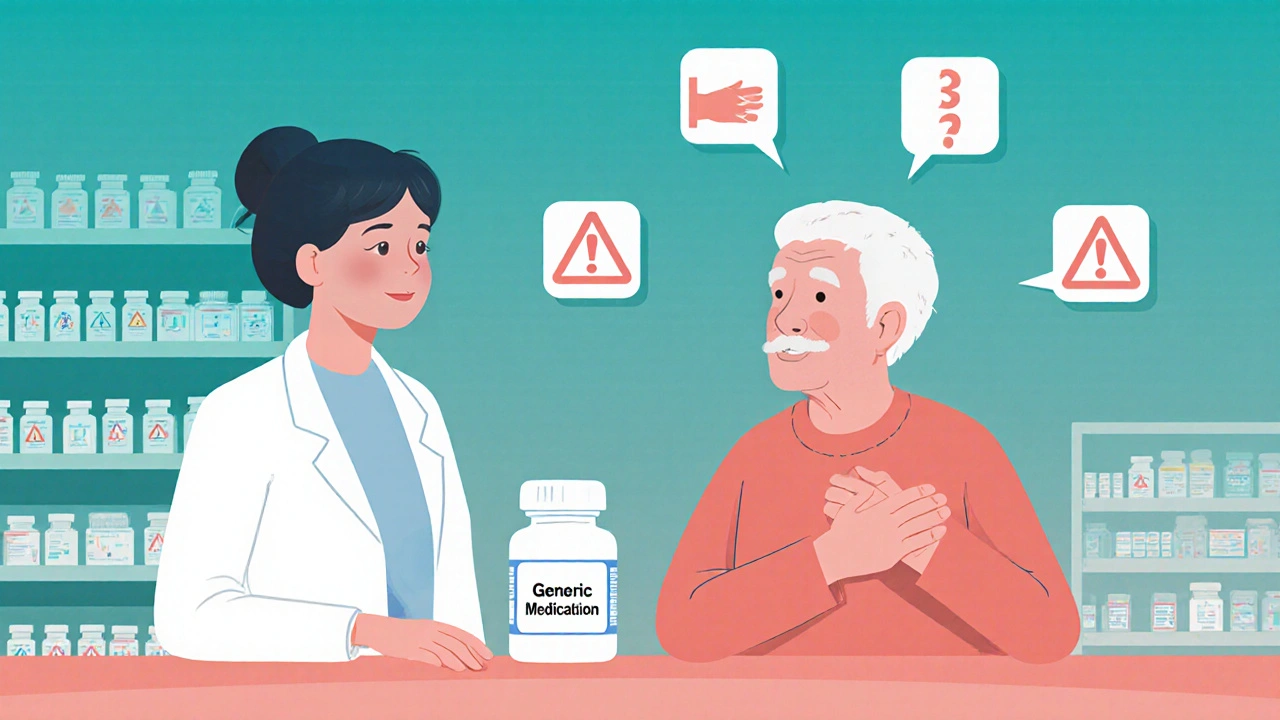
When a patient picks up a generic version of their blood pressure pill and suddenly feels dizzy, nauseous, or develops a rash, most people assume it’s just a side effect. But what if it’s not? What if the generic version has a different filler, a slight variation in absorption, or an ingredient that triggers a reaction the brand-name version never did? Adverse event reporting isn’t just paperwork-it’s the frontline defense in catching hidden dangers in generic medications. And pharmacists are the ones who see it first.
Why Generic Medications Need Extra Scrutiny
Generic drugs are supposed to be identical to brand-name versions in strength, dosage, and effect. That’s the rule. But in reality, they’re only required to be bioequivalent-meaning they deliver the same active ingredient at a similar rate and amount. That leaves room for differences in inactive ingredients: fillers, dyes, binders, coatings. These don’t treat the disease, but they can trigger reactions. A 2022 study in the Journal of the American Pharmacists Association found that 1 in 5 patients switching to a generic version reported a new or worsened side effect. For some, it was a skin rash. For others, it was unexplained fatigue or GI upset. In rare cases, it led to hospitalization. These aren’t random bad luck. They’re signals. And if no one reports them, Health Canada, the FDA, or other agencies never see the pattern. Pharmacists are uniquely positioned to spot these. We’re the last healthcare professional the patient talks to before taking the pill. We see the patient’s full medication history. We know what they’ve taken before. We hear their complaints. Yet, only about 5-10% of all adverse drug reactions get reported-according to Health Canada. For generics? It’s likely even lower.What’s the Pharmacist’s Legal Duty?
There’s no single federal law in the U.S. that forces pharmacists to report adverse events. But that doesn’t mean you’re off the hook. Many states and provinces have made it part of professional responsibility. In British Columbia, the law is clear: if you identify an adverse drug reaction, you must notify the patient’s prescriber, document it in PharmaNet, and report it to Health Canada. Failure to do so could be considered a breach of professional standards. In New Jersey, consultant pharmacists in long-term care must report adverse events and medication errors before the end of their shift. In Australia, while not yet mandatory, the Therapeutic Goods Administration strongly expects pharmacists to report serious reactions. Even where it’s not legally required, regulatory bodies like the FDA and Health Canada treat pharmacist reports as critical. Over 98% of reports in the FDA’s FAERS database come from manufacturers-but those manufacturers get those reports from healthcare providers, including pharmacists. If you don’t report, the data doesn’t enter the system. And without data, no one can detect a safety trend.What Counts as an Adverse Event?
Not every side effect is an adverse event worth reporting. But the line isn’t always clear. The FDA defines a serious adverse event as one that results in:- Hospitalization or prolongation of hospital stay
- Life-threatening condition
- Permanent disability
- Birth defect
- Death
How to Report: The Real-World Process
Reporting doesn’t have to be a nightmare. Here’s how it works in practice:- In hospitals: Most electronic health record systems have built-in ADR reporting modules. Just click, fill in the patient details, reaction, drug, and submit. Done.
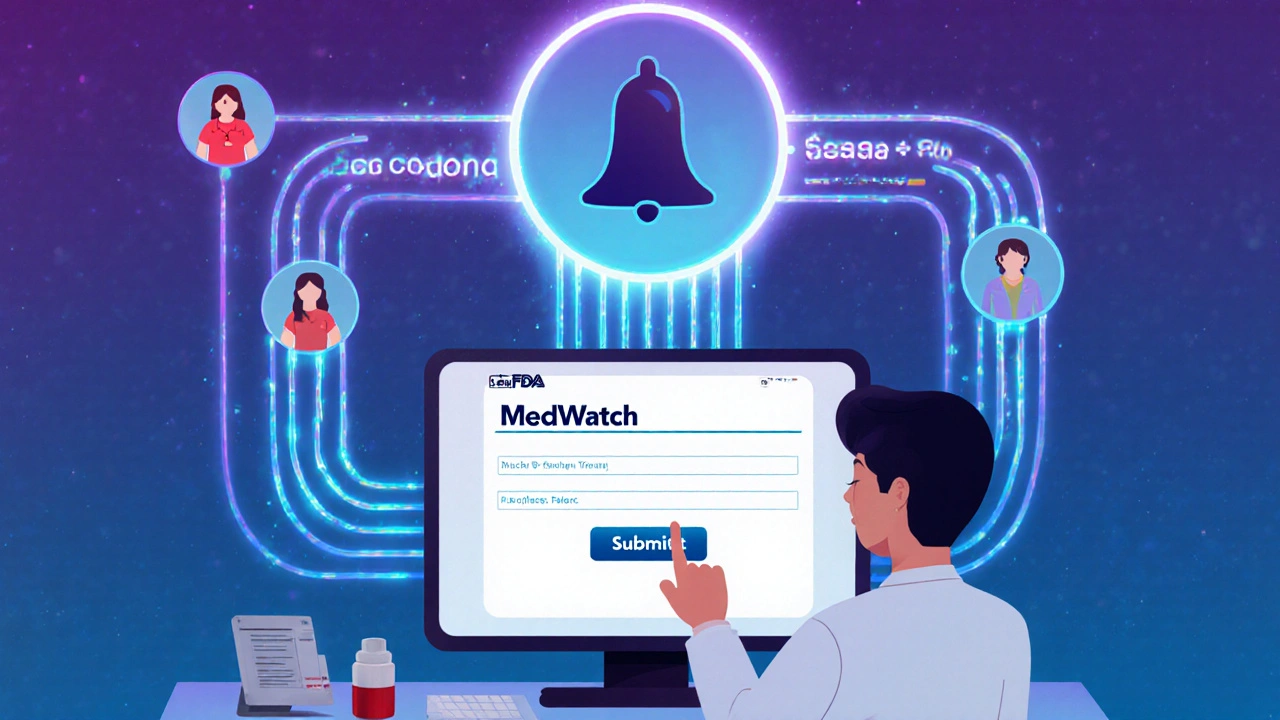
- In community pharmacies: You have two main options: use MedWatch Online (FDA’s free portal) or report directly to the drug manufacturer. For generics, reporting to the manufacturer is often faster. They’re required to forward serious reports to the FDA within 15 days.
- Patient age, gender, and weight
- Drug name (brand and generic), dosage, and route
- Date the reaction started
- Description of the reaction
- Any other medications the patient is taking
- Outcome (resolved, ongoing, hospitalized, etc.)
Why So Few Pharmacists Report
The biggest barrier? Time. But it’s not the only one. A 2021 survey found that 62% of community pharmacists say they simply don’t have enough time during the day to complete reports. Another 45% admit they’re unsure what counts as reportable. Many think, “It’s just a headache,” or “The patient had that before.” But if no one reports the small stuff, the big patterns never show up. The British Columbia Pharmacists Association calls under-reporting a “recognized problem.” They’ve found that many pharmacists don’t realize their role in pharmacovigilance. They think it’s the doctor’s job-or the manufacturer’s. But it’s yours too. Training gaps are real. Most pharmacy schools barely cover pharmacovigilance. Continuing education rarely includes it. That’s changing slowly. In Canada, the Ontario College of Pharmacists now includes ADR reporting as a core competency. In the U.S., ASHP recommends all pharmacists receive annual training on identifying and reporting adverse events.What Happens When You Report?
You might think, “What difference does one report make?” The FDA’s FAERS database has over 24 million reports since 1968. That’s not just a number. It’s a safety net. In 2018, a pattern of kidney injury emerged from multiple reports linked to a specific generic version of a blood pressure drug. The manufacturer investigated. The issue was traced to a new coating that broke down too slowly in the gut. They changed it. Patients were warned. Harm was prevented. That chain started with a pharmacist who noticed three patients with the same reaction after switching generics. They reported it. Someone noticed the pattern. Someone acted. The European Medicines Agency made reporting mandatory for all healthcare professionals in 2012. Within two years, adverse event reports jumped by 220%. That’s not because more people got sick. It’s because more people reported.The Future Is Here: Pharmacist-Led Safety Networks
By 2025, experts predict 75% of U.S. states will adopt mandatory ADR reporting for pharmacists, following British Columbia’s lead. Why? Because the data proves it works. The FDA’s Sentinel Initiative is now pulling data from community pharmacies-not just hospitals. That means your reports are being used in real-time to monitor drug safety across the entire system. Some pharmacies are even creating internal ADR dashboards. One chain in Texas started tracking every reported reaction to generics. Within six months, they flagged a pattern of tremors linked to a specific manufacturer’s levothyroxine. They switched suppliers. Patient complaints dropped by 80%. This isn’t science fiction. It’s happening now.
What You Can Do Today
You don’t need to wait for a law to change. Here’s what you can do right now:- When a patient reports a new or unusual reaction after switching to a generic, don’t dismiss it. Ask: “When did it start? Was it right after the switch?”
- Document it in their record. Use clear language: “Suspected ADR to generic [drug name]-new onset [symptom] after switch from brand.”
- Report it. Use MedWatch Online (free, FDA-approved) or contact the manufacturer directly.
- Encourage your pharmacy to adopt integrated reporting tools. If they don’t have them, request them.
- Talk to your colleagues. Share stories. Normalize reporting. It’s not extra work-it’s core to patient safety.
Frequently Asked Questions
Do I have to report every side effect a patient mentions?
No. You only need to report reactions that are unexpected, serious, or linked to a change in medication-especially when switching to a generic. Common side effects like mild nausea from metformin don’t need reporting unless they’re new, worse, or happen after a formulation change.
Can I report an adverse event if I’m not 100% sure the drug caused it?
Yes. The FDA and Health Canada encourage reporting even when causation isn’t certain. Your report adds to the evidence pool. If multiple reports point to the same drug, regulators can investigate further. Uncertainty is exactly why reporting exists.
Is reporting a generic drug different from reporting a brand-name drug?
The process is the same, but you should always note the manufacturer and lot number if possible. Generic drugs from different manufacturers can have different inactive ingredients, which may cause different reactions. Including the manufacturer helps regulators identify if the issue is tied to a specific producer.
What if my pharmacy doesn’t have a reporting system?
Use MedWatch Online at fda.gov/medwatch. It’s free, secure, and takes less than 10 minutes. You can also call the manufacturer’s pharmacovigilance line and report directly. Your report still counts.
Will reporting get me in trouble if I’m wrong?
No. Reporting is protected under good faith provisions in most jurisdictions. Regulators expect pharmacists to use their clinical judgment. If you report in good faith, even if later proven incorrect, you won’t face penalties. Silence, not error, is the risk.
Scotia Corley
December 1, 2025 AT 09:18The systemic underreporting of adverse drug reactions in community pharmacies is not merely an oversight-it is a catastrophic failure of professional accountability. Pharmacists are trained to be the final gatekeepers of medication safety, yet too many treat reporting as an optional chore rather than a non-negotiable duty. The data is clear: 90% of reactions go unreported. That’s not negligence; it’s malpractice by omission. If you’re too busy to file a MedWatch form, you’re too busy to be dispensing life-altering medications.
elizabeth muzichuk
December 2, 2025 AT 14:17I know a woman who went into anaphylaxis after switching to a generic levothyroxine-no one believed her until she showed the rash. The pharmacist told her it was "just stress." Now she’s on a feeding tube because her thyroid crashed. And no one reported it. Not the doctor. Not the pharmacist. Not even the ER. This isn’t about paperwork. It’s about people dying because someone didn’t care enough to type a few sentences into a form. I’m not angry. I’m devastated.
Debbie Naquin
December 2, 2025 AT 16:23Pharmacovigilance is fundamentally an emergent property of distributed observation. The FDA’s FAERS database is not a repository of isolated incidents-it’s a high-dimensional signal manifold where noise becomes pattern through aggregation. The excipient heterogeneity in generics introduces non-pharmacological variables that violate the assumption of bioequivalence as therapeutic equivalence. When a patient reports a novel reaction post-switch, it’s not anecdotal-it’s a data point in a latent space of pharmacokinetic divergence. Reporting isn’t administrative-it’s epistemological.
Karandeep Singh
December 3, 2025 AT 09:10u/ScotiaCorley u/ElizabethMuzichuk you guys are overreacting. Its just pills. People get sick all the time. Why blame the pharmacist? Maybe the patient is just hypochondriac. I work in a pharmacy in India and no one reports anything. We dont even have medwatch here. Chill out.
Mary Ngo
December 5, 2025 AT 07:45Have you considered that the entire generic drug system is a controlled experiment orchestrated by Big Pharma and the FDA to normalize substandard medications? The "inactive ingredients" they claim are harmless? Glyphosate, talc, titanium dioxide-all in your blood pressure pill. And now they’re pushing mandatory reporting to make pharmacists complicit in the cover-up. Who benefits when you report? Not the patient. Not the pharmacist. The manufacturer. The system. They want your data so they can tweak the formula again and call it "improved." This isn’t safety. It’s surveillance disguised as duty.
James Allen
December 6, 2025 AT 11:38Man, I get where you’re coming from. I’ve seen it too-patients come in, switch generics, start feeling weird, and the pharmacist just says "it’s probably nothing." But here’s the thing: I’m not mad. I’m just… tired. Tired of seeing people suffer because we’re too rushed to care. I’m not a hero. I just want to do my job right. If reporting takes 20 minutes, then we need to make time. Not because the law says so-but because someone’s kid might be next. And if we don’t speak up, who will?
Kenny Leow
December 6, 2025 AT 12:19Respectfully, this post is a masterclass in why pharmacy needs more frontline voices. 🙏 I’ve worked in both urban and rural settings, and the gap in awareness is staggering. In one pharmacy, we started a simple whiteboard: "Generic Switch? Note the Reaction." Within 3 months, we caught 3 cases of unexplained tremors-all from the same manufacturer. We switched. No one got hurt. No lawsuits. Just better care. You don’t need a law to do the right thing. You just need to start. And yes, it’s worth the 15 minutes.