
Thyroid eye disease isn't just dry eyes or puffiness. It's an autoimmune condition that attacks the tissues behind your eyes, causing swelling, pain, and sometimes vision loss. If you have Graves’ disease, you’re at high risk - up to half of those patients develop it. But even people with normal or low thyroid levels can get it. The real danger? If you wait too long to treat it, the damage can become permanent.
What Thyroid Eye Disease Actually Feels Like
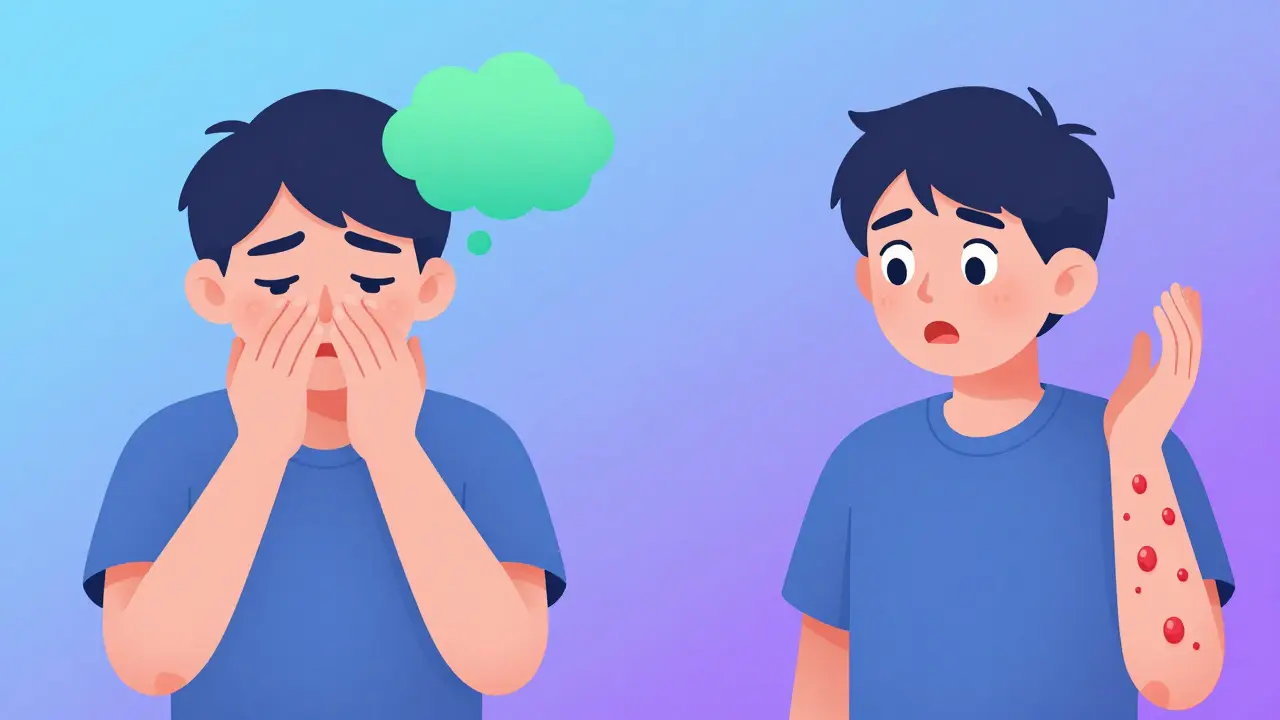
Most people don’t realize how much their eyes are changing until it’s hard to ignore. You might think it’s allergies or fatigue. But if you’re getting a gritty, burning feeling in your eyes - like sand is grinding under your lids - that’s a red flag. About 78% of people with thyroid eye disease report this. Light sensitivity? That’s common too. You start avoiding bright rooms, squinting in daylight, even wearing sunglasses indoors.
Pain behind the eyes, especially when you move them, affects more than half of patients. Your eyelids may look red or puffy, even if you haven’t cried or stayed up late. Some notice their eyes bulging - not dramatically at first, but enough that friends comment, “Did you lose weight?” or “Your eyes look different.”
Double vision is one of the scariest symptoms. You see two images of the same thing - a sign the eye muscles are swollen and stuck. This isn’t just annoying; it makes driving, reading, and even walking dangerous. Around 28% of people with TED develop this. And in 89% of cases, both eyes are affected. It’s rare for just one eye to go wrong.
Doctors use something called the Clinical Activity Score (CAS) to measure how active the disease is. A score of 3 or higher means inflammation is still ramping up. That’s the window to act. Once it drops below 3, the disease shifts into a scarred, inactive phase - and that’s when surgeries become the only option.
Why Steroids Are Still the First Line of Defense
When inflammation is raging, steroids are the fastest way to calm it down. But not all steroids are the same. Oral prednisone is easy to take - just a pill. But it comes with a heavy price: weight gain, high blood sugar, mood swings, and bone loss. About 25-30% of people relapse after stopping it. And on average, patients gain over 8 kilograms.
The better option for moderate-to-severe cases? Intravenous methylprednisolone. This is given as a weekly infusion, usually 500 mg for six weeks, then 250 mg for another six. It’s more effective - 60-70% of patients see real improvement in swelling and double vision. It also has fewer long-term side effects than daily pills.
But there’s a catch. Too much IV steroid can damage your liver. That’s why guidelines cap the total dose at 4.5 to 5 grams. Doctors also check your liver enzymes before and during treatment. And even with IV steroids, you’re not off the hook. You still need to manage blood sugar, protect your bones, and watch for infections.
Here’s what most patients don’t know: timing matters more than dose. If you start IV steroids within two weeks of noticing symptoms, your chances of recovery jump to 65%. Wait eight weeks or longer, and that drops to 42%. That’s why early diagnosis is critical.
Biologics: A Game-Changer for TED
Before 2020, steroids were the only real medical option. Then came teprotumumab - the first drug designed to target the root cause of thyroid eye disease, not just suppress inflammation.
Teprotumumab (brand name Tepezza) is a monoclonal antibody that blocks the IGF-1 receptor, which is overactive in TED. It doesn’t just reduce swelling - it reverses it. In the OPTIC trial, 71% of patients saw their eyes bulge back by at least 2 millimeters. Only 20% of those on placebo did. Double vision improved in 59% of those on teprotumumab, compared to 26% on placebo.
The treatment is eight infusions, given every three weeks. It’s not quick - it takes about five months. But the results are often dramatic. People who couldn’t close their eyes fully or read without double vision start seeing clearly again.
But it’s expensive. In the U.S., one full course costs around $360,000. Even with insurance, many patients pay $5,000 per infusion. Insurance denials are common - 42% of patients report delays or rejections. The average wait for approval is 47 days. That delay can cost you your vision.
Side effects aren’t minor either. Muscle spasms happen in 24% of patients. Some report hearing changes or ringing in the ears. High blood sugar is a concern - especially if you’re already prediabetic. The FDA added a boxed warning for these risks in 2021.
What If Steroids and Biologics Don’t Work?
Not everyone responds to teprotumumab. About 30% of patients see little to no improvement. For them, alternatives are limited. Rituximab and tocilizumab are being studied, but evidence is still weak. Satralizumab, approved in 2023, is a subcutaneous option - meaning you can inject it at home. Early results show 54% of patients improved in eye bulging, making it a promising backup.
Selenium supplements are often recommended for mild cases. A Cochrane review found they slightly improve quality of life - but not enough to stop progression. Still, 200 mcg daily is safe and may help in the early stages.
For persistent double vision, prism glasses can help. They shift the image to align the eyes. But if the muscle misalignment is more than 15 prism diopters, prisms won’t work. That’s when surgery becomes necessary.
Orbital decompression surgery removes bone from around the eye socket to create space. It reduces bulging by 2 to 5 millimeters. But it carries risks: 15% of patients develop new or worse double vision. Sinus infections happen in 8%. Vision loss is rare - under 0.5% - but it’s real.
Who’s at Highest Risk?
Women are four to six times more likely to get TED than men. Most cases happen between ages 40 and 60. But the biggest risk factor isn’t age or gender - it’s smoking. Smokers are 7.7 times more likely to develop TED than non-smokers. And if you smoke and get radioactive iodine treatment for Graves’ disease, your risk spikes even higher - by 2.3 to 4 times.
High levels of TSH receptor antibodies (TRAb) are another warning sign. If your TRAb is above 15 IU/L, your chance of developing TED is nearly five times greater. That’s why endocrinologists now test TRAb levels in every Graves’ patient. Early detection means early treatment.
What Comes Next for TED Treatment?
The future of TED is personalization. Researchers are looking for genetic markers that predict who will get severe TED and who will respond to which drug. One trial is testing teprotumumab combined with selenium - early results show an 82% response rate, better than either alone.
A biosimilar version of teprotumumab is coming. It’s expected to cut costs by 30-40% by 2025. That could make treatment accessible to more people, especially those on Medicaid - 67% of whom face insurance barriers right now.
But the biggest challenge remains access. In rural areas, only 28% of patients can reach a specialized TED center. Most ophthalmologists still rely on steroids because biologics are hard to get. And even in cities, delays in diagnosis and treatment are common.
The message is clear: if you have Graves’ disease and notice any eye changes - redness, bulging, double vision, pain - don’t wait. See an ophthalmologist who specializes in thyroid eye disease. Don’t assume it’s just “dry eyes.” This isn’t a cosmetic issue. It’s a vision-threatening condition that can be stopped - if caught early.
What You Can Do Right Now
- If you have Graves’ disease, ask your doctor for a TRAb test. If it’s high, get an eye exam.
- Stop smoking. It’s the single most effective thing you can do to lower your TED risk.
- Use preservative-free artificial tears if your eyes feel gritty. They won’t cure TED, but they help with comfort.
- Don’t delay treatment. If you have moderate-to-severe symptoms, start steroids or biologics within weeks - not months.
- Find a specialist. Look for an endocrinologist and ophthalmologist who work together on TED. They’re out there - you just have to ask.
Can thyroid eye disease go away on its own?
Thyroid eye disease can stabilize over time, but it rarely goes away completely without treatment. The active inflammatory phase usually lasts 6 to 24 months. After that, the disease becomes inactive, but the damage - like bulging eyes or double vision - often remains. Without treatment, permanent changes like scarring, muscle tightness, and vision loss can occur. Early intervention is key to preventing long-term problems.
Are biologics better than steroids for TED?
For moderate-to-severe active thyroid eye disease, biologics like teprotumumab are more effective and have fewer long-term side effects than steroids. They target the root cause of inflammation, not just suppress it. In clinical trials, biologics reversed eye bulging in 71% of patients, compared to 60-70% with IV steroids. But biologics are expensive and not always covered by insurance. Steroids are still used for milder cases or when biologics aren’t available.
Does selenium help with thyroid eye disease?
Selenium supplements (200 mcg daily) show modest benefits in mild thyroid eye disease, especially in the early stages. A Cochrane review found they improve quality of life and reduce eyelid swelling slightly. But they don’t stop progression or reverse bulging eyes. They’re not a substitute for steroids or biologics in moderate-to-severe cases, but they’re safe and may help as an add-on for mild symptoms.
Can you still get TED if your thyroid levels are normal?
Yes. While most people with thyroid eye disease have Graves’ disease, up to 10% develop TED with normal thyroid function (euthyroid) or even hypothyroidism. The immune system attacks the eye tissues independently of thyroid hormone levels. That’s why eye symptoms should never be ignored - even if your thyroid blood tests are fine.
How long does it take for teprotumumab to work?
Teprotumumab is given in eight infusions, spaced three weeks apart, so the full course takes about five months. Most patients start noticing less swelling and redness within the first two infusions. Double vision often improves by week 6 to 8. The biggest changes - like reduced eye bulging - are usually seen after the last infusion. Results are typically lasting, with most patients maintaining improvement for over a year.
Is surgery the last resort for thyroid eye disease?
Yes. Surgery - like orbital decompression, eye muscle repair, or eyelid surgery - is only done after the disease becomes inactive, usually 6 to 12 months after inflammation stops. Medical treatments like steroids and biologics aim to avoid surgery. If you still have double vision, bulging, or eyelid retraction after medical therapy, surgery can correct those issues. But it carries risks, including new or worsened double vision, so it’s only recommended when necessary.

Elizabeth Farrell
December 3, 2025 AT 09:29After my diagnosis, I wish I’d known how urgent this was. I ignored the grittiness for months thinking it was allergies. By the time I saw a specialist, my CAS was already at 4. IV steroids helped, but the real game-changer was teprotumumab. I went from barely closing my eyes to sleeping without tape. It’s expensive, yes - but so is losing your vision. Don’t wait like I did.
Sheryl Lynn
December 5, 2025 AT 04:53Oh, darling, let’s not pretend this is some quaint autoimmune hiccup - it’s a full-blown ocular dystopia orchestrated by your own immune system’s existential crisis. Teprotumumab? A molecular ballet of IGF-1 receptor suppression, a veritable symphony of targeted biologics. Meanwhile, prednisone is just the medical equivalent of throwing a flamethrower at a candle. The real tragedy? Insurance bureaucrats treating this like a spa package they’re denying because ‘it’s not medically necessary’ - as if your eyeballs aren’t sentient beings deserving of dignity.
Paul Santos
December 6, 2025 AT 22:12Interesting piece - though I’d argue the real meta-narrative here is the commodification of autoimmunity. Teprotumumab isn’t a cure - it’s a capitalist trophy. $360k for a drug that works? That’s not medicine, that’s performance art. And don’t get me started on selenium supplements - the placebo of the wellness industrial complex. We’re treating symptoms like they’re fashion choices. 🤷♂️
Eddy Kimani
December 8, 2025 AT 10:07Just want to add - the 65% recovery rate if you start IV steroids within 2 weeks? That stat is everything. I’m an endo tech and we’ve seen it over and over: patients who come in within 14 days of symptom onset? Their CAS drops like a stone. Those who wait? They end up on the surgery waitlist. Early = better. Always. Also, TRAb testing should be standard for every Graves’ patient - period. Not optional.
Chelsea Moore
December 8, 2025 AT 15:10John Biesecker
December 9, 2025 AT 13:19man i had this and i didn't even know it was a thing until my dog started staring at me like i was an alien. then i saw the bulge in the mirror one morning and nearly screamed. tepezza saved me. yes it cost a fortune and yes my legs cramped like crazy but now i can read without double vision and that's worth every penny. also smoke like a chimney for 20 years? bad idea. just sayin' 🌿👁️
Genesis Rubi
December 10, 2025 AT 18:11U.S. healthcare is broken. In other countries, they just give you the drug. Here? You gotta fight for 47 days just to get a shot that could save your eyes. And they wonder why people leave? We have the science. We have the money. We just don't have the will. This isn't medicine - it's a privilege.
Doug Hawk
December 10, 2025 AT 21:15Just wanted to say the part about TRAb levels being above 15 IU/L = 5x risk? That’s huge. My doc never mentioned that. I got tested after reading this - mine was 22. Got an eye consult next week. Also, the 7.7x risk for smokers? That’s not a suggestion. That’s a warning label on your life. I quit yesterday. No regrets.
John Morrow
December 12, 2025 AT 13:34Let’s be brutally honest - the entire TED treatment paradigm is a house of cards built on pharmaceutical lobbying and delayed diagnosis. Steroids are a band-aid with side effects worse than the disease. Teprotumumab? A miracle drug with a price tag that makes it inaccessible to 70% of the population. And now we’re layering on biosimilars and subcutaneous alternatives like we’re optimizing a spreadsheet instead of saving sight. The real problem isn’t the medicine - it’s the system that lets profit dictate who gets to see clearly.