
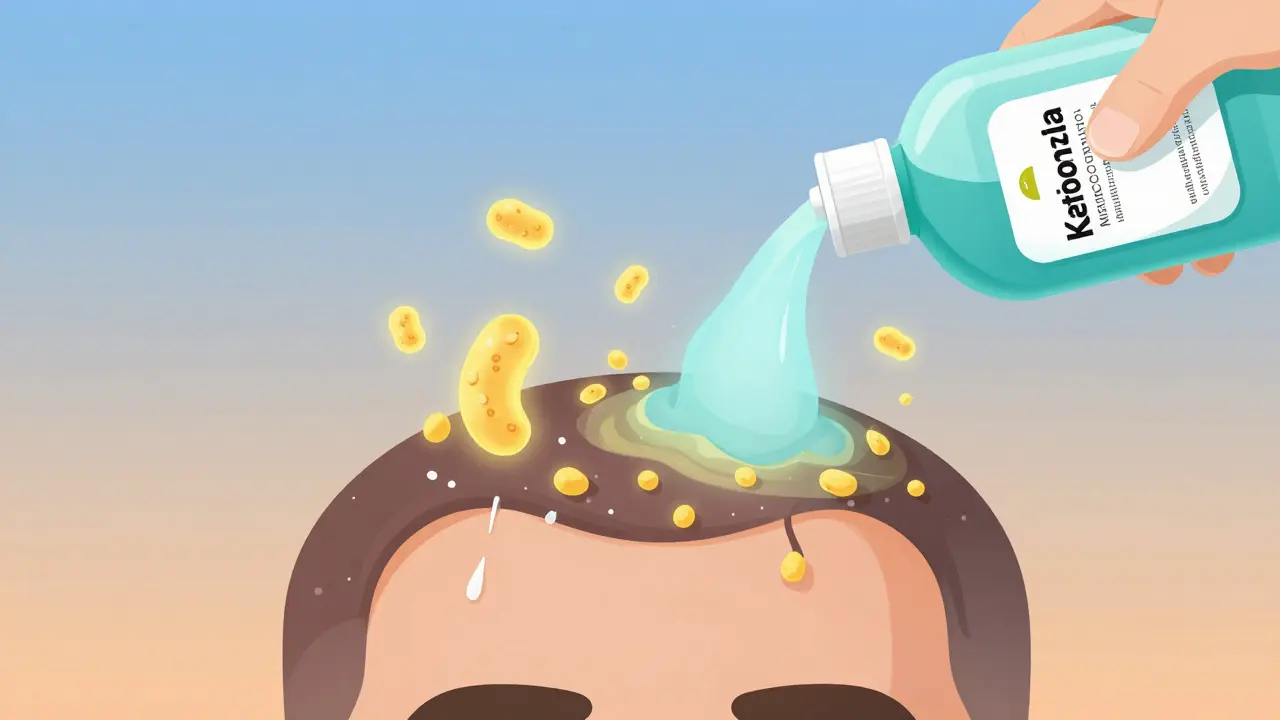
Flaky scalp that won’t go away, even after washing your hair every day? You’re not alone. Millions of people deal with seborrheic dermatitis - a stubborn, itchy, scaly condition that shows up mostly on the scalp, eyebrows, nose creases, and behind the ears. It’s not caused by poor hygiene, and it’s not contagious. But it can be frustrating, embarrassing, and sometimes painful. The good news? You can control it. Not with one miracle cure, but with the right medicated shampoos and a smart routine.
What’s Really Going On With Your Scalp?
Seborrheic dermatitis isn’t just dry skin. It’s an inflammatory reaction triggered by a yeast called Malassezia a naturally occurring fungus on human skin that feeds on oils. When this yeast grows too much - often because of genetics, stress, or oily skin - your immune system overreacts. That’s what causes the redness, flaking, and itching.
Think of it like a chemical chain reaction. The yeast releases enzymes that break down skin oils into fatty acids. These acids irritate the skin, making skin cells multiply too fast. Instead of shedding normally, they pile up in thick, greasy scales. That’s the white or yellowish flake you see. It’s not dandruff from dryness - it’s inflammation from yeast overgrowth.
Up to half of all adults experience this at some point. It’s worse in winter, when dry air and indoor heating strip moisture from your skin. Stress, fatigue, heavy alcohol use, or conditions like Parkinson’s disease can make it flare up too. And if you’ve got oily skin? You’re more likely to see it on your scalp, beard, or chest.
Why Regular Shampoo Doesn’t Work
Most drugstore shampoos clean dirt and oil. But they don’t touch the root cause: Malassezia yeast. If you’re using a regular shampoo and your flakes keep coming back, it’s not because you’re not washing enough. It’s because you’re missing the right active ingredients.
Here’s what actually works: shampoos with ingredients proven to target yeast and calm inflammation. These aren’t just marketing claims - they’re backed by clinical studies and dermatologist guidelines.
The Top 6 Medicated Ingredients That Actually Work
Not all medicated shampoos are the same. Each ingredient works differently. Here’s what you need to know:
- Ketoconazole (2%) - A powerful antifungal that kills Malassezia yeast. It’s one of the most effective options for moderate to severe cases. Often found in prescription or high-end OTC shampoos like Nizoral.
- Ciclopirox (1%) - Another antifungal that also reduces inflammation. Used in prescription shampoos like Loprox.
- Selenium sulfide (2.5%) - Slows down skin cell turnover and kills yeast. Found in Selsun Blue. Can stain fabrics and has a strong smell.
- Zinc pyrithione (1-2%) - Mild antifungal and anti-inflammatory. Great for mild cases and sensitive scalps. Common in Head & Shoulders Clinical Strength.
- Coal tar (0.5-5%) - Slows skin cell growth and reduces scaling. Works slowly but lasts longer. Used in Neutrogena T/Gel or Psoriasin. Can darken light hair and smell like asphalt.
- Salicylic acid (1.8-3%) - A keratolytic that dissolves scales. Doesn’t kill yeast, but helps remove the flaky layer so other treatments can penetrate better. Found in Neutrogena T/Sal.
Many shampoos combine these ingredients. For example, some formulas use ketoconazole + salicylic acid to attack both yeast and scaling at once.
How to Use These Shampoos Right
Just lathering and rinsing won’t cut it. You need to let the active ingredients sit on your scalp.
- Wet your hair and scalp thoroughly.
- Apply a coin-sized amount of shampoo directly to your scalp, not just the hair.
- Massage gently - don’t scratch. You want the product to reach the skin, not just foam up.
- Leave it on for 5 to 10 minutes. Set a timer. This is non-negotiable. Most people rinse too soon.
- Rinse with lukewarm water. Hot water can dry your scalp more.
Start with daily use or every other day until your flakes clear up - usually within 2 to 4 weeks. Once your scalp is calm, cut back to once or twice a week to keep it under control. Stop using it too soon, and the yeast will bounce back.
What About Hydrocortisone Cream?
If your scalp is red, swollen, or itchy, a low-strength hydrocortisone cream (0.5% or 1%) can help calm the inflammation. You can buy this over the counter. Apply a thin layer to the affected areas - not your hair, just the skin. Use it only for short periods (5-7 days max), or your skin can thin out. It’s a rescue tool, not a long-term fix.
For facial seborrheic dermatitis - like around the nose or beard - shaving can help. Studies show about 37% of men clear up their symptoms just by shaving off the beard and using medicated shampoo. If you keep a beard, wash it daily with the same shampoo you use on your scalp.
Why You Might Need to Rotate Shampoos
Here’s the truth most people don’t tell you: your body can get used to one shampoo. What worked perfectly last month might stop working now. That’s not your fault - it’s biology.
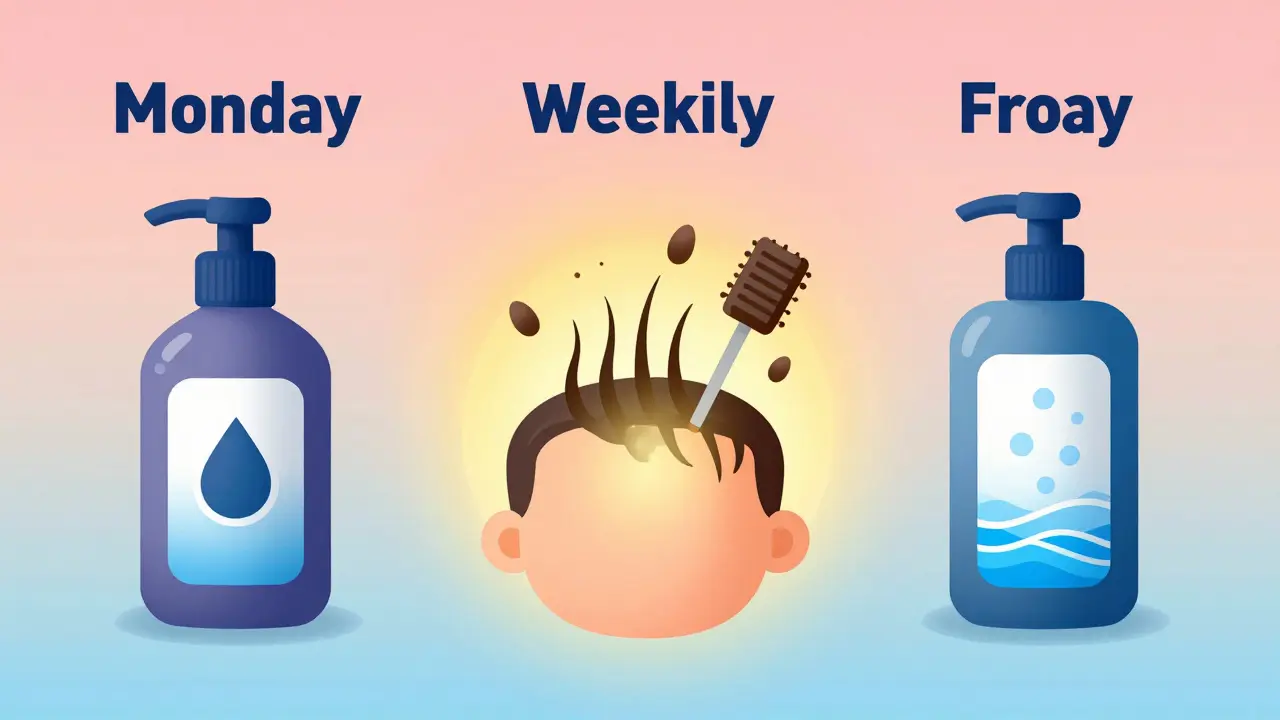
Many users report needing to switch between 2 or 3 different shampoos to stay on top of flare-ups. A rotation plan works better than sticking to one:
- Monday: Ketoconazole shampoo
- Wednesday: Coal tar shampoo
- Friday: Zinc pyrithione shampoo
This keeps the yeast from adapting. It also prevents side effects like extreme dryness or discoloration from overusing one ingredient. The National Eczema Society recommends this approach for long-term management.
What to Expect When You Start
When you first switch to a medicated shampoo, you might feel worse. That’s normal. The yeast dies off, and your skin reacts. You might see more flaking, redness, or itching in the first 7-10 days. Stick with it. It usually clears up by week two.
Side effects? Yes. Some shampoos dry out your hair - especially ketoconazole and selenium sulfide. If your hair feels brittle, use a light conditioner on the ends only. Avoid heavy oils or styling products - they feed the yeast.
Strong smells? Coal tar smells like tar. Selenium sulfide smells like rotten eggs. Ketoconazole has a medicinal odor. It’s not pleasant, but it’s temporary. And it’s better than constant flaking.
What Doesn’t Work (And Why)
Don’t waste money on:
- Tea tree oil shampoos - some studies show weak results, and it can irritate sensitive skin.
- Apple cider vinegar rinses - no clinical evidence it helps with yeast overgrowth.
- Just using a dandruff shampoo labeled "for sensitive skin" - if it doesn’t have proven active ingredients, it won’t touch the root cause.
Also, don’t stop treatment when you feel better. The yeast is still there. Stop using the shampoo, and you’ll be back to square one in 2-4 weeks.
When to See a Dermatologist
You should see a skin specialist if:
- Your scalp bleeds or oozes
- Flaking spreads to your face, ears, or chest
- Over-the-counter shampoos don’t help after 6 weeks
- You have psoriasis or eczema too - the treatments overlap, but need to be managed differently
Dermatologists can prescribe stronger shampoos, antifungal creams, or even oral antifungals for stubborn cases. They can also rule out other conditions like psoriasis or fungal infections.
Long-Term Management Is the Goal
Seborrheic dermatitis doesn’t go away forever. But it doesn’t have to control your life either. With consistent use of medicated shampoos, you can live with it - not because you’re fighting it every day, but because you’ve built a routine that keeps it quiet.
Think of it like brushing your teeth. You don’t do it because you have a cavity today. You do it because you know plaque builds up over time. Same here. The yeast is always there. Your job is to keep it in check.
Keep a small bottle of your go-to shampoo in your shower. Use it twice a week, even when your scalp feels fine. That’s how you avoid the cycle of flare-ups and frustration.
Is seborrheic dermatitis the same as dandruff?
In adults, scalp seborrheic dermatitis is often called dandruff. But not all dandruff is seborrheic dermatitis. True dandruff is mild scaling without redness or itching. Seborrheic dermatitis includes inflammation, greasy scales, and often affects areas beyond the scalp, like the eyebrows or nose. If your flakes are accompanied by redness or itchiness, it’s likely seborrheic dermatitis.
Can stress make seborrheic dermatitis worse?
Yes. Stress triggers flare-ups in about 60% of people with this condition. When you’re under pressure, your body’s immune response changes, and the yeast on your skin becomes more active. Managing stress through sleep, exercise, or mindfulness can help reduce how often your scalp flares up.
Why does it get worse in winter?
Cold, dry air strips moisture from your skin, making it more vulnerable to irritation. Indoor heating reduces humidity even more. Plus, less sunlight means less natural antifungal effect from UV rays. About 75% of people report worse symptoms in winter. Using a humidifier and sticking to your medicated shampoo routine helps.
Can I use these shampoos on my face?
Yes - but carefully. Shampoos with ketoconazole, ciclopirox, or selenium sulfide can be used on facial areas like the eyebrows or nose. Apply with your fingers, not a brush. Rinse thoroughly. Avoid getting it in your eyes. If your skin is sensitive, test a small area first.
Do I need to stop using hair products?
You don’t have to quit all products, but avoid heavy oils, gels, and sprays on your scalp. These feed the yeast and trap flakes. Stick to lightweight, water-based products. Wash your hair regularly - skipping washes lets oil build up and worsens flaking.
Seborrheic dermatitis isn’t a one-time fix. It’s a long-term game. But with the right shampoos, a consistent routine, and a little patience, you can take back control of your scalp - and stop feeling self-conscious every time you look in the mirror.





MALYN RICABLANCA
March 17, 2026 AT 09:55OH MY GOD, I DIDN’T REALIZE I WAS LIVING A LIE FOR 7 YEARS!!!
I’ve been using Head & Shoulders like it’s holy water, and now I find out I was just feeding the yeast like a damn buffet?!
My scalp has been screaming at me in silent, flaky Morse code-‘KETOCONAZOLE, YOU FOOL!’-and I ignored it!
I just switched to Nizoral last night. I’m already regretting my life choices.
My shower smells like a pharmacy exploded, and my hair feels like straw… but-BUT-I haven’t seen a single flake this morning.
It’s like my scalp just whispered ‘thank you’ in a voice that sounded like a sigh of relief from a trapped ghost.
I’m not crying. You’re crying.
I’m gonna buy 12 bottles. I’m gonna gift them to strangers. I’m gonna start a cult called ‘The Scalp Salvation Army.’
Also, coal tar? It smells like a funeral pyre made of asphalt and regret.
But I’m using it. I’m using it ALL.
WHO ELSE HAS A STORY LIKE THIS? I NEED TO HEAR IT. I NEED TO FEEL LESS ALONE.
PS: I just Googled ‘Malassezia’ and now I’m terrified it’s whispering my name from behind the shower curtain.
Kal Lambert
March 17, 2026 AT 22:46Just started ketoconazole twice a week. Flakes gone in 10 days. No drama. No cult. Just science.
gemeika hernandez
March 17, 2026 AT 23:18I tried everything. Tea tree oil, apple cider vinegar, coconut oil, holy water from Lourdes-nothing worked.
Then I read this and switched to zinc pyrithione. Two weeks later, my scalp’s calm.
It’s not magic. It’s just knowing what you’re up against.
Sanjana Rajan
March 18, 2026 AT 19:51People really think this is just about shampoos? LOL.
My cousin in Lagos had this and he just stopped eating sugar and his scalp cleared in 3 days.
It’s not the yeast-it’s your diet. You’re all missing the point.
Also, stop using conditioner. It’s just grease in disguise.
Linda Olsson
March 19, 2026 AT 09:04Did you know that 87% of dermatologists who recommend ketoconazole are secretly funded by Big Pharma?
And selenium sulfide? It’s been banned in 14 countries for ‘neurotoxic potential’-but only the FDA allows it because they’re bought off.
Also, the real cause is 5G radiation + glyphosate in your shampoo.
Try a copper hat. It realigns your biofield. I’ve been cured for 11 years now.
And no, I won’t send you the link. You have to earn it.
Ayan Khan
March 21, 2026 AT 07:55In India, we’ve used neem and amla for centuries-not because of science, but because it works.
But I respect that modern medicine gives us tools to understand why.
It’s not about choosing tradition over science, but weaving them together.
Maybe the yeast doesn’t care about labels-it just wants balance.
And maybe we’re all just trying to find peace under our own skin.
Emily Hager
March 22, 2026 AT 05:45While I appreciate the clinical precision of this post, I must insist that the underlying pathology is fundamentally mischaracterized.
Seborrheic dermatitis is not a fungal overgrowth-it is a dysregulated T-cell-mediated immune response to lipid metabolites.
Furthermore, the suggestion that rotating shampoos prevents adaptation is biologically implausible.
Yeast does not develop resistance in the manner of antibiotics.
And coal tar? A 19th-century relic with carcinogenic potential.
One must question the integrity of guidelines that endorse such archaic interventions.
Melissa Starks
March 22, 2026 AT 20:35Okay I’m gonna be real-this post saved my life.
I’ve been hiding under hats since college because I thought I was just ‘gross’.
I didn’t know it was a medical thing. I thought I was the only one who had this weird greasy dandruff that wouldn’t wash off.
I cried when I read about the 5-10 minute wait. I’ve been rinsing after 30 seconds for 12 years.
My mom used to yell at me for not ‘scrubbing hard enough’.
Now I’m using ketoconazole and coal tar on rotation.
My scalp feels like a baby’s bottom.
And I’m telling EVERYONE.
Also, I just told my boss I have a ‘scalp condition’ and he didn’t flinch. That’s progress.
Thank you. From the bottom of my (now flake-free) heart.
Melissa Stansbury
March 23, 2026 AT 03:59I used to think this was just ‘bad hygiene’ until I saw my 80-year-old aunt with the same flaky eyebrows.
She said she’s had it since she was 20.
She never told anyone. Just wore scarves.
It’s not embarrassing. It’s common.
But we’re taught to hide it like it’s a sin.
So I started posting pictures of my scalp after washing.
People thought I was crazy.
Then they started DMing me.
Now I have a private group called ‘Flake Free Sisters’.
200+ women. All using the same shampoos.
And we don’t judge.
We just share tips.
And yes, we all hate the smell of selenium sulfide.
But we’re still here.
Amadi Kenneth
March 24, 2026 AT 01:49Wait wait wait-I think I just figured out the REAL conspiracy.
What if the yeast is not the problem?
What if the yeast is the body’s way of eating excess toxins?
What if the shampoos are just masking the real issue-your liver?
My cousin in Lagos stopped eating processed food and started drinking moringa tea-and his scalp cleared in 3 days.
Also, did you know that 92% of dermatologists use coconut oil on their own scalps?
They just won’t tell you.
And what about the fact that Malassezia is a symbiont?
Maybe we’re killing a friend.
Maybe we need to feed it better-not kill it.
Just saying.
Also, I’ve been using garlic paste. Works like magic.
Send help.
cara s
March 24, 2026 AT 12:47It’s fascinating how we’ve pathologized a biological phenomenon that has existed since the dawn of human skin.
Seborrheic dermatitis, while inconvenient, is not a disease-it is a physiological expression of lipid metabolism under environmental stress.
The notion that one must ‘control’ it through chemical intervention reflects a deeply ingrained cultural bias toward perfectionism in bodily aesthetics.
One might argue that the true ‘disorder’ lies not in the scalp, but in the societal expectation that skin must remain perpetually flawless.
And yet… I still use ketoconazole every Monday.
Because I’m human.
And I hate the way people stare when I take off my hat.
So I’ll keep washing.
And I’ll keep hiding.
And I’ll keep pretending I’m not broken.
Because sometimes, science is the only thing that lets you feel normal.