
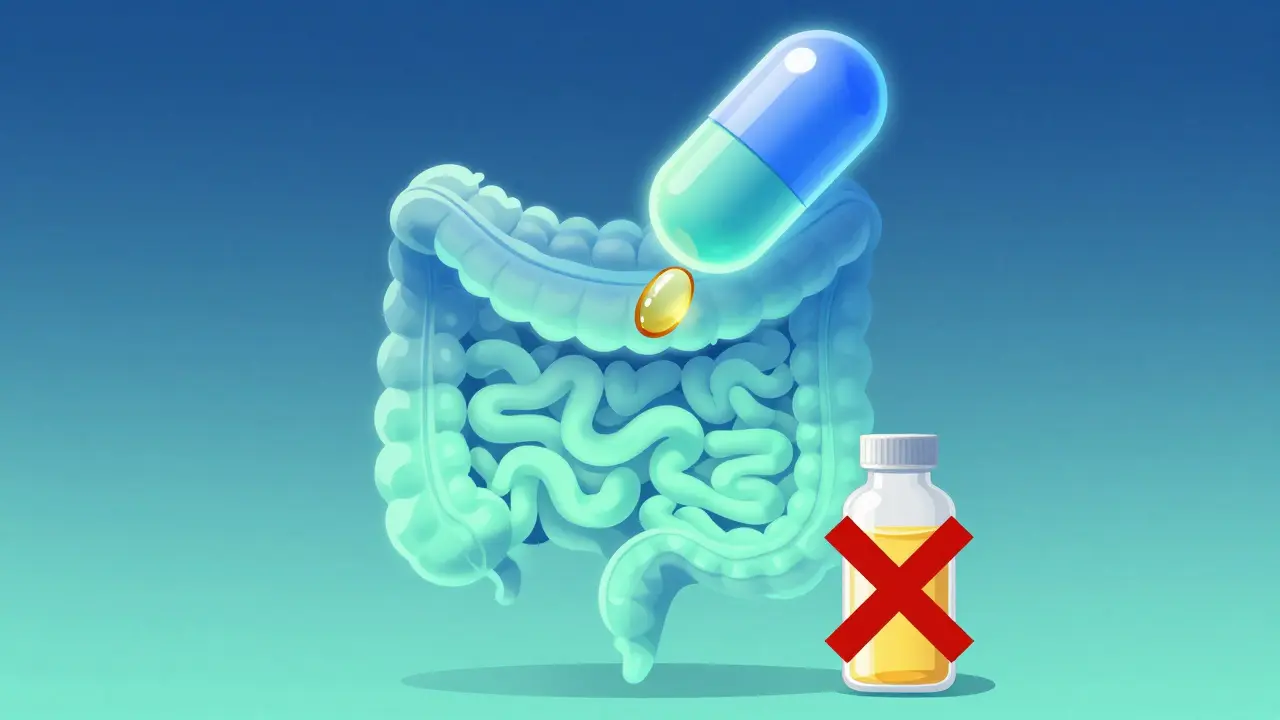
If you’ve struggled with bloating, cramps, or sudden bowel changes for years, you’re not alone. About 11% of people worldwide have irritable bowel syndrome (IBS), and many have tried everything from prescription meds to elimination diets-only to feel let down. But there’s one natural option that keeps showing up in doctor’s offices and research journals: peppermint oil. Not the tea. Not the candy. Not the essential oil you dab on your temples. We’re talking about specially formulated, enteric-coated capsules that deliver peppermint oil straight to your intestines. And the science behind it is stronger than most people realize.
How Peppermint Oil Actually Works for IBS
Peppermint oil doesn’t just smell refreshing-it actively calms your gut. The magic ingredient is L-menthol, which makes up 30-55% of the oil. This compound blocks calcium channels in the smooth muscle lining your intestines. Think of it like hitting pause on muscle spasms. When your gut muscles contract too hard or too often, you get cramps and pain. L-menthol slows that down.
It also interacts with TRPM8 receptors, which are involved in how your body senses pain in the gut. In people with IBS, these receptors are overly sensitive. Peppermint oil helps dial that sensitivity back, reducing the feeling of discomfort even when there’s no physical damage.
But here’s the catch: if you swallow regular peppermint oil-like from a bottle you bought at the store-it dissolves in your stomach. That’s why some people get heartburn after trying it. The oil irritates the stomach lining and can even trigger reflux. That’s why only enteric-coated capsules work for IBS. These capsules are designed to survive the acidic environment of your stomach and break open only when they reach the small intestine, where they’re needed most.
The Evidence: What Studies Show
A 2014 meta-analysis published in the Journal of Clinical Gastroenterology looked at five high-quality studies with nearly 400 participants. The results? People taking enteric-coated peppermint oil were 2.23 times more likely to see overall improvement in IBS symptoms than those taking a placebo. That’s not a small effect-it’s comparable to many prescription medications.
More recent reviews back this up. The American College of Gastroenterology’s 2022 guidelines gave peppermint oil a conditional first-line recommendation for global IBS symptoms. That means, based on current evidence, doctors should consider it before jumping to stronger drugs.
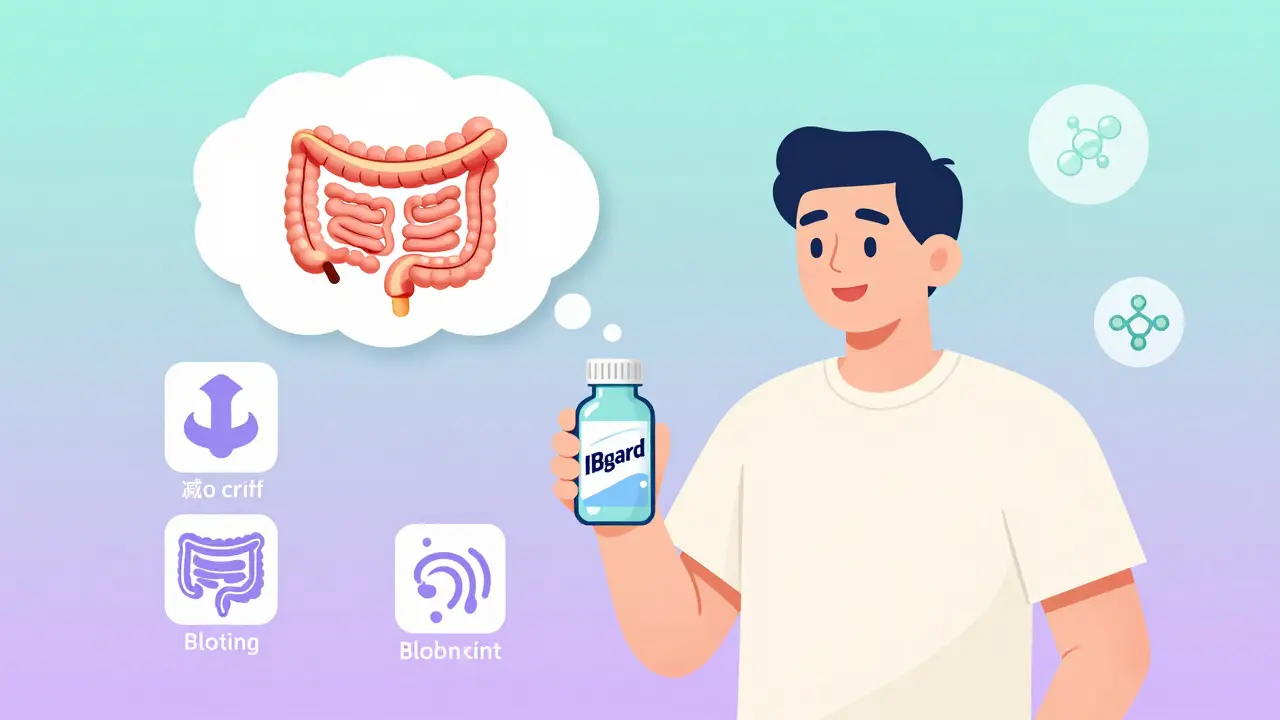
One standout study tested a product called IBgard, which uses a special triple-coated microsphere technology to release peppermint oil in the small intestine. After four weeks, users saw a 40% drop in total IBS symptoms. The placebo group? Only a 24% drop. That difference was statistically significant.
When compared to other treatments:
- It worked just as well as hyoscine butylbromide (a common antispasmodic).
- It was better than loperamide (Imodium) for pain relief.
- It was less effective than eluxadoline (Viberzi), a prescription drug, but had far fewer side effects.
And here’s something surprising: peppermint oil is cost-effective. A 2021 study found it had an 89% chance of being the better value for money compared to other IBS treatments, costing just €8,342 per quality-adjusted life year gained.
Who Benefits Most-and Who Should Avoid It
Peppermint oil isn’t a one-size-fits-all solution. It works best for people with IBS-C (constipation-predominant) and IBS-M (mixed). In these groups, up to 68% report significant symptom improvement.
But if you have IBS-D (diarrhea-predominant), it’s a different story. Peppermint oil can relax the sphincters in your gut too much, making diarrhea worse. In studies, only 32% of IBS-D patients saw benefit.
Also avoid it if you have:
- GERD or severe acid reflux (even enteric-coated forms can sometimes trigger symptoms)
- A hiatal hernia
- Liver disease (menthol is processed by the liver)
- Or if you’re pregnant or breastfeeding-there’s not enough safety data yet.
And don’t take it with proton pump inhibitors (PPIs) like omeprazole. These drugs raise stomach pH, which can cause the enteric coating to break down too early-wasting the dose and possibly causing heartburn.
How to Use It Correctly
Most studies use 0.2-0.4 mL of peppermint oil per dose, which equals about 180-200 mg in capsule form. The standard is three times a day, taken 30-60 minutes before meals.
Why before meals? Because that’s when your gut starts preparing for digestion. Peppermint oil works best when it’s already in place, calming muscle activity before food triggers spasms.
Here’s what real users report:
- “I took it 20 minutes before breakfast and felt less cramping by lunch.” - Reddit user, March 2023
- “I tried it with food and got awful heartburn. Taking it before meals changed everything.” - Amazon review
Start slow. If you’re new to this, begin with one capsule a day for a week. Watch for side effects. If you’re fine, increase to two, then three. About 28% of new users feel mild heartburn at first-but most of them stop feeling it after a few days.
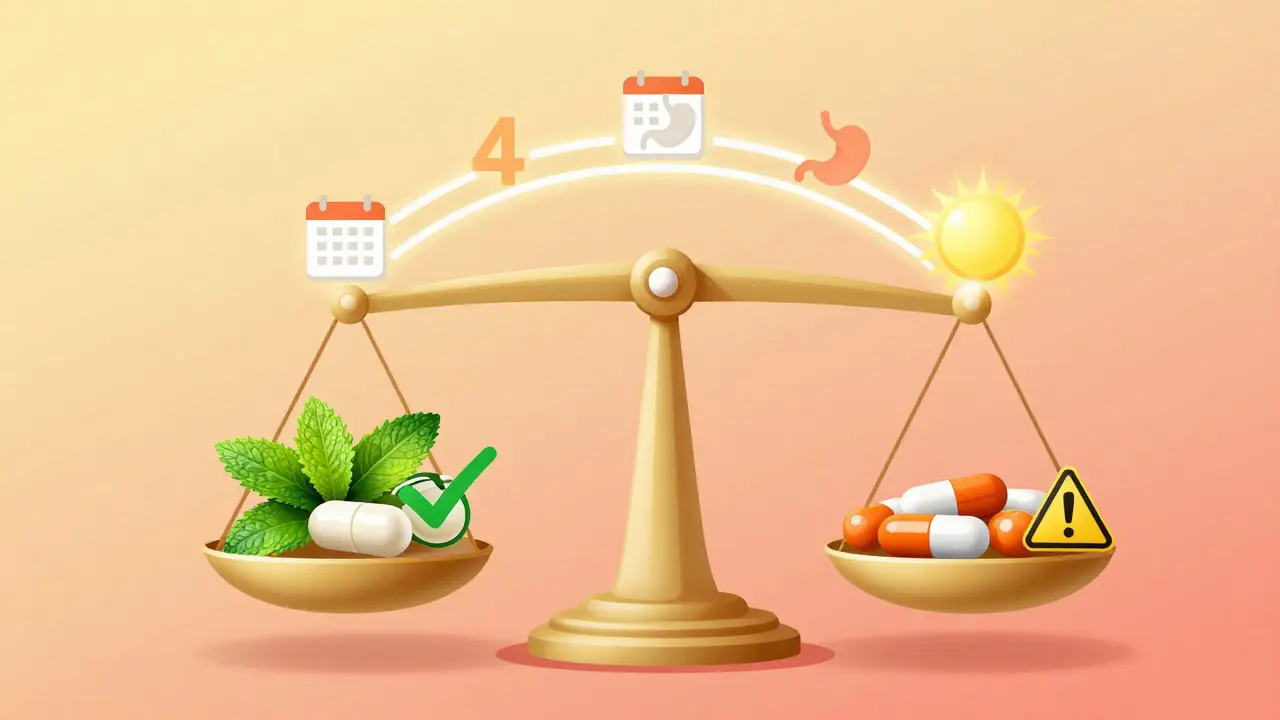
Give it at least 4 weeks to work. Most people see improvement by week 2-3, but full benefits often take longer. A 2016 study found 79% of users had good control of symptoms by week 4 when they followed the protocol.
What to Look for When Buying
Not all peppermint oil capsules are created equal. In fact, a 2022 test by ConsumerLab found only 62% of products on the market met quality standards.
Look for these markers:
- Enteric coating - this is non-negotiable.
- USP Verified Mark - means it’s been independently tested for purity and potency.
- 30-55% L-menthol content - check the label. If it doesn’t say, avoid it.
- Reputable brands like IBgard, Colpermin, or Nature’s Way (if USP Verified).
Avoid products labeled “pure peppermint oil” or “essential oil for internal use.” Those aren’t made for IBS and can be dangerous.
Also, steer clear of products that don’t list the exact amount of peppermint oil per capsule. If it just says “peppermint oil” without mg or mL, you’re guessing-and that’s not safe.
Side Effects and Safety
Peppermint oil is generally safe, but side effects happen. About 11.4% of users report issues, compared to 5.1% in placebo groups.
The most common:
- Heartburn (7.3%) - usually mild and temporary
- Nausea (2.1%)
- Perianal burning (1.8%) - yes, really. Some users report a tingling sensation near the anus, especially if they have hemorrhoids or sensitive skin.
These are rarely serious. In the largest safety registry tracking over 12,000 users for two years, no serious adverse events were linked to peppermint oil.
Long-term use (beyond 8-12 weeks) hasn’t been studied much. But there’s no evidence of dependence or organ damage. Many people use it for months or even years with no problems-especially if they stick to the right dosage and timing.
How It Compares to Other IBS Treatments
Let’s put peppermint oil in context:
| Treatment | Effectiveness for Pain | Common Side Effects | Cost (Monthly) | Prescription Required? |
|---|---|---|---|---|
| Peppermint oil (enteric-coated) | High (52% responder rate) | Mild heartburn, nausea | $15-$30 | No |
| Hyoscine butylbromide | High (comparable to peppermint oil) | Dry mouth, blurred vision | $25-$50 | Yes |
| Loperamide (Imodium) | Moderate (for diarrhea only) | Constipation, dizziness | $5-$15 | No |
| Eluxadoline (Viberzi) | Very high | Nausea, constipation, pancreatitis risk | $300+ | Yes |
| Probiotics (e.g., Bifidobacterium infantis) | Moderate | Bloating (initial) | $20-$40 | No |
Peppermint oil wins on accessibility, cost, and safety. It’s not as strong as Viberzi, but it doesn’t carry the risk of pancreatitis. It’s not as targeted as prescription antispasmodics, but it doesn’t cause dry eyes or urinary retention.
For many, it’s the best middle ground: effective, affordable, and safe enough to try before going full pharmaceutical.
What’s Next? The Future of Peppermint Oil for IBS
Researchers aren’t done yet. A new compound called PO-101, a modified menthol derivative, is in phase 3 trials. Early results show it’s just as effective-but causes 70% less heartburn. If approved, it could become the new gold standard.
Another exciting area: gut microbiome research. Scientists at Stanford are studying whether your unique gut bacteria (your “enterotype”) affects how well peppermint oil works. Early data suggests people with certain bacterial profiles respond better. That could lead to personalized IBS treatment in the future.
And for the first time, clinical trials are now including children. The NIH is funding a study on peppermint oil for IBS in kids aged 5-12. Right now, there’s almost no data for this group. That’s about to change.
Final Thoughts: Is It Worth Trying?
Peppermint oil isn’t a miracle cure. But it’s one of the few natural remedies for IBS with solid, repeatable science behind it. If you’ve tried diet changes, stress management, and even some meds without lasting relief, it’s worth a shot.
Do it right: get enteric-coated capsules, take them 30-60 minutes before meals, stick with it for at least four weeks, and avoid PPIs. Skip the cheap, unverified brands. And if you don’t feel better-or if your symptoms get worse-talk to your doctor. There are other options.
For millions of people with IBS, peppermint oil isn’t just a trendy supplement. It’s a real tool. And when used correctly, it can bring back control over your body-and your life.
Can I use peppermint oil from the grocery store for IBS?
No. Regular peppermint oil, even if labeled "food grade," is not enteric-coated and will dissolve in your stomach. This often causes heartburn, nausea, or reflux-making IBS symptoms worse. Only use capsules specifically designed for IBS with enteric coating.
How long does it take for peppermint oil to work for IBS?
Some people feel relief within 30 minutes after taking a capsule, especially for cramping. But for lasting improvement in bloating, pain, and bowel habits, you need at least 4 weeks of consistent use. Most studies show full benefits appear between weeks 4 and 8.
Can peppermint oil make IBS diarrhea worse?
Yes. Peppermint oil relaxes intestinal muscles, which can speed up transit time. If you have IBS-D (diarrhea-predominant), it may make loose stools worse. Studies show only about 32% of IBS-D patients benefit. If you notice more diarrhea after starting, stop using it.
Is peppermint oil safe to take long-term?
Current evidence suggests it is. The longest study followed patients for 12 weeks, but real-world data from a safety registry of over 12,000 users showed no serious side effects over two years. Many people use it for months or years without issues-as long as they stick to recommended doses and avoid it if they have GERD or liver disease.
Do I need to stop other IBS medications to use peppermint oil?
Not necessarily. Peppermint oil can be used alongside probiotics, fiber supplements, or low-dose antidepressants (if prescribed). But do not take it with proton pump inhibitors (PPIs) like omeprazole-they reduce its effectiveness by changing stomach pH. Always check with your doctor before combining treatments.

jesse chen
December 26, 2025 AT 12:00Wow, this is the most thorough guide I’ve seen on peppermint oil for IBS-seriously, thank you.
Just started taking IBgard last week, and while I felt a little heartburn at first, it’s faded after 3 days.
I’m on day 9 now and my bloating? Gone. I actually ate a burrito without panic. That’s a win.
Joanne Smith
December 27, 2025 AT 07:28Oh great. Another miracle cure wrapped in a PubMed citation.
Next you’ll tell me lavender candles cure cancer.
Meanwhile, my gut’s been screaming since 2017 and your ‘conditional first-line recommendation’ still left me crying in the bathroom.
But hey, at least it’s cheaper than Viberzi-congrats on selling hope on Amazon.
Prasanthi Kontemukkala
December 28, 2025 AT 02:44Thank you for sharing this with such care.
I’m from India, where peppermint is common in teas and chutneys, but I never knew about enteric-coated capsules.
I’ve had IBS-M for 8 years and tried everything-yoga, Ayurveda, even fasting.
My doctor finally suggested IBgard last month.
It’s not magic, but it’s the first thing that made me feel like my body wasn’t betraying me.
Take it before meals, don’t skip days, and give it time.
You deserve to feel safe in your own skin.
Ryan Cheng
December 29, 2025 AT 18:28Important note: if you're on PPIs like omeprazole, peppermint oil won't work-your stomach pH is too high, so the coating dissolves early.
And yes, it's a real issue-many people think they're doing it right but they're just wasting money.
Also, don't buy random ‘essential oil’ capsules from eBay.
I saw one labeled ‘for aromatherapy only’ with 12% menthol.
That’s not medicine, that’s a hazard.
Jeanette Jeffrey
December 30, 2025 AT 16:11Let me guess-you’re one of those people who think ‘natural’ means ‘safe’ and ‘science’ means ‘what’s on the bottle.’
Peppermint oil relaxes smooth muscle. So does alcohol. So does heroin.
Just because it’s plant-based doesn’t mean it’s not a pharmacological agent.
And ‘no serious adverse events’? That’s because nobody’s tracking long-term liver enzyme changes in Reddit warriors who take 6 capsules a day.
Also, ‘cost-effective’? You paid $20 for a placebo with a fancy label.
Good luck when your insurance stops covering your ‘natural’ crutches.
Shreyash Gupta
December 30, 2025 AT 19:56Bro I tried this after reading your post 😭
took 3 caps before lunch
then I had to run to the bathroom 4 times in 20 mins
like… was that the menthol or my soul leaving my body?
IBS-D over here and this was a disaster 🤡
now I just eat rice and cry in peace
also why does everyone say ‘enteric-coated’ like it’s a magic word? 🤨
Ellie Stretshberry
January 1, 2026 AT 00:49i took it before dinner and felt better
no heartburn
not sure if it worked or if i just got lucky
but i like that its not a pill i need a prescription for
also i hate doctors so this feels good
still eating salad tho so maybe its that
idk
Zina Constantin
January 1, 2026 AT 21:13This is why I love how science meets tradition.
In my Nigerian family, we’ve always used mint for stomach upset-chewed leaves, tea, even rubbed on the belly.
But this? This is the modern version of that wisdom.
Enteric coating? That’s the tech upgrade.
And the fact that it’s backed by real studies? That’s the bridge between grandma’s remedy and modern medicine.
Keep sharing this kind of info. We need more of it.
Dan Alatepe
January 2, 2026 AT 13:45Y’all ain’t ready for this.
I took peppermint oil.
Then I took a nap.
Woke up.
My gut was QUIET.
Not just better.
QUIET.
Like… I forgot I had IBS.
Then I ate a taco.
And the silence broke.
But still.
That 3 hours? That was the first time in 12 years I didn’t feel like a walking toilet.
Also, I cried.
Not because it hurt.
Because it didn’t.
And that’s wild.
Angela Spagnolo
January 3, 2026 AT 22:08i read this whole thing twice
and i still dont know if i should try it
what if i get heartburn again
what if it makes my diarrhea worse
what if i spend money and its a waste
and what if i dont feel better and then i feel even worse
im so scared of trying things
but i’m also so tired of being sick
help
Sarah Holmes
January 4, 2026 AT 23:02While I appreciate the effort to compile empirical data, I must emphasize the epistemological fallacy inherent in reducing complex physiological phenomena to pharmacological interventions.
IBS is not merely a biochemical imbalance-it is a somatic manifestation of psychological fragmentation in a hyper-capitalist, sensorially overloaded society.
Peppermint oil, however efficacious in reducing smooth muscle contraction, does not address the existential alienation of the modern gut.
Until we confront the ontological crisis of digestion in the digital age, we are merely palliating symptoms while the soul continues to hemorrhage.
Jay Ara
January 5, 2026 AT 04:04took ibgard for 3 weeks
felt better
then stopped cause i forgot
started again
felt better again
so yeah its good
just dont take it with food
and if you got diarrhea dont expect miracles
also dont buy the cheap ones
they taste like soap
Michael Bond
January 7, 2026 AT 01:52Works. Before meals. Capsules only. Don’t overthink it.