
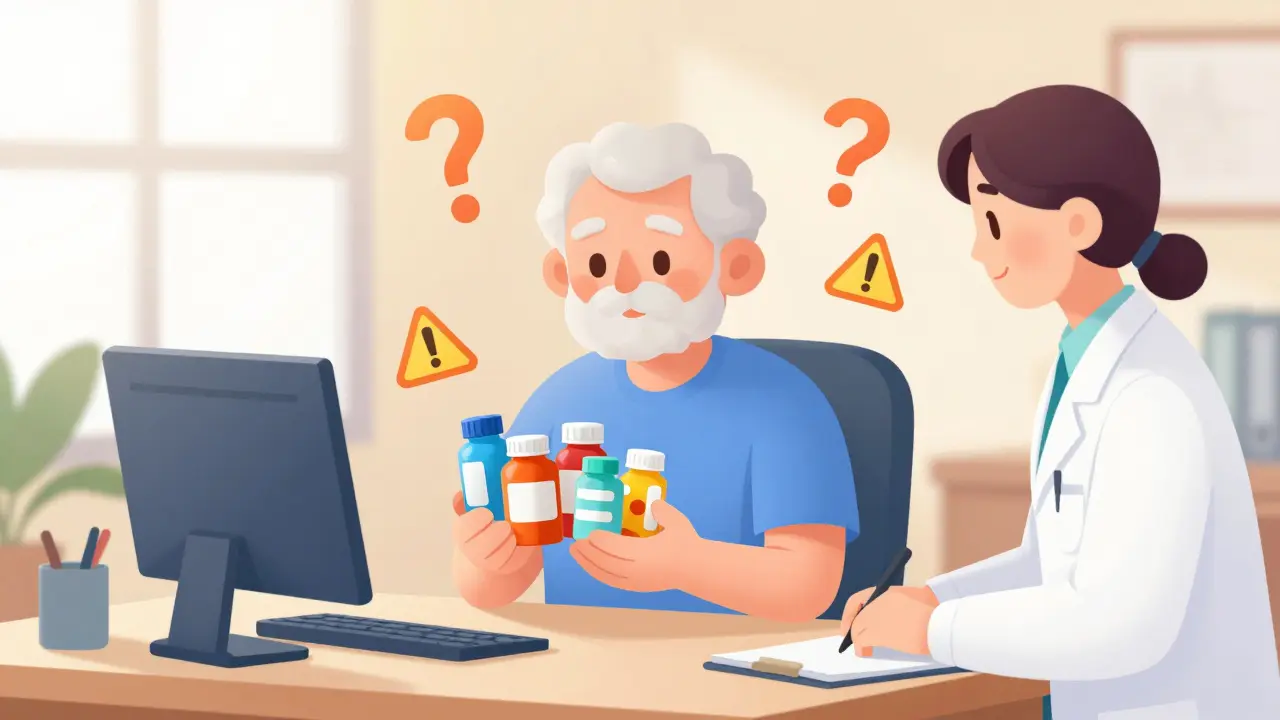
Almost 9 out of 10 adults over 65 take at least two prescription drugs. Some take five, ten, or even more. With so many medications, it’s easy for things to get mixed up - a pill missed, a side effect ignored, a dangerous interaction overlooked. That’s why talking clearly and confidently with healthcare providers about senior medications isn’t just helpful - it’s essential for safety.
Start with a complete list of everything you’re taking
Don’t rely on memory. Bring every bottle, box, or packet to your appointment. That includes prescription drugs, over-the-counter pain relievers like ibuprofen or acetaminophen, vitamins, herbal supplements, and even eye drops or patches. Many seniors don’t think of these as "medications," but they can interact with prescriptions in dangerous ways.A 2022 study in the Journal of General Internal Medicine found that when patients brought actual medication bottles to appointments, providers spotted discrepancies in 25% of cases. One woman thought she was taking 10 mg of her blood pressure pill, but the bottle said 25 mg. Another man had been taking a supplement for "memory" that contained a sedative - something his doctor didn’t know about. These aren’t rare mistakes. They’re common.
Write down the name, dose, how often you take it, and why. If you’re unsure why you’re on a certain pill, write that down too. Your doctor doesn’t expect you to know everything - but they do expect you to show up with the facts.
Bring someone with you
It’s not weak to bring a family member or friend. It’s smart. Appointments move fast. Stress makes it hard to focus. You might forget to ask the most important question. A second set of ears helps.Research from the Annals of Internal Medicine shows seniors with an advocate present have 18% fewer adverse drug events. That person can help by: writing down answers, asking questions you didn’t think of, noticing if you seem confused, and later reminding you what was said. They can also speak up if you’re too tired or overwhelmed to say something.
Don’t wait until the day of the appointment to ask someone to come. Talk to them ahead of time. Say: "I want to make sure I understand my meds. Can you come with me and help me take notes?" Most people are happy to help - they just don’t know how.
Ask the four key questions
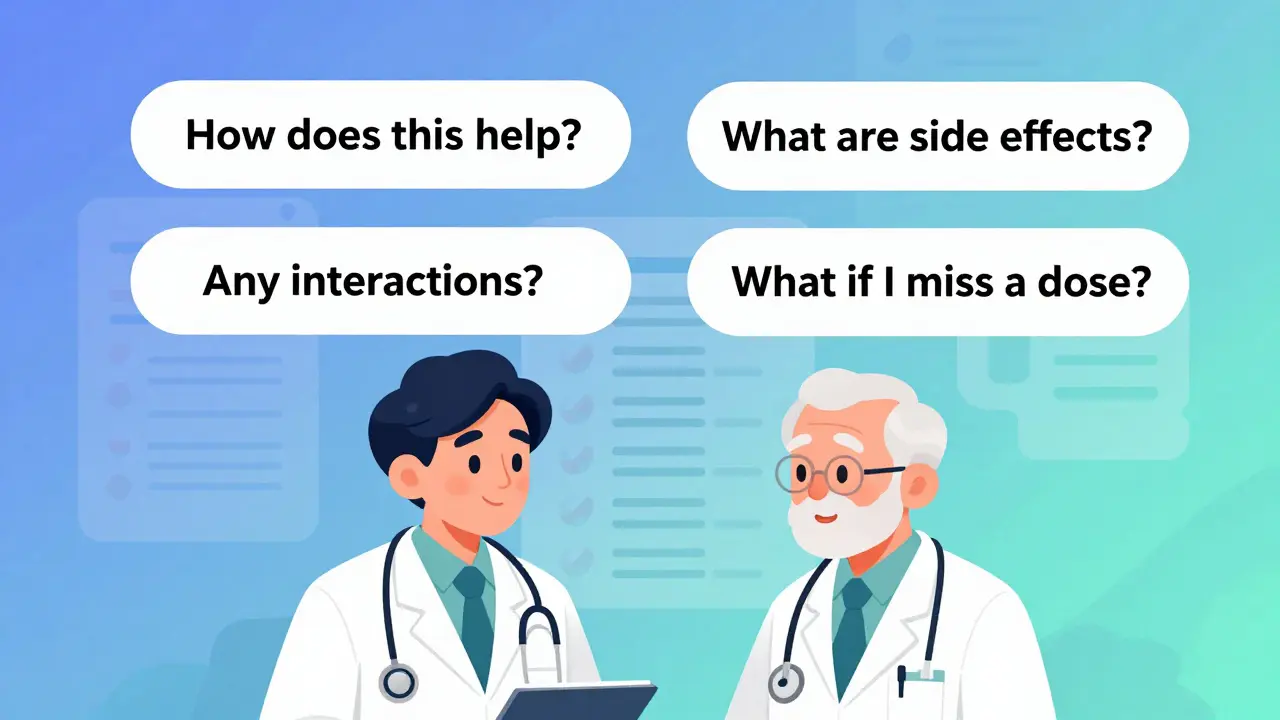
You don’t need to be an expert to ask the right questions. These four are proven to uncover hidden risks:- "How does this medication specifically help manage my health condition?" - Sometimes, a pill was prescribed years ago and isn’t needed anymore. This question forces clarity.
- "What are the potential side effects and adverse reactions?" - Not all side effects are obvious. Dizziness might seem like aging, but it could be from a blood pressure drug. Confusion might be mistaken for dementia, but it could be from an anticholinergic.
- "What are the drug interactions and potential conflicts?" - Mixing a blood thinner with a common painkiller or a supplement like St. John’s Wort can be dangerous. Your pharmacist can help, but your doctor needs to know everything you’re taking.
- "What should I do if I miss a dose?" - This is often skipped, but it matters. Some meds are okay to skip; others can cause rebound effects. Don’t guess.
These aren’t just questions - they’re tools to stop dangerous practices before they hurt you.

Use tools to stay on track
Managing ten pills a day is hard. Your brain isn’t designed for that. Use tools to reduce the mental load.Pill organizers that separate doses by morning, afternoon, evening, and night make a big difference. Some even have alarms. Apps like Medisafe or Round Health send reminders and let you log whether you took the pill. They can even alert a family member if you miss a dose.
Another simple trick: tie your pills to daily habits. Take your morning meds right after brushing your teeth. Take your evening ones before dinner. Routines stick better than alarms.
And don’t forget: many pharmacies now offer medication synchronization. That means all your refills are due on the same day each month. No more juggling different refill dates. You get one trip to the pharmacy, one conversation with the pharmacist, and one clear schedule.
Review everything - regularly
Medications aren’t set in stone. Your body changes. Your conditions change. What helped last year might not be needed now.Ask your doctor for a full medication review at least once a year - or sooner if you’ve had a hospital stay, fall, or major change in health. The goal isn’t just to add pills - it’s to remove ones that aren’t helping anymore.
Studies show that regular reviews reduce polypharmacy (taking five or more drugs) by 27%. That’s not just fewer pills - it’s fewer falls, less confusion, and lower risk of hospitalization.
The Beers Criteria, updated in 2023, lists 30 classes of drugs that should be avoided or used with extreme caution in older adults. These include certain sleeping pills, antihistamines like diphenhydramine, and some antidepressants. If you’re on any of these, ask: "Is there a safer alternative?"
Speak up - even if it feels uncomfortable
Many seniors don’t want to seem difficult. They think: "Maybe the doctor knows best." Or: "I don’t want to waste their time."But here’s the truth: your voice matters more than you think.
Dr. Christine Ritchie from UCSF says structured communication reduces hospital readmissions by 22% among Medicare patients. That’s not magic. It’s because when patients speak up, doctors adjust. When caregivers report changes - like new dizziness, confusion, or loss of appetite - doctors can act before it turns into an emergency.
Use simple, direct language. Say: "I’ve been feeling dizzy since I started this new pill." Or: "I’m not sure why I’m taking this one anymore." Or: "Can we cut back on something?"
And if your doctor brushes you off? Ask for a second opinion. Or ask to speak with a pharmacist. Many clinics now have medication therapy management (MTM) services - free for Medicare beneficiaries taking eight or more drugs. These are specialists trained to untangle complex regimens.
What if you’re the caregiver?
If you’re helping an older loved one manage their meds, you’re not just a helper - you’re part of the care team.Keep your own updated list. Note any changes in behavior, appetite, sleep, or balance. Report these to the doctor - even if they seem small. A sudden fall or confusion might be linked to a new drug.
Don’t assume the doctor knows everything. They might not know about the supplement your loved one takes daily, or the over-the-counter sleep aid they use on weekends. Write it down. Bring it in.
And remember: you’re not responsible for fixing everything. Your job is to observe, ask questions, and make sure the doctor hears what’s really going on.
What’s changing in 2026?
Medication safety for seniors is getting more attention. In early 2024, Medicare expanded its requirements for medication reviews for people on eight or more drugs. Independent pharmacies are offering more synchronization programs. And new FDA-cleared apps are making it easier to track doses without paper.By 2027, experts predict most senior care facilities will use digital platforms that connect patients, caregivers, doctors, and pharmacists in real time. That means fewer phone calls, fewer missed messages, and faster responses to problems.
But technology won’t fix poor communication. Only you can do that.
Start today. Bring the list. Bring a helper. Ask the four questions. Review what you’re taking. Speak up. These aren’t big actions - they’re simple, practical, and life-saving.
What if I don’t know why I’m taking a certain medication?
That’s very common. Write down the name of the pill and bring it to your appointment. Ask your doctor: "Why was this prescribed?" and "Is it still needed?" Many seniors are on medications that were started years ago for a condition that’s since improved or resolved. A review can help stop unnecessary drugs.
Can over-the-counter drugs and supplements be dangerous for seniors?
Yes. Common OTC drugs like ibuprofen can raise blood pressure or harm kidneys. Antihistamines like Benadryl can cause confusion and dizziness. Supplements like St. John’s Wort can interfere with heart meds, antidepressants, or blood thinners. Always tell your doctor about everything you take - even if you think it’s "natural" or "harmless."
How often should I get a medication review?
At least once a year - or after any major health change: a hospital stay, a fall, new symptoms like confusion or fatigue, or if you’ve started or stopped any medication. If you take eight or more prescriptions, Medicare now requires a formal review. Don’t wait for them to call - ask for one.
What should I do if I miss a dose?
Never guess. Check the label or call your pharmacist. For some meds, you can take it as soon as you remember. For others, like blood thinners or heart meds, skipping or doubling up can be dangerous. Always ask your doctor or pharmacist for clear instructions before you start a new medication.
Can I stop a medication if I think it’s causing side effects?
No. Stopping a medication suddenly can be dangerous - especially for blood pressure, heart, or mental health drugs. Instead, write down what you’re feeling (dizziness, nausea, sleepiness, etc.) and bring it to your next appointment. Your doctor can decide if it’s safe to lower the dose or switch to something else.





Randall Little
January 14, 2026 AT 02:55Let’s be real-most doctors don’t have time to unpack a 17-pill regimen, and patients don’t know how to articulate what’s actually happening. This guide? Solid. But it’s still a Band-Aid on a hemorrhage. The system’s broken. We treat seniors like walking pharmacy inventories, not humans with lived experience. If you’re not asking why a drug was prescribed five years ago, you’re not managing care-you’re just maintaining inertia.
Gregory Parschauer
January 14, 2026 AT 06:55Oh please. You think bringing bottles helps? I’ve seen it a hundred times-grandma shows up with 12 containers, all expired, half of them from Canada, and the doctor just nods and writes another script. The real issue? No one’s auditing these regimens. The FDA doesn’t track polypharmacy deaths. Pharmacies don’t flag interactions. And Medicare? They’re too busy billing to care. This is a death sentence disguised as ‘best practice.’
Acacia Hendrix
January 15, 2026 AT 13:35As a geriatric pharmacologist, I must say this guide is refreshingly pragmatic-though it lacks nuance regarding CYP450 enzyme polymorphisms in elderly populations. The Beers Criteria, while useful, fails to account for phenotypic variability in drug metabolism among octogenarians with multimorbidity. Moreover, the reliance on pill organizers ignores the cognitive load of temporal sequencing in patients with mild neurocognitive disorder. A truly evidence-based approach would integrate pharmacogenomic screening and real-time therapeutic drug monitoring via wearable biosensors-none of which are currently reimbursed under Medicare Part D.
James Castner
January 17, 2026 AT 11:24Look, I’ve spent 20 years in elder care, and I’ve seen families torn apart because someone didn’t ask the four questions. This isn’t about pills-it’s about dignity. When you’re 82 and your body’s a map of chronic conditions, the last thing you need is someone talking down to you like you’re a child who can’t remember where they put their glasses. But here’s the truth: if you don’t speak up, no one else will. Not the nurse. Not the pharmacist. Not even your own child. You have to be the captain of your own health ship. And that means showing up with the bottles, writing the questions, bringing the ally, and refusing to let anyone tell you that ‘it’s just aging.’ It’s not. It’s negligence. And you have the power to stop it.
Rosalee Vanness
January 17, 2026 AT 15:06I’m a nurse who helps seniors manage meds at home, and I can tell you-this is the most realistic, compassionate advice I’ve seen in years. I’ve watched people panic because they forgot if they took their blood thinner, or took two because they were scared. The routine trick? Genius. Tie it to brushing teeth. Tie it to coffee. Tie it to the news. Your body learns habits faster than your brain remembers instructions. And the apps? I’ve seen 90-year-olds use Medisafe better than their grandkids. It’s not about tech-it’s about trust. When you give someone a tool that doesn’t judge them for forgetting, they start to believe they’re still in control. And that? That’s everything.
lucy cooke
January 18, 2026 AT 12:16Oh, how quaint. A ‘clear guide’ for seniors who can’t even remember their own names. The real tragedy isn’t polypharmacy-it’s the societal collapse that allows our elders to be turned into walking pill dispensers by a medical-industrial complex that profits from their decline. We’ve turned aging into a medical problem to be optimized, not a human experience to be honored. And now we’re telling them to bring bottles and ask questions? Darling, the system doesn’t want them to ask questions-it wants them to comply. This guide is just another form of performative empathy. The real solution? Abolish the profit motive in elder care. But that’s too radical for Reddit, isn’t it?
Trevor Davis
January 19, 2026 AT 16:39I’m 74 and I’ve been on 8 meds since 2018. I bring my list. I bring my wife. I ask the four questions. And you know what? My doctor actually listens now. It took three visits. But once I stopped saying ‘yes, doctor’ and started saying ‘I don’t feel right,’ things changed. One pill was for a heart rhythm I don’t even have anymore. Got off it. No dizziness. No fog. I’m sleeping better. It’s not rocket science. Just be honest. And don’t be afraid to say ‘I’m not sure why I’m on this.’ They’ve heard it a thousand times. They won’t think you’re dumb. They’ll think you’re smart.
mike swinchoski
January 20, 2026 AT 17:55Everyone’s acting like this is a revelation. Newsflash: most seniors are on drugs they don’t need because their doctor didn’t wean them off. My uncle was on Xanax for 15 years because no one ever asked if he still had anxiety. He didn’t even remember why he started it. This isn’t about ‘asking questions.’ It’s about doctors being lazy. And we’re blaming the patients? Pathetic. Just fire the doctors who don’t do annual reviews. Problem solved.
Damario Brown
January 20, 2026 AT 22:48bruh i read this and i was like wow this is so helpful but then i realized like 90% of old people cant even read this let alone bring bottles to appts. also who has time to do all this? my grandma cant even find her glasses and you want her to remember 10 pills and ask about cyp450? this is for rich people with kids who care. the rest of us are just praying the meds dont kill em before the next refill. also st johns wort? yeah right. she takes ginkgo and 3 kinds of turmeric and nobody says anything. lol
sam abas
January 22, 2026 AT 21:13Interesting. But you missed the real elephant in the room: most of these meds are prescribed by specialists who never talk to each other. Cardiologist gives a beta-blocker. Neurologist adds an anticholinergic. Orthopedist prescribes NSAIDs. PCP gets the bill and the chaos. No one’s coordinating. So telling patients to bring bottles? Cute. But the system is designed to fail. And now we’re putting the burden on the 80-year-old with dementia to fix it? Brilliant. Just brilliant.
Clay .Haeber
January 23, 2026 AT 22:44Oh look, another feel-good pamphlet from the wellness-industrial complex. ‘Bring a helper.’ ‘Ask four questions.’ How poetic. Meanwhile, Medicare cuts home health visits, pharmacies close in rural towns, and seniors are driving 50 miles to get their prescriptions filled because the local Walgreens went out of business. This isn’t empowerment-it’s victim-blaming wrapped in a bow. You don’t solve systemic neglect with bullet points. You solve it with policy. But hey, at least we can all feel virtuous while our grandparents choke on their own polypharmacy.
Priyanka Kumari
January 23, 2026 AT 23:20This is exactly what we need-clear, kind, and practical. I work with elderly patients in rural India, and many face the same issues: no one to accompany them, no access to apps, no understanding of why they’re on certain drugs. But when we sit with them, write down each pill with their help, and explain in simple terms-‘This is for your heart, this is for your sleep’-they feel seen. You don’t need fancy tech. You need patience. And someone who cares enough to listen. Thank you for writing this. It’s a gift.
Avneet Singh
January 25, 2026 AT 21:52While the intent is laudable, this guide exhibits a concerning lack of epistemological rigor. The reliance on anecdotal evidence from JGIM and Annals-both peer-reviewed, yes, but with limited generalizability to non-Western geriatric populations-is methodologically suspect. Furthermore, the uncritical endorsement of Medisafe ignores the digital divide and the commodification of health data. Until we interrogate the neoliberal underpinnings of patient empowerment rhetoric, this remains a technocratic illusion masking structural abandonment.