
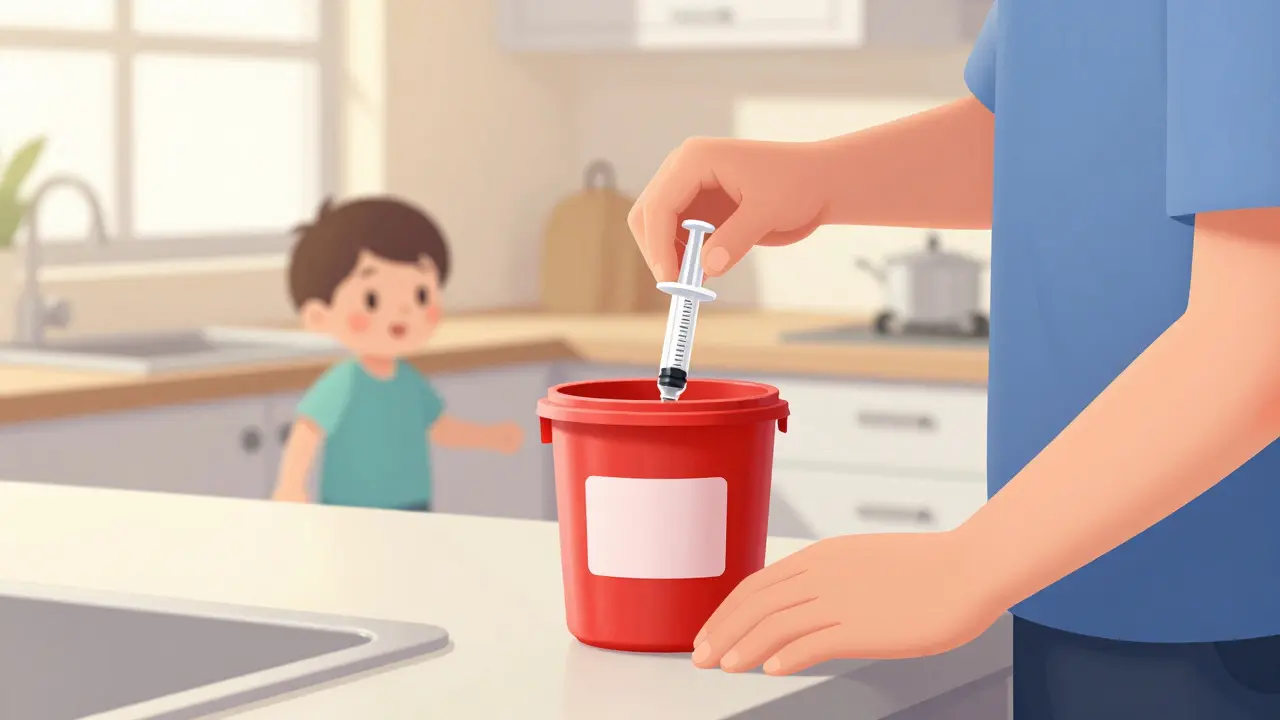
Every year, millions of people in Australia and around the world use injectable medications-insulin, blood thinners, autoimmune treatments, and more. But after the injection, what do you do with the needle? Throwing it in the trash? Tucking it into a soda bottle? That’s not just careless-it’s dangerous. Sharps like needles and syringes can pierce skin, spread infections, and put kids, sanitation workers, and even pets at risk. The good news? Safe disposal is simple, legal, and widely available-if you know how.
What Counts as a Sharp?
A sharp isn’t just a needle. It includes any medical device that can cut or puncture skin after use. That means:
- Needles (used with syringes)
- Syringes (even if the needle is removed)
- Lancets (for blood glucose testing)
- Auto-injectors (like EpiPens or insulin pens with attached needles)
- Infusion sets and IV catheters
- Glass capillary tubes or scalpels (if used in home care)
Once used, these items are considered contaminated medical waste. Even if you don’t see blood, there’s still a risk of exposure to bloodborne pathogens like hepatitis B, hepatitis C, or HIV. The CDC estimates that more than 385,000 needlestick injuries happen each year in healthcare settings-and many more happen at home because people don’t know how to handle them safely.
Why You Can’t Just Toss Them in the Trash
It might seem harmless to drop a used needle into your regular bin. But here’s what happens when you do:
- Sanitation workers can get stuck while sorting trash-over 1,000 injuries are reported annually in Australia alone.
- Curbside collection trucks crush bins, bending or breaking containers and exposing needles.
- Children or pets may find and play with discarded sharps.
- Recycling centers can’t process contaminated sharps, so they end up in landfills where they stay dangerous for years.
In fact, a 2023 FDA report found that 68% of sharps-related injuries in the community happen because people use household items like plastic bottles, yogurt containers, or coffee cans to store used needles. These containers aren’t strong enough. They crack. They leak. They get pierced by other trash.
What You Need: FDA-Cleared Sharps Containers
The safest way to store used sharps is in a dedicated sharps container. These aren’t just plastic boxes-they’re engineered safety devices. Here’s what makes them different:
- Thick, puncture-resistant plastic (at least 1mm thick)
- Locking lid that won’t open if dropped or squeezed
- Clear fill line-never fill past 3/4 full
- Biohazard symbol and warning labels
- Sturdy base so it won’t tip over
You can buy these at pharmacies like Chemist Warehouse, Priceline, or local medical supply stores. Prices range from $8 to $25 depending on size. A 1.5L countertop container is usually enough for most home users. Some brands even offer mail-back programs where you send the full container back for safe disposal.
Don’t be fooled by ‘reusable’ containers. Unless they’re specifically FDA-approved for reuse and cleaned under medical-grade sterilization standards, they’re not safe for home use. Stick to single-use, disposable containers.
How to Use a Sharps Container Correctly
Using the container right matters just as much as having one. Follow these steps every time:
- After injecting, immediately place the needle into the container-don’t try to recap it. Recapping is one of the top causes of needlestick injuries.
- Don’t bend, break, or twist the needle before disposal. It can snap and cause injury.
- Keep the container within arm’s reach while you’re injecting-ideally on a table or counter, not on the floor.
- Close the lid after every use. Even if it’s not full, locking it keeps kids and pets out.
- Stop filling when the sharps reach the fill line. Never overfill. If you can’t see the line, stop when the contents are 2-3 cm from the top.
Pro tip: Write the start date on the container. Most programs require you to dispose of it within 3 months, even if it’s not full.
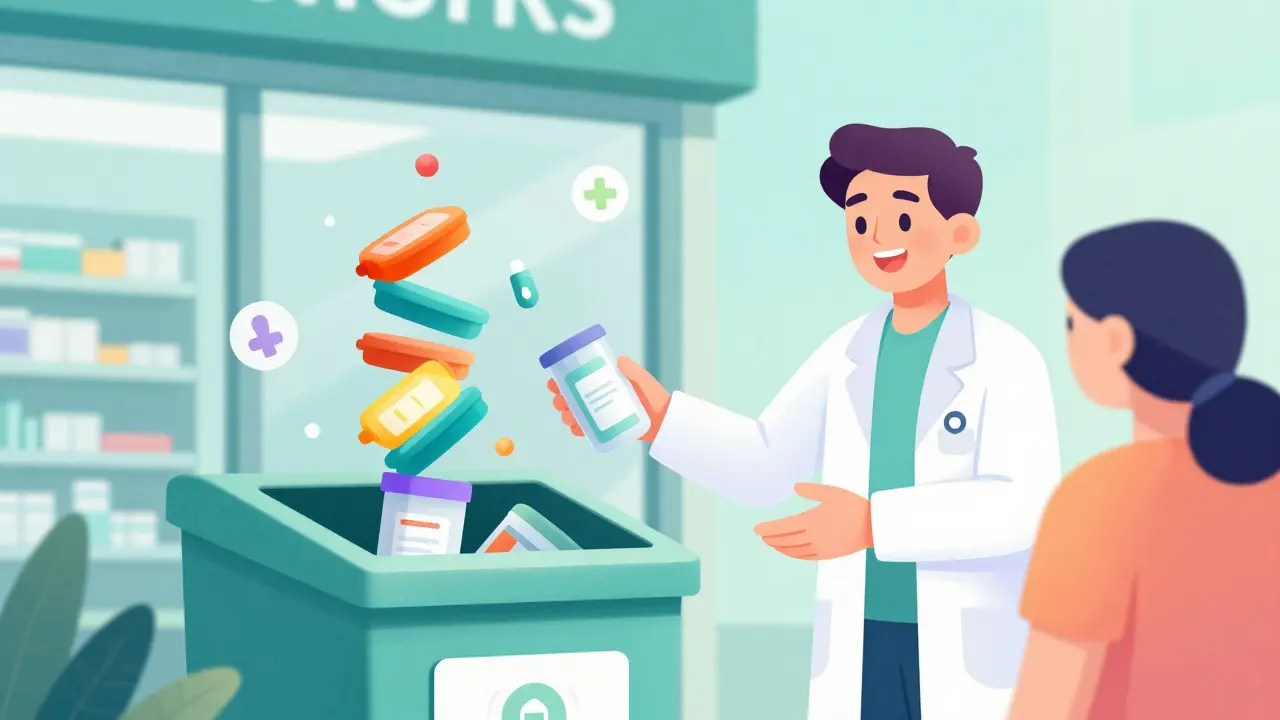
Where to Drop Off Full Sharps Containers in Australia
Australia has a network of free or low-cost sharps disposal options. You don’t need to drive far to find one:
- Pharmacies: Most Chemist Warehouse, Priceline, and independent pharmacies have sharps collection bins. Just ask at the counter. You can drop off your full container anytime during opening hours.
- Hospital clinics: If you get your medication through a hospital or diabetes clinic, they often accept used sharps from patients.
- Local council drop-off points: Many Brisbane councils (like Brisbane City Council, Redland City, Moreton Bay) have designated sharps disposal bins at libraries, community centres, or waste transfer stations. Check your council website.
- Mail-back programs: Companies like Sharps Compliance and SafeRx offer prepaid mailers. You seal your full container, drop it in the post, and they handle the rest. Some are free with a prescription.
Never use public bins like park trash cans or recycling bins. Even if they say ‘medical waste,’ they’re not designed for sharps and can be dangerous.
What to Do If You Don’t Have a Container
If you’ve run out and don’t have access to a container right away, here’s what to do-temporarily:
- Use a rigid plastic bottle with a screw-top lid-like a laundry detergent bottle or bleach bottle. It must be thick and unbreakable.
- Label it clearly: ‘DANGER: USED NEEDLES-DO NOT RECYCLE’.
- Keep it out of reach of children and pets.
- Take it to a disposal site within 48 hours. Do not store it longer.
This is not ideal. It’s a last resort. Get a proper container as soon as possible.
Costs and Financial Help
Yes, sharps containers cost money. But there’s help:
- If you’re on the Pharmaceutical Benefits Scheme (PBS) and use insulin or other injectables, you may qualify for free or discounted sharps containers through your pharmacy.
- Some local councils offer free sharps containers to residents with chronic conditions.
- Non-profits like Diabetes Australia and the Australian Diabetes Council sometimes provide free disposal kits to low-income patients.
- Mail-back programs often cost less than $10 per box and include postage.
Compare that to the cost of a needlestick injury: treatment, testing, and follow-up care can run over $3,000. Safe disposal isn’t an expense-it’s protection.
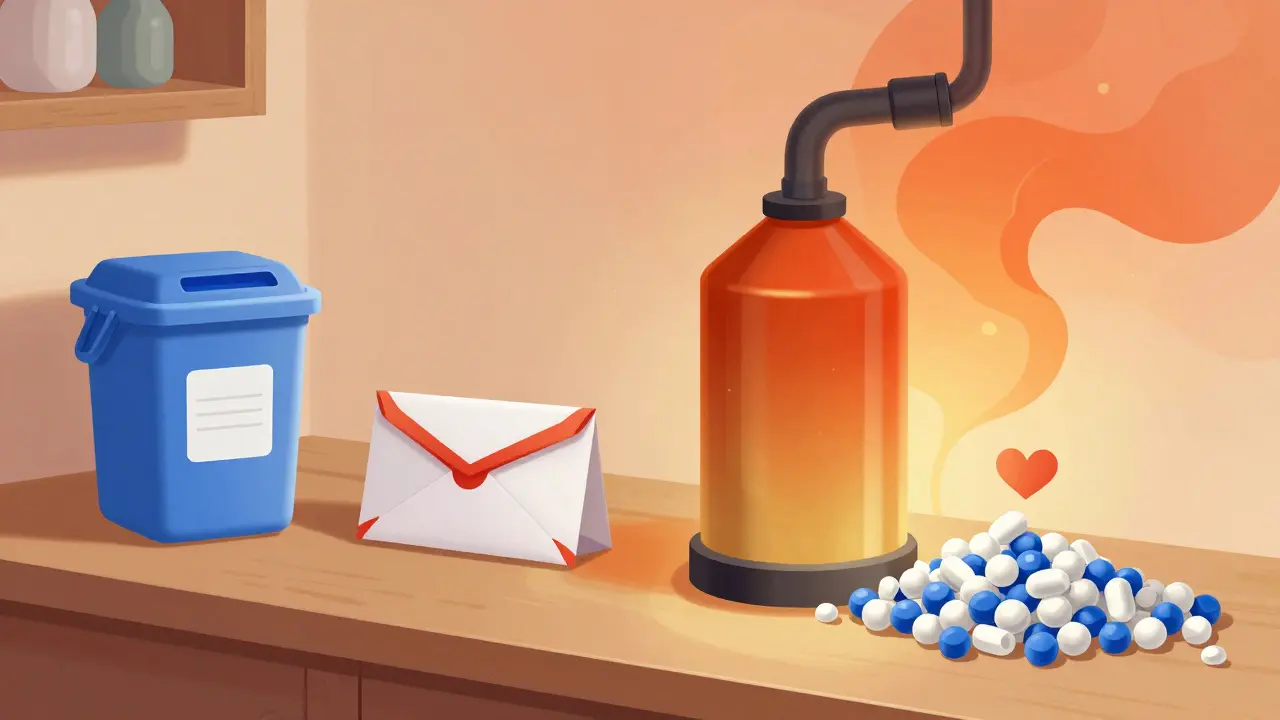
What Happens After You Drop It Off?
When you hand over your full sharps container, it doesn’t just disappear. Here’s the journey:
- It’s collected by licensed medical waste carriers.
- Transported in sealed, labeled containers to specialized facilities.
- Incinerated at high temperatures (over 800°C) to destroy all pathogens.
- Any remaining plastic is processed into non-hazardous material for industrial reuse.
This system exists because it works. In places with strong disposal programs, sharps-related injuries in the community drop by over 90%.
Common Mistakes (And How to Avoid Them)
People make the same mistakes over and over. Don’t be one of them:
- Mistake: Recapping needles to ‘save’ them. Fix: Never recap. Use one-handed scoop technique only if absolutely necessary-and even then, avoid it.
- Mistake: Waiting until the container is full to dispose of it. Fix: Dispose when it’s 3/4 full. Don’t risk overfilling.
- Mistake: Assuming you don’t need instructions. Fix: Always ask your pharmacist or doctor for disposal guidance when you get your prescription. If they don’t give it, ask again.
- Mistake: Throwing away containers with needles still inside if they’re not full. Fix: Even if it’s half-empty, if it’s been used, it’s hazardous. Dispose properly.
What’s Changing in 2026?
Australia is updating its medical waste rules. Starting this year, all sharps containers must carry a standardized biohazard label nationwide. Pharmacies are required to offer free disposal to PBS users. And by 2027, more councils will have drop-off points in rural areas-something that’s been badly needed.
For now, the rules are clear: Use a proper container. Don’t overfill. Dispose at an approved site. It’s not optional. It’s the law-and it saves lives.
Can I reuse a sharps container?
No. Reusable sharps containers are only designed for use in hospitals or clinics under strict sterilization conditions. For home use, always use single-use, FDA-approved containers. Reusing any container-even if it looks clean-puts you and others at risk of infection.
Is it illegal to throw sharps in the trash in Australia?
Yes. Under the National Waste Policy and state environmental laws, disposing of sharps in household waste is illegal in all Australian states and territories. Fines can apply to individuals and businesses who violate these rules.
Do I need a prescription to get a sharps container?
No. You can buy sharps containers over the counter at any pharmacy. However, if you’re on the PBS for insulin or another injectable medication, you may be eligible for free containers-ask your pharmacist.
Can I take my sharps container on public transport?
Yes, as long as the container is sealed and labeled. Keep it in a bag or purse, not in your pocket. Most public transport systems allow this because it’s safer than leaving sharps at home. Just make sure the lid is locked and the container is intact.
What if I accidentally stick myself with a used needle?
Wash the area immediately with soap and running water. Don’t suck or squeeze the wound. Go to the nearest hospital emergency department or call Healthdirect on 1800 022 222. You may need testing for hepatitis B, hepatitis C, and HIV. Early treatment can prevent infection.


Catherine Scutt
January 9, 2026 AT 15:41So you’re telling me I can’t just toss my insulin needle in the trash like I’ve been doing for 5 years? Wow. Guess I’m the villain now. 😑
Darren McGuff
January 10, 2026 AT 15:43Oh my god, I had no idea this was such a massive public safety issue. I’ve been using a coffee can since my dad started insulin. I just thought it was ‘fine’ until someone got hurt. I’m getting a proper container today. Thank you for this. 🙏
Aron Veldhuizen
January 11, 2026 AT 07:14Let’s be real-this entire system is a corporate scam. FDA-approved containers cost $20? Meanwhile, a 2L soda bottle costs $0.50 and is just as effective if you’re not an idiot. The real danger isn’t needles-it’s the medical-industrial complex profiting off your fear. You don’t need a ‘biohazard’ label to be responsible. You need common sense. And if you can’t use a screw-top bottle without getting stabbed, maybe you shouldn’t be injecting yourself at all.
Jeffrey Hu
January 12, 2026 AT 23:02Actually, the CDC data cited here is outdated. The 385,000 needlestick injuries figure is from 2015 and refers to healthcare workers, not home users. Community needlestick injuries are estimated at 1,500–2,000 per year in the US, not millions. Also, ‘FDA-cleared’ containers aren’t magically safer-just legally compliant. Many are made of brittle plastic that cracks under pressure. A thick HDPE bottle with a locking cap is more reliable. And no, you don’t need to dispose within 3 months. That’s a pharmacy myth. The real rule is: don’t let it sit for years.
Drew Pearlman
January 13, 2026 AT 03:16I just want to say-this post gave me hope. I’ve been scared to even talk about my diabetes because people act like I’m a walking hazard. But reading this made me feel seen. You’re right-it’s not about being perfect, it’s about trying. I started using a laundry detergent bottle last week and dropped it off at my local pharmacy yesterday. They smiled and said ‘good job.’ I cried. Not because it was hard-but because someone finally made me feel like I mattered. Keep spreading this kind of info. We need more of it.
Chris Kauwe
January 15, 2026 AT 01:30Let me get this straight-we’re spending millions on ‘safe disposal’ programs while our veterans are getting denied insulin? This isn’t about needles, it’s about systemic neglect. If you can’t afford a $25 container, you’re not ‘careless,’ you’re being failed by a broken healthcare system. The real solution isn’t better bins-it’s free insulin, free needles, and free disposal for everyone. Until then, stop shaming people who use soda bottles. They’re not the enemy. The system is.
RAJAT KD
January 16, 2026 AT 21:38Used needle in pocket? Bad. Bottle with lid? Better. Proper container? Best. Simple.
Phil Kemling
January 18, 2026 AT 04:19It’s interesting how we’ve turned a biological necessity-injecting medication-into a moral test. The fear around sharps isn’t really about safety. It’s about control. Who gets to decide what’s ‘acceptable’ waste? Who profits from the container industry? And why do we assume someone who can’t afford a $25 box is less human? The needle doesn’t care if you’re rich or poor. It just wants to be handled with care. Maybe we should focus less on compliance and more on compassion.
Diana Stoyanova
January 18, 2026 AT 05:00Y’ALL. I just got my first sharps container from my pharmacy for FREE because I’m on PBS. I felt like I won the lottery. 🎉 I even took a selfie with it (yes, I’m that person). I used to hide my needles like they were contraband. Now I’m proud to say I’m doing it right. If you’re struggling-ask. Seriously. Ask your pharmacist. Ask your doctor. Ask your local council. Someone will help. You’re not alone. And you’re not a bad person for needing help. 💪❤️
Elisha Muwanga
January 19, 2026 AT 07:09Disposing of sharps improperly is not just irresponsible-it’s a violation of public trust. The fact that people still use yogurt containers is a reflection of societal decay. We’ve become so entitled to convenience that we ignore basic hygiene. This isn’t just about needles. It’s about character. If you can’t take five minutes to drop off a container, you don’t deserve to live in a civilized society.
Maggie Noe
January 20, 2026 AT 06:14Just got my container today! 🙌 Also, I put a sticker on it that says ‘I’m not a monster, I’m a diabetic.’ 😊❤️ I feel like a superhero now. If you’re scared to start-just do it. One step. One container. One less risk for someone else. You got this. 💉✨
Gregory Clayton
January 21, 2026 AT 02:23Ohhh so NOW we’re policing people’s trash? What’s next? Mandatory hand-washing inspections? You people are ridiculous. I’m not gonna pay $20 for a plastic box when my 2L bottle works fine. And if a sanitation worker gets stabbed? That’s their job. They signed up for it. Don’t make me feel guilty for saving money.
Meghan Hammack
January 22, 2026 AT 12:54Hey, if you’re reading this and you’re scared to start using a proper container-you’re not alone. I was too. I thought I’d look ‘weird’ carrying it around. But guess what? No one cared. And now I feel safer. You don’t have to be perfect. Just start. One container. One day. One less risk. You’re doing better than you think. 💕
Matthew Maxwell
January 23, 2026 AT 02:27It’s worth noting that the FDA does not regulate sharps containers sold in Australia. The term ‘FDA-cleared’ is misleading in this context. Australian standards are governed by AS/NZS 4031:2018. While the principles are similar, the regulatory framework is entirely domestic. This post, while well-intentioned, exhibits dangerous American-centric framing. Please consult local guidelines. Also, ‘mail-back programs’ are not widely available outside major cities. Don’t assume they’re accessible.