
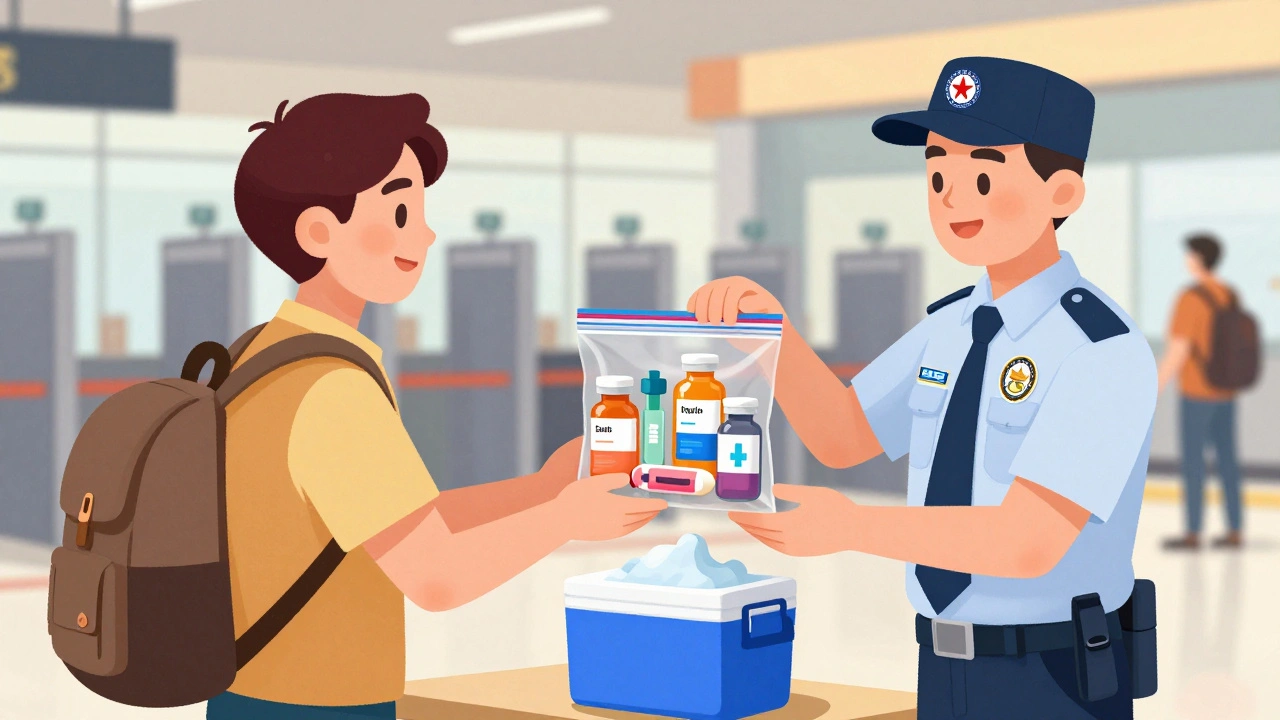
Traveling with liquid medications doesn’t have to be a stress-filled ordeal. Millions of people fly every year with insulin, chemotherapy drugs, EpiPens, or other essential liquid medicines-and most of them get through security without a hitch. But if you’ve ever been pulled aside at the checkpoint, asked to open your bag, or watched your vials go through the X-ray machine while the officer stared confusedly, you know how messy it can get. The good news? The rules are clear. The bad news? Not every TSA officer knows them. Here’s how to make sure you’re one of the ones who breeze through.
Know What’s Allowed
The TSA lets you bring liquid medications in any quantity, no matter how big the bottle. That means your 100 mL insulin vials? Your 8 oz bottle of oral steroid solution? Your 16 oz bag of feeding formula? All perfectly legal. The 3.4-ounce rule that applies to shampoo, toothpaste, and lotion? It doesn’t apply to you. Medications are exempt. This includes:- Prescription liquids (insulin, liquid antibiotics, pain meds)
- Injectables (EpiPens, GLP-1 agonists like Ozempic, injectable hormones)
- Prescription creams and gels (for eczema, psoriasis, or joint pain)
- Medical supplements like liquid electrolytes or feeding formulas
Keep Them in Original Containers
This is the single most important step. Don’t transfer your meds into unlabeled pill organizers, small travel bottles, or plastic bags. Over 60% of delays at security in 2024 happened because officers couldn’t verify what the liquid was. TSA officers aren’t pharmacists. They need to see the pharmacy label: your name, the drug name, the prescriber’s name, and the pharmacy’s contact info. If you’re worried about bulk, here’s what works: keep your medications in their original bottles, but pack them together in a single clear zip-top bag. Not the same bag as your shampoo and toothpaste-this is your meds-only bag. Keep it in an outer pocket of your carry-on so you can grab it fast. No need to put it in the 3-1-1 bag. Don’t mix them. Don’t hide them. Just lay them out.Declare Them Before Screening
Don’t wait for the officer to ask. As soon as you walk up to the checkpoint, say it out loud: “I have liquid medications in my bag.” Make eye contact. Be calm. This simple step cuts your screening time in half. According to Johns Hopkins research, travelers who declare upfront pass through in under 2 minutes. Those who don’t? They average 4.7 minutes-sometimes longer. If you’re carrying something unusual-a glucagon kit, a syringe with a vial, a cooler with ice packs-say that too. “I have an emergency glucagon kit” or “I have a small cooler for insulin.” Officers hear this all the time. They’re trained for it. But they won’t know unless you tell them.Ice Packs and Coolers: What You Can Bring
If you need to keep your meds cold, ice packs are allowed-but they can’t be solid when they go through the X-ray. The TSA says frozen ice packs must be melted before screening. That doesn’t mean you have to thaw them at home. Just take them out of your cooler 10 minutes before you get to the checkpoint. Let them sit on the counter while you take off your shoes. By the time you reach the belt, they should be slushy or liquid. If they’re still frozen, the officer will ask you to open the cooler and inspect the contents. That’s fine. Just be ready. Coolers must be small-no bigger than 8x6x2 inches. That’s about the size of a lunchbox. No large insulated bags. No dry ice. If you’re flying internationally, check the airline’s rules too. Some airlines restrict coolers in the cabin.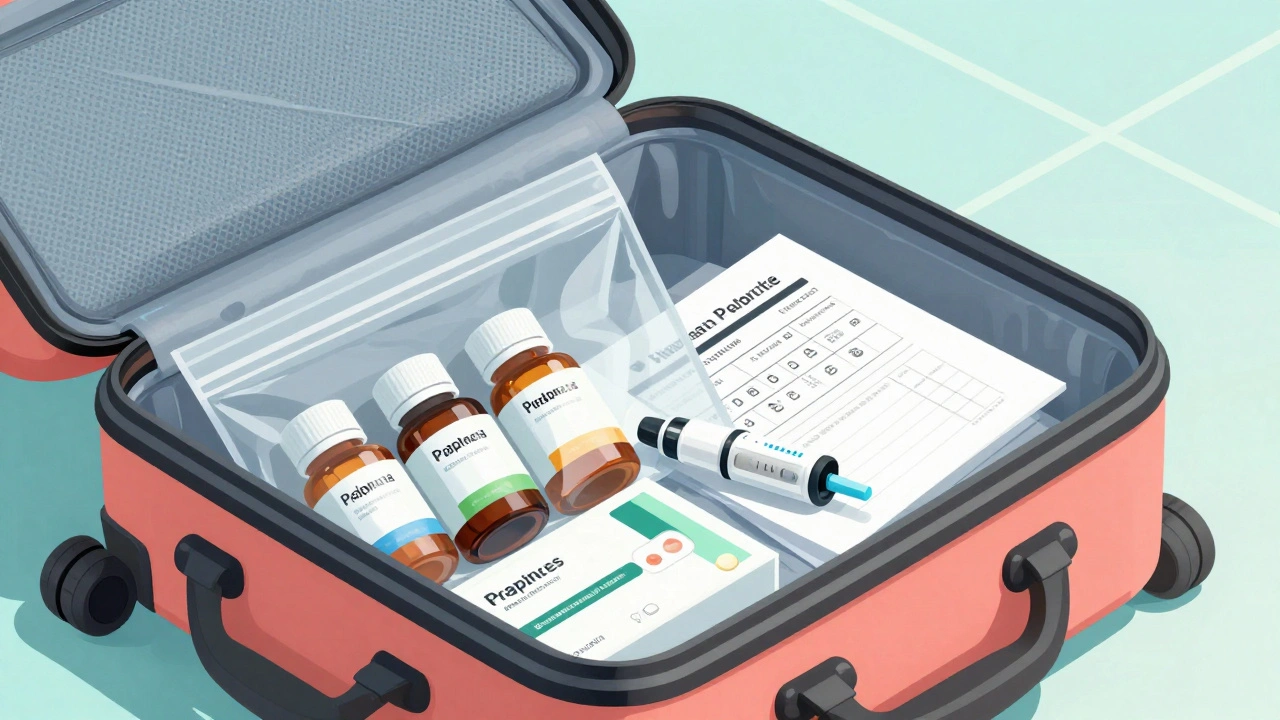
Bring Documentation-Just in Case
You don’t need a doctor’s note for most meds. But if you’re carrying controlled substances (like oxycodone, Adderall, or benzodiazepines), bring a copy of your prescription. Even better: print out a list. Include:- Drug name (generic and brand)
- Dosage and frequency
- Prescribing doctor’s name and phone number
- Pharmacy name and number
- Condition being treated (optional but helpful)
What Doesn’t Work
Here are the top mistakes travelers make:- Putting meds in the 3-1-1 bag. This confuses officers. They think you’re trying to hide them.
- Using unlabeled containers. Even if it’s your own pill organizer, if it doesn’t have a label, it’s a red flag.
- Waiting until you’re screened to say you have meds. That’s when delays spike.
- Trying to sneak extra meds into your checked bag. Checked luggage gets lost. You don’t want your insulin sitting in a cargo hold for 8 hours.
- Not bringing enough for the whole trip. Always pack extra. Flight delays happen.
What to Expect at the Checkpoint
Once you declare your meds, here’s what usually happens:- You hand over your meds bag to the officer.
- They may ask you to open the bottles or show the labels.
- They’ll screen each item individually-either by X-ray or by swabbing for traces.
- They’ll return your meds to you. No need to repack them.
- You’re done.
Special Cases: Insulin, EpiPens, and Medical Devices
Insulin users: You can bring vials, pens, and pumps. No limits. Keep them with you. Don’t check them. If you’re using a pump, tell the officer. Some pumps have batteries that need to be removed for screening. Ask ahead of time if you’re unsure. EpiPens: These are allowed. No restrictions. You can carry two or three. They’re not considered weapons. Don’t remove them from their cases unless asked. Glucagon kits: These are emergency meds. If you have one, say so. Officers are trained to recognize them. But if they don’t, show them the label. It says “Glucagon” right on it. Hearing aids, nebulizers, oxygen tanks? All allowed. Declare them. Same process.What’s Changing in 2025
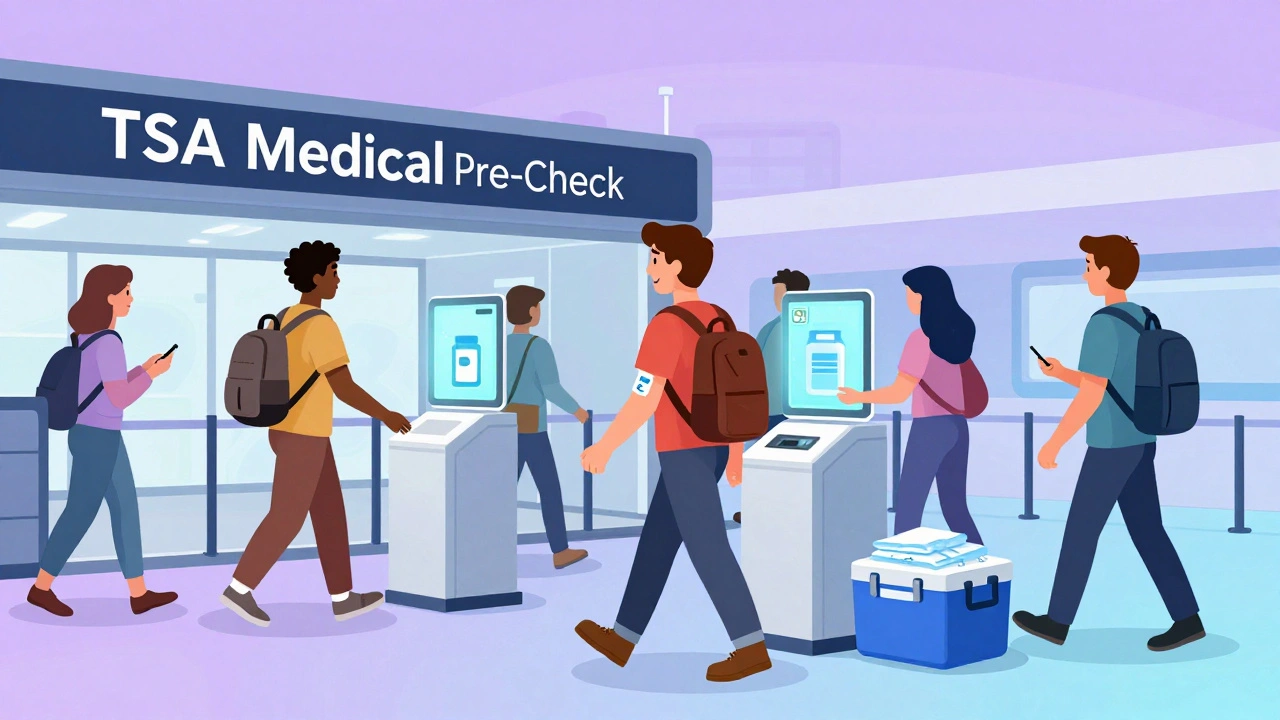
The TSA is rolling out a new program called Medical Traveler Pre-Check. Starting in September 2025, frequent travelers with chronic conditions can sign up for a voluntary registry. If you’re approved, you’ll get a special lane at 12 major U.S. airports. Screening time drops from 3.2 minutes to under 1.1 minutes. The system uses AI to recognize common medications by label and container shape. Trials at Dallas/Fort Worth reduced screening errors by 41%. This won’t replace the need to declare your meds-but it will make things faster. If you fly often with liquid meds, keep an eye out for the application link on the TSA website.Final Tips
- Practice packing your meds bag before your trip. Do it the night before. Make sure everything’s labeled and visible. - Always carry more than you think you’ll need. A 7-day trip? Bring 10 days’ worth. - Never put meds in checked luggage. Always keep them in your carry-on. - If you’re flying internationally, check the destination country’s rules. Some countries restrict certain meds-even if they’re legal in the U.S. - Bring a small wet bag for spills. Insulin vials break. It happens. - If you’re nervous, arrive 30 minutes earlier than usual. Give yourself room. You’re not asking for special treatment. You’re asking for the right to stay healthy while you travel. That’s not a privilege. It’s a necessity. And the rules are on your side.Can I bring liquid medications in my carry-on without any limits?
Yes. The TSA allows prescription liquid medications in any quantity, regardless of the standard 3.4-ounce limit. This includes insulin, chemotherapy fluids, oral medications, and prescription creams. You must declare them at security, but there’s no cap on volume.
Do I need a doctor’s note for my liquid medications?
Not for most medications. But if you’re carrying controlled substances like opioids, stimulants, or benzodiazepines, bring a copy of your prescription. Even better, carry a printed list with drug names, dosages, and your doctor’s contact info. It speeds things up if questions arise.
Can I put my liquid meds in the same bag as my toiletries?
No. Keep your medications in a separate clear bag. Mixing them with shampoo or lotion causes confusion at security. TSA officers treat medical liquids differently. Keep them isolated so they’re easy to identify and screen quickly.
Are ice packs allowed for refrigerated medications?
Yes, but they must be melted or slushy when screened. Frozen ice packs are allowed, but TSA requires them to be partially thawed before going through the X-ray. If they’re still solid, officers may ask to inspect the cooler. Keep your cooler small-no larger than 8x6x2 inches.
What if a TSA officer doesn’t recognize my medication?
Stay calm and show them the original pharmacy label. Say, “This is my prescription medication,” and point to the name, dosage, and prescriber info. Most officers will accept it. If they’re unsure, ask to speak to a supervisor. You’re within your rights to carry these items. Don’t argue-just provide the facts.
Can I bring my insulin pump through security?
Yes. Insulin pumps are allowed in carry-on luggage. Tell the officer you’re wearing a medical device. They may ask you to remove the pump for screening, but most of the time, they’ll just do a pat-down or swab test. Never check your pump-it’s critical for your health.
Will my medication be X-rayed?
Yes, most liquid medications go through X-ray screening. But you can request a visual inspection instead. Say, “I’d prefer a visual inspection for my medication,” before it enters the machine. TSA officers are trained to accommodate this request. It’s your right.
Are there any liquid medications that aren’t allowed on planes?
All prescription and over-the-counter medications are allowed, even if they’re not FDA-approved in the U.S. But if a medication contains a federally controlled substance (like marijuana-derived THC in some states), it’s still illegal under federal law. TSA doesn’t search for drugs-but if they find something suspicious, they may refer you to law enforcement. Always check the laws of your destination country.



Harriet Wollaston
December 12, 2025 AT 13:18Just flew last week with my insulin pump and a cooler for my GLP-1 meds-followed every tip here and sailed through security. The officer even thanked me for being organized. Seriously, this post is a lifesaver for people like me who just want to get to their destination without a panic attack. 🙌
Tyrone Marshall
December 14, 2025 AT 02:39There’s something deeply human about how we treat medical needs as exceptions instead of rights. You’re not asking for special treatment-you’re asking to be allowed to live while you move through the world. That’s not privilege. It’s dignity. And the fact that TSA officers have to be educated on this? That’s the system failing, not you. Keep speaking up. We all benefit when someone makes the path easier for others.
Tom Zerkoff
December 15, 2025 AT 03:29While the guidance provided is largely accurate and well-intentioned, I must emphasize the critical importance of compliance with 49 CFR § 1540.111, which governs the carriage of medical substances aboard aircraft. Although TSA policy permits exemptions for prescription liquids, the absence of standardized federal documentation protocols across jurisdictions creates operational ambiguity. Travelers should consider obtaining a signed attestation from their prescribing physician, particularly when transiting through international hubs where regulatory frameworks diverge from U.S. standards. Failure to do so may result in detention under bilateral health security agreements.
Yatendra S
December 16, 2025 AT 00:54bro… i just put my insulin in a water bottle and said it was ‘vitamin water’… 😅 TSA didn’t even look. they were busy arguing about a guy with 17 jars of pickles. sometimes the system works if you don’t play by its rules. 🤫💊
Shelby Ume
December 16, 2025 AT 23:14As someone who travels monthly with a nebulizer and liquid steroids, I’ve seen every version of this chaos. The key is confidence. If you sound like you know what you’re doing, they’ll follow your lead. I always say, ‘These are my medically necessary treatments under ADA protections,’ and I hand them the pharmacy label before they even ask. It’s not about being loud-it’s about being clear. And yes, I do carry an extra week’s supply. Always. Flight delays are not a suggestion-they’re a guarantee.
Jade Hovet
December 18, 2025 AT 19:28OMG YES I DID THIS LAST MONTH AND IT WORKED SO WELL!! 🥹 I had my meds in a cute clear pouch, labeled everything with sticky notes (yes, I’m a mess) and just yelled ‘MEDS!’ as I walked up. Officer laughed and said ‘finally someone who gets it!’ 🤝 I brought 12 days worth for a 5-day trip and they didn’t even open the cooler. Just showed the label and walked on. You’re all my heroes. P.S. Wet bag is a MUST. I spilled on my shirt. Again. 😭
nithin Kuntumadugu
December 20, 2025 AT 00:38THIS IS ALL A GOVERNMENT DISTRACTION. They want you to think you’re ‘allowed’ to carry meds… but what they’re really doing is conditioning you to accept surveillance. Why do they need to ‘swab’ your bag? Why do they need your doctor’s info? Who’s tracking this data? The same people who flagged your insulin as ‘suspicious’ last year? 🕵️♂️ They’re building a biometric profile. Don’t be fooled. Bring your meds? Sure. But don’t volunteer your identity. And NEVER use the ‘Medical Traveler Pre-Check’-that’s a trap. #TSAisWatching
John Fred
December 22, 2025 AT 00:36Big up to the OP-this is the kind of guide I wish I had when I was first diagnosed with Type 1. Pro tip: if you’re using an insulin pump, ask for a pat-down instead of going through the mill. It’s faster and less stressful. Also, if you’re flying with a cooler, use a frozen gel pack wrapped in a towel-it looks less like a ‘science experiment’ and more like ‘lunch.’ TSA agents appreciate aesthetics. 😎 And yes, I’ve been flagged 3x. Now I print my meds list on neon paper. Works every time.