

It’s not just forgetting where you put your keys. Real cognitive decline starts with subtle shifts - a delay in recalling a name, struggling to follow a conversation in a noisy room, or taking longer to plan a simple task. These aren’t normal aging quirks. They’re early signals that the brain is changing. And today, we have tools that can catch them before they turn into something more serious.
Why Early Detection Matters More Than Ever
For years, doctors waited until memory loss became obvious - until someone got lost driving home or couldn’t manage their bills. By then, brain damage was often advanced. But that’s changing. New treatments like lecanemab don’t just slow decline; they work best when started early, during the Mild Cognitive Impairment (MCI) stage. That’s the window between normal aging and dementia - a time when the brain still has room to respond.
Studies show that people with MCI are 10 times more likely to develop Alzheimer’s than those without it. But not everyone with MCI progresses. Some stay stable. Others even improve. The key is knowing who’s at risk and acting fast. That’s why screening isn’t optional anymore - it’s essential.
Old Screening Tools Are Falling Behind
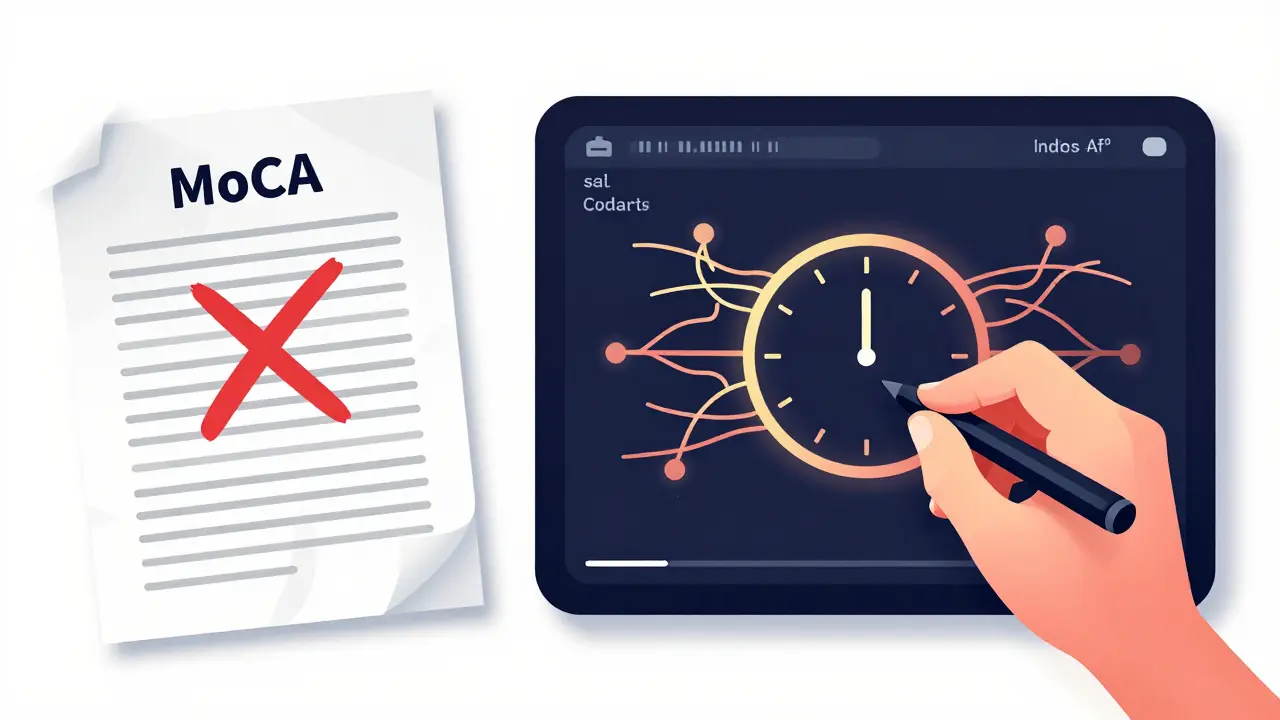
You’ve probably heard of the MMSE or MoCA - paper-and-pencil tests that ask you to draw a clock, remember three words, or count backward. They’ve been used for decades. But here’s the problem: they’re too crude.
A 2023 meta-analysis found these tools miss up to 30% of early MCI cases. Why? Because they only measure outcomes - not how you get there. Did you forget the word? Or did you pause too long, fumble with the pen, or hesitate before answering? Traditional tests can’t tell the difference between a memory issue and a motor delay or anxiety.
And they’re inconsistent. One doctor might score a 26/30 on the MoCA as normal. Another might flag it as concerning. That’s not reliable. Especially when we’re trying to track tiny changes over time.
The New Generation: Digital Screening Tools
By 2025, the best tools aren’t on paper. They’re on tablets, computers, and even VR headsets. These aren’t gimmicks - they’re precise medical devices backed by clinical data.
Take the Virtual Reality-Based Cognitive Function Examination (VR-E). It immerses you in a simulated grocery store. You’re asked to find items, remember a list, and make decisions - all while eye-tracking software records where you look, how long you pause, and how your pupils react. It doesn’t just ask if you remember - it measures the *process* of remembering. Its accuracy? AUC of 0.94 - far higher than MoCA’s 0.80-0.85.
Then there’s Linus Health’s Digital Assessment of Cognition (DAC). In just seven minutes, it combines two tasks: a digital clock-drawing test and a digital Trail Making Test (dTMT-B). But here’s what’s new: it doesn’t just look at whether the clock looks right. It measures stroke speed, timing between numbers, drawing efficiency, and even how much your pen wobbles. Machine learning compares your pattern to thousands of others - and flags subtle deviations that humans would miss.
At the Cleveland Clinic, the Cognitive Battery (C3B) is now part of routine Medicare annual visits. It’s quick, automated, and integrates directly into the electronic health record. If your score drops by even 1 point from last year, the system alerts your doctor. No more waiting for a crisis.
What These Tools Can Actually Measure
Traditional tests ask: “Can you recall this word?”
Digital tools ask: “How long did it take you to recall it? Did you hesitate? Did you correct yourself? Did your hand shake while writing?”
Here’s what’s being captured:
- Pen stroke velocity - how fast you move the stylus (slower = possible motor delay)
- Hit duration - how long your finger stays on a button (longer pauses = decision-making delay)
- Drawing efficiency - actual path length vs. ideal path (inefficient lines = impaired spatial planning)
- Eye-tracking patterns - where you look first, how often you re-fixate (abnormal patterns = attention or memory disruption)
- Response variability - inconsistent timing between similar tasks (a red flag for early neurodegeneration)
These aren’t just numbers. They’re biological signals. And they’re proving to be more accurate than MRI scans in detecting preclinical Alzheimer’s.
Are These Tools Accessible for Older Adults?
Yes - mostly. But not perfectly.
According to a 2025 study, 83% of users aged 65-85 found digital tools like RoCA or Linus Health’s app intuitive. One Reddit user, 78, said she completed her test in her doctor’s waiting room with no help. Another, 81, said she liked it because “it felt like a game, not a test.”
But 17% struggled. Not because of memory - because of unfamiliar interfaces. Small buttons, unclear instructions, or auto-advancing screens caused frustration. One man failed a test because he didn’t know he had to tap, not click. His score wasn’t low - he just didn’t know how to interact with the device.
That’s why the best clinics now pair digital screening with a brief orientation. A medical assistant spends two minutes showing you how to use the tablet. No tech skills needed. Just a gentle nudge.
And here’s the good news: 78% of Americans over 65 now own a smartphone. Digital literacy is rising. Tools designed for seniors are getting better - bigger buttons, voice prompts, slower pacing.
What’s Next? Blood Tests and AI Predictions
The next leap isn’t just digital - it’s biological.
For years, confirming Alzheimer’s meant a costly PET scan or an invasive spinal tap. Now, blood tests can detect amyloid and tau proteins - the same markers found in the brain. In early 2025, the NIH confirmed these tests are ready for clinical use in high-risk patients.
And here’s the game-changer: digital tools are now being combined with blood biomarkers. Linus Health’s model - combining dTMT-B, clock-drawing, and APOE gene status - predicted amyloid buildup with 89% accuracy. That’s almost as good as a PET scan.
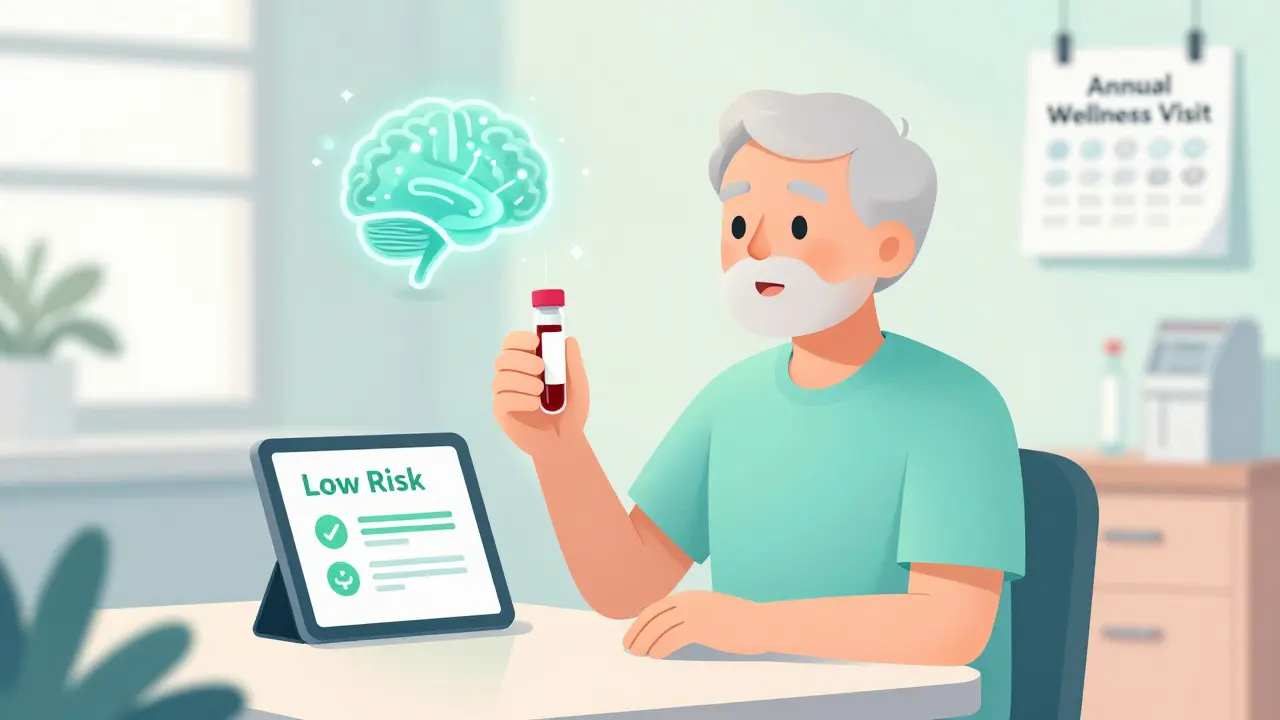
Imagine this: a 68-year-old walks in for their annual check-up. They do a 7-minute digital test. A blood sample is taken. Within 48 hours, their doctor gets a report: “Low risk for amyloid buildup. Cognitive trajectory stable.” Or: “High risk. Recommend follow-up with neurologist and consider early intervention.”
That’s not science fiction. It’s happening now.
Why Your Doctor Should Be Screening You - Even If You Feel Fine
Most people don’t bring up memory concerns. They think it’s “just getting older.” Or they’re embarrassed. But if you’re over 65, you should be screened - just like you get your blood pressure checked.
Here’s why:
- Early MCI is reversible in up to 20% of cases - often due to vitamin B12 deficiency, thyroid issues, or depression.
- If it’s early Alzheimer’s, starting treatment now can delay progression by 18-24 months - giving you more time to plan, travel, and enjoy life.
- Medicare now covers cognitive screening during your Annual Wellness Visit. It’s free.
- Tools like C3B and RoCA take less time than a flu shot.
There’s no downside. No radiation. No needles. Just a few minutes on a tablet.
What to Ask Your Doctor
If your doctor doesn’t mention cognitive screening, bring it up. Say this:
- “Do you screen for early cognitive changes during annual visits?”
- “Are you using digital tools like C3B or Linus Health?”
- “Can we compare my results to last year’s?”
- “If my score drops, what’s the next step?”
If they say they only use the MoCA or MMSE, ask if they’re aware of newer options. Most don’t - and that’s a red flag. The field has moved on. Your care should too.
What This Means for Families
If you’re caring for a parent or partner, don’t wait for them to forget your name. Watch for small changes: slower decision-making, avoiding complex tasks, repeating stories, or losing interest in hobbies. These aren’t personality shifts - they’re brain signals.
Offer to go with them to their next check-up. Ask if they can do a digital screen. Bring a list of concerns - not accusations. Say: “I noticed you’ve been taking longer to pay bills. I worry. Can we ask the doctor about this?”
Most people respond better to care than criticism. And early detection? It’s not about fear. It’s about time - the most precious thing we have.




Monica Puglia
January 10, 2026 AT 21:15Just did my annual check-up and asked for the digital screen-my doctor had no idea what I was talking about 😅 I showed him the article and he said he’d look into it. Took 5 minutes on a tablet, felt like a fun game. No needles, no stress. If you’re over 65, just ask. Seriously. Your future self will thank you. 🙏
George Bridges
January 12, 2026 AT 00:11I’ve watched my dad go from sharp as a tack to struggling with his phone bill. We thought it was just aging. Turns out, it was early MCI-and his doctor never screened him. He’s on lecanemab now. It’s not a cure, but it’s buying us time. If you’re reading this and your parent is 65+, please, gently ask their doctor about digital screening. Don’t wait for them to get lost.
Rebekah Cobbson
January 13, 2026 AT 00:38My mom did the VR grocery test last month. She laughed the whole time-said it felt like a Nintendo game from the 90s. But when the results came back, her score dropped 1.2 points from last year. That’s when her doctor flagged it. Turns out she had a vitamin B12 deficiency. After a few weeks of shots, she’s back to knitting complex sweaters and remembering everyone’s birthdays. It’s not magic-it’s early detection. Don’t ignore the small things.
gary ysturiz
January 14, 2026 AT 22:28This is huge. I’m 71 and I never thought I’d care about pen stroke velocity. But after seeing how the digital tools catch tiny changes before I even notice them, I get it. My brain is changing. And now I can do something about it. No fear. No shame. Just action. If your doctor still uses paper tests, ask them why. They’re using a flashlight to look for a cancer tumor.
laura manning
January 15, 2026 AT 19:38While the technological advancements described herein are undeniably impressive, the underlying assumption-that cognitive decline can be reliably quantified via stylus pressure and eye-tracking metrics-is methodologically suspect. The conflation of motoric hesitation with neurodegenerative pathology introduces significant confounding variables. Furthermore, the cited AUC values lack context regarding cohort stratification, and the claim that these tools outperform MRI scans is not substantiated in peer-reviewed literature. One must exercise extreme caution before institutionalizing such metrics as diagnostic standards.
Sumit Sharma
January 17, 2026 AT 11:10Let’s be real-this is just another Silicon Valley scam. You think a tablet can detect Alzheimer’s? My cousin in Bangalore got a similar app-said it detected ‘cognitive decline’ because he was tired. These tools are trained on Western datasets. They don’t account for cultural differences in decision-making, language fluency, or even how people hold pens. You’re not detecting disease-you’re pathologizing normal human variation. And now Medicare’s paying for it? Absurd.
Jay Powers
January 18, 2026 AT 21:40Sumit makes a good point about cultural bias but I think we’re missing the bigger picture. Even if these tools aren’t perfect, they’re way better than asking someone to draw a clock and calling it a day. My grandma’s test flagged a drop, turned out she was depressed-not dementia. She started therapy, now she’s back to gardening and FaceTiming us daily. The goal isn’t perfection-it’s catching what we used to miss. Let’s not throw the baby out with the bathwater.
Lawrence Jung
January 19, 2026 AT 05:12Technology is a mirror. It doesn’t reveal truth-it reveals patterns we’ve programmed into it. You think you’re detecting early Alzheimer’s? No-you’re detecting anxiety, fatigue, screen fatigue, arthritis, loneliness. The brain isn’t a machine to be optimized. It’s a living thing shaped by decades of joy, grief, music, silence. You can’t reduce a soul’s whisper to a wobble in a pen stroke. We’re not saving minds-we’re quantifying fear. And that’s the real decline.