
When a patient asks why they’re getting a cheaper pill with a different name, doctors need to answer with confidence. Not just because it’s cost-effective-but because it’s medically equivalent. That’s where continuing medical education (CME) on generic drugs comes in. It’s not just a box to check. It’s the difference between a patient sticking to their treatment plan or skipping doses because they think the generic is "weaker."
Why Generics Matter More Than Ever
Nearly 91% of all prescriptions filled in the U.S. are for generic drugs. Yet, they make up only about 23% of total drug spending. That’s billions saved every year-money that goes back into patient care, not corporate profits. But here’s the catch: if doctors don’t understand generics, they won’t prescribe them confidently. And if they don’t prescribe them, patients pay more, skip doses, or end up back in the hospital.
The FDA doesn’t approve generics lightly. Every single one must prove it delivers the same active ingredient, in the same amount, at the same rate as the brand-name version. That’s bioequivalence. It’s not guesswork. It’s science. And when doctors know this, they can explain it to patients-and reduce anxiety. One family doctor in California found that after taking a CME course on bioequivalence, her patients’ concerns about generics dropped by 40%.
What Doctors Are Required to Learn
CME rules vary wildly across states. In California, doctors need 50 hours of approved CME every two years. But there’s no specific requirement for generics. In Maryland, if you prescribe opioids, you need three hours of CME-half of which must cover prescription drug monitoring programs. In Florida, it’s two hours every two years on controlled substances. And since June 2023, every doctor with a DEA number must complete eight hours of training on substance use disorders, including how to use generic alternatives to controlled medications.
Here’s the reality: 68% of state medical boards require some form of pharmacology education. And 42 of them specifically include training on distinguishing generic from brand-name drugs. That’s not a coincidence. It’s a response to real gaps in knowledge. A 2022 study by the National Board of Medical Examiners showed that doctors who completed pharmacology-focused CME made 17.3% more accurate decisions about generic substitutions.
The Opioid Crisis Changed Everything
Before 2020, most CME on generics was about cost. Now, it’s about safety. The opioid epidemic forced medical boards to act. Thirty-two states now require education on opioid prescribing. Eighteen of them mandate two hours every two years. And in many of those courses, doctors are taught that generic versions of buprenorphine or naloxone are just as effective-and far more accessible.
That’s why the MATE Act (Medication Access and Training Expansion Act) was such a game-changer. It didn’t just add hours. It changed the focus. Now, education isn’t just about what drugs to avoid-it’s about what generics to use instead. And it’s mandatory for every DEA-registered provider. Compliance is due by June 2025. No exceptions.
What’s Actually Taught in CME Courses
Not all CME is created equal. Some courses are 12-hour marathons on pain management that feel irrelevant to a radiologist. Others are sharp, focused, and practical. The best ones include:
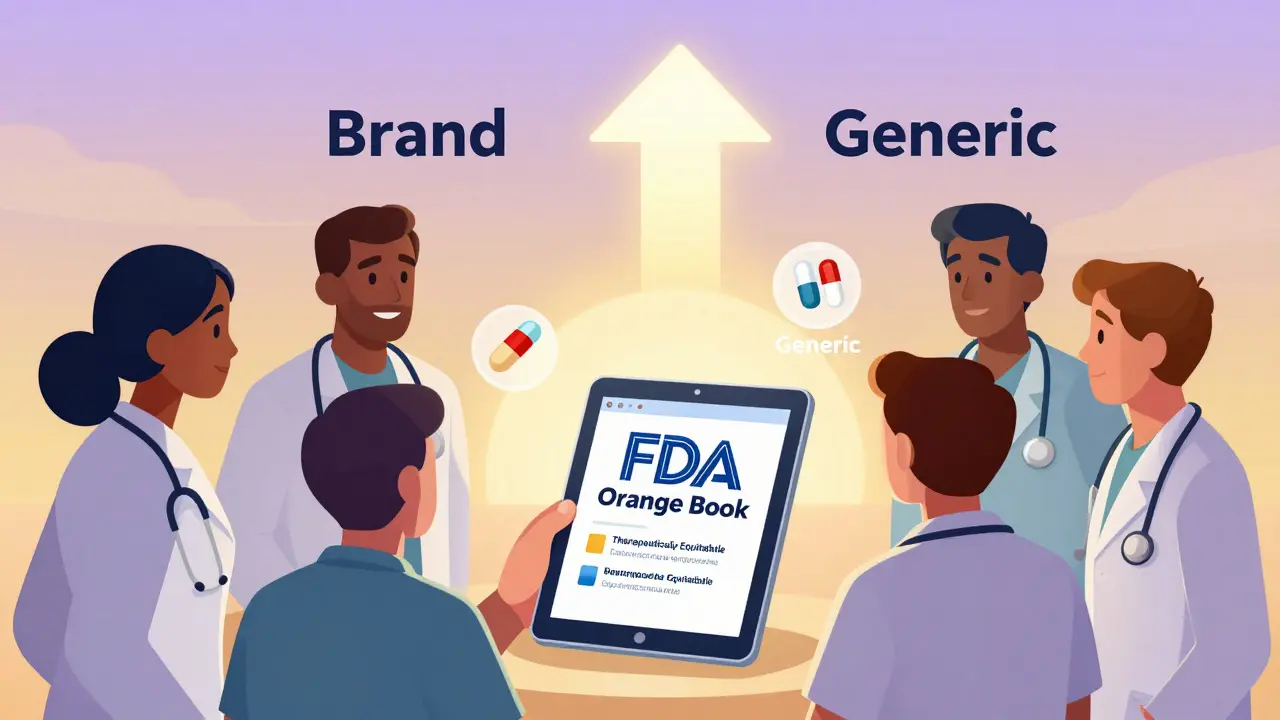
- How to read the FDA’s Orange Book-where therapeutic equivalence ratings are listed
- When generics aren’t interchangeable (like with warfarin, levothyroxine, or anti-seizure drugs)
- How to explain bioequivalence to patients in plain language
- How to handle insurance formularies that push certain generics
- How to spot counterfeit or substandard generics (rare, but possible)
Platforms like UpToDate, Medscape, and RenewNowCE now offer modules that integrate directly into EHRs. Some even give you 0.5 CME credits just for reviewing a drug monograph during a patient visit. That’s not just convenient-it’s effective. Doctors are more likely to complete training when it’s woven into their workflow, not tacked on at the end of the year.
What Doctors Really Think
Surveys show mixed feelings. On Sermo, a physician network, 68% said pharmacology CME made them more confident about prescribing generics. But 32% said it felt like a waste-especially if it was focused on pain meds when they work in radiology or dermatology.
One radiologist on Reddit put it bluntly: "I prescribe contrast agents. Not opioids. Why am I spending hours learning about oxycodone generics?" That’s a real problem. CME needs to be smarter. Not just more hours-but more relevant hours.
Still, the data backs up the push for generics education. The American College of Physicians says switching to generics could save the U.S. healthcare system $156 billion a year. And studies show patients are 23.7% more likely to stick with their meds when they’re on generics. That’s not just money. That’s lives.

What’s Changing in 2024 and Beyond
California just added a new rule: 2 hours of CME on biosimilars. These aren’t traditional generics-they’re complex biologic drugs with no exact copy. But they’re cheaper and just as effective. Doctors need to understand the difference.
The FDA approved over 1,000 new generics in 2023. That’s more than ever before. And by 2027, experts predict most CME will use AI to personalize learning. If you prescribe a lot of statins, the system will push you content on generic statins. If you rarely prescribe antidepressants, you won’t be forced to sit through hours on SSRIs.
The National Academy of Medicine is even testing competency-based CME instead of hour-based. Instead of counting hours, they’ll test your knowledge. Can you correctly identify a therapeutically equivalent generic? Can you explain why a patient should switch? If yes-you’re done.
How to Get Started
You don’t need to hunt for courses. Most major CME providers-UpToDate, Medscape, WebMD-have filters for "pharmacology" and "generics." Look for ACCME-accredited courses. Check if they cover:
- FDA Orange Book ratings
- Bioequivalence standards
- Narrow therapeutic index drugs
- Generic substitution laws in your state
- MATE Act requirements (if you have a DEA number)
And don’t overlook free resources. The FDA offers downloadable "Orange Book Primers"-updated quarterly. The American Society of Health-System Pharmacists has short online modules. Many hospitals and health systems also offer in-house training.
The goal isn’t to become a pharmacist. It’s to know enough to prescribe wisely, explain clearly, and trust the science. Because when you do, patients get better care. And the system gets cheaper.
What’s Next for Generics Education
There’s no going back. Generics are the backbone of affordable care. And as new drugs come out-59 new molecular entities were approved in 2023 alone-the need for ongoing education will only grow. By 2030, experts predict annual demand for generics-focused CME will rise by 7.2%.
The future isn’t about more hours. It’s about smarter learning. Tailored content. Real-time updates. Integration with clinical work. And above all-trust in the data.
If you’re a doctor, don’t see CME as a requirement. See it as your tool to give better care. Because when you know generics inside and out, you’re not just saving money. You’re saving adherence. You’re saving outcomes. And you’re saving lives.
Do all generics work the same as brand-name drugs?
For most drugs, yes. The FDA requires generics to be bioequivalent-meaning they deliver the same amount of active ingredient at the same rate as the brand-name version. But for drugs with a narrow therapeutic index-like warfarin, levothyroxine, or certain anti-seizure meds-small differences in absorption can matter. That’s why doctors need to know when substitution is safe and when it’s not.
Is CME on generics mandatory for all doctors?
No-not in every state. But 42 states require training on generic vs. brand-name identification as part of pharmacology CME. And if you have a DEA number, you’re federally required to complete eight hours of substance use disorder training, which includes education on generic alternatives to controlled substances. That’s mandatory nationwide as of June 2025.
How do I find accredited CME courses on generics?
Start with ACCME-accredited providers like UpToDate, Medscape, WebMD, and RenewNowCE. Filter for "pharmacology," "generics," or "therapeutic equivalence." Check the course description for keywords like "Orange Book," "bioequivalence," and "FDA standards." Make sure it’s Category 1 credit if your state requires it.
Why do some doctors resist generics education?
Some feel the content isn’t relevant to their specialty-like a radiologist forced to take opioid prescribing courses. Others distrust the sources or think it’s just cost-cutting in disguise. But studies show that when the training is practical and tailored, resistance drops. The best courses connect generics directly to patient outcomes, not just policy.
Can I get CME credit just by using clinical tools during work?
Yes. Some platforms, like UpToDate integrated with Epic or Cerner, now award 0.5 CME credits when you review a drug monograph during a patient visit. It’s learning built into practice-no extra time needed. Check with your EHR system or CME provider to see if this option is available.
Branden Temew
December 31, 2025 AT 04:48So we’re telling doctors they need to spend hours learning about generic drugs so they can convince patients that a $4 pill isn’t a knockoff from a shady Amazon seller? Meanwhile, the same system lets pharmacies switch brands without telling anyone and then wonders why people think their antidepressants stopped working. The real problem isn’t education-it’s transparency. If the FDA’s Orange Book was as easy to read as a Yelp review, we wouldn’t need CME. We’d need a damn app.
Frank SSS
December 31, 2025 AT 07:41I’m a radiologist. I inject contrast. I don’t prescribe opioids. Why am I forced to sit through 8 hours of buprenorphine generics? This isn’t education-it’s bureaucratic theater. They’re not trying to make me better at my job. They’re trying to make me feel guilty for not being a primary care doctor.
Paul Huppert
January 1, 2026 AT 07:04Just had a patient ask why her levothyroxine looked different. I pulled up the Orange Book on my phone mid-visit and showed her the AB rating. She sighed and said, ‘Oh, so it’s not fake?’ I told her no, it’s just cheaper. She smiled. That’s all it took. No lecture. No jargon. Just a quick look at the facts.
Hanna Spittel
January 1, 2026 AT 15:28🚨 ALERT 🚨
They’re slipping generics into your meds and calling it ‘cost-saving’-but what if they’re just cutting corners? I heard a nurse say some generics are made in China and have ‘inactive ingredients’ that are actually psychoactive. 🤔
Who’s really behind this? Big Pharma? The FDA? 🧐
Stay vigilant, people. Your thyroid isn’t a toy.
Brady K.
January 3, 2026 AT 05:45Let’s cut through the noise: CME on generics isn’t about compliance-it’s about power. The system wants doctors to be the cheerleaders for cost-cutting so they don’t have to fix insurance, pharmacy benefit managers, or the 17 different formularies that make patients jump through hoops. You want to save money? Stop letting insurers dictate your prescribing. Stop making doctors the face of corporate greed. And yes-know your damn bioequivalence. But don’t let them turn your ethical duty into a checkbox.
Deepika D
January 4, 2026 AT 18:09As a physician from India who now works in the U.S., I’ve seen both sides. In my home country, generics are the only option-and we have incredible access to life-saving meds at 1/10th the cost. But here, even though generics are cheaper, patients are terrified of them because no one explains them properly. I’ve started doing 5-minute ‘Generic 101’ chats during intake. I show them the pill, the name, the FDA logo, and say, ‘This is the same medicine, just without the marketing budget.’ The relief on their faces? Priceless. And guess what? My adherence rates went up 30%. It’s not rocket science. It’s just human connection. We need more of that, not just more CME hours. Let’s make education about trust, not just compliance.
Bennett Ryynanen
January 4, 2026 AT 20:22They want us to learn about biosimilars now? Cool. So next they’ll make us learn how to code EHRs and fix the printer too? This is ridiculous. I didn’t go to med school to become a pharmacy clerk. If you want doctors to care about generics, stop making us jump through 500 hours of irrelevant CME and just pay us more to do our jobs. Stop punishing us for the system’s failures.
Lawver Stanton
January 6, 2026 AT 15:15Let me tell you what’s really going on here. I used to be a skeptic too-until my cousin got prescribed a generic seizure med and had a seizure because the absorption rate was off. Turns out, the generic was approved under a loophole because the manufacturer used a different salt form. The FDA didn’t catch it because they’re understaffed and overworked. And now they want to hand us a 10-minute online module and call it ‘education’? That’s not training. That’s a liability shield for the system. You think this is about patient safety? It’s about covering their asses. I’ve seen too many bad outcomes. This isn’t a CME issue. It’s a regulatory failure. And until we fix that, no amount of Orange Book reading will save someone.