
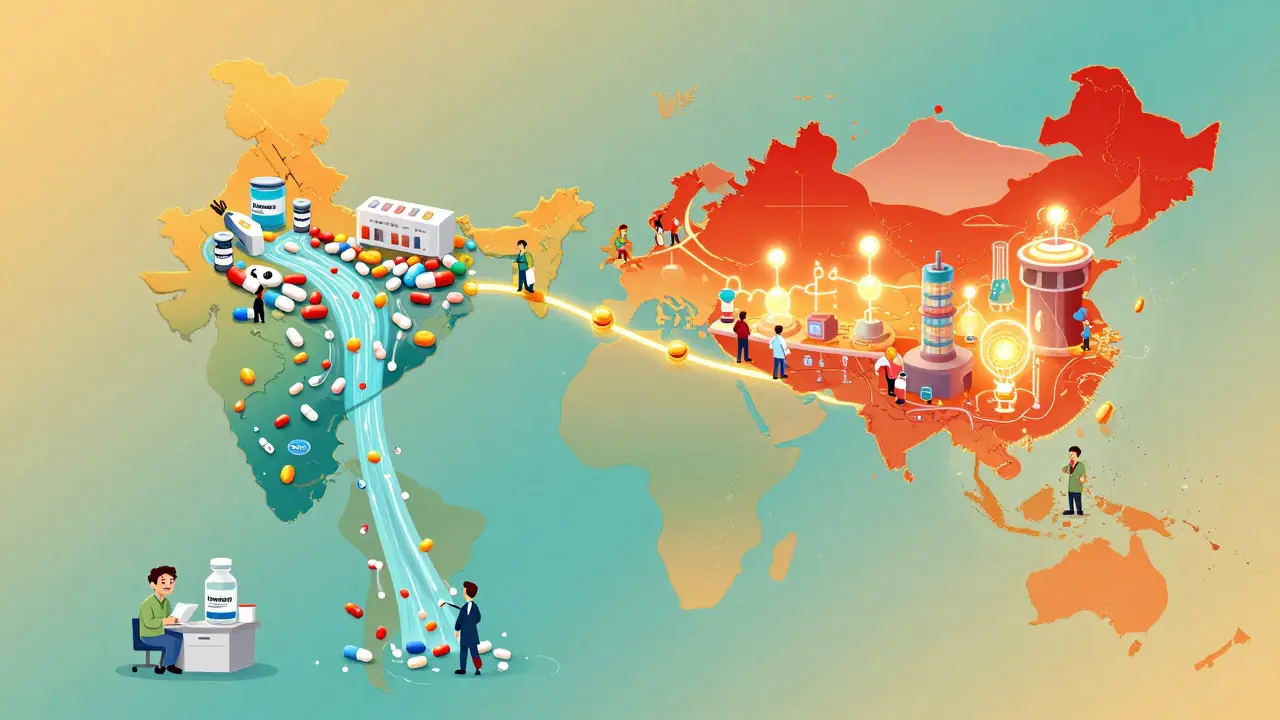
The world doesn’t just rely on pills-it relies on factories in Asia. When you take a generic antibiotic, blood pressure med, or vaccine, there’s a good chance it came from India or China. These two countries aren’t just players in the global generic drug market-they’re the backbone. And now, countries like Vietnam and Cambodia are stepping in to carve out their own niches. This isn’t about politics or trade wars. It’s about manufacturing, cost, quality, and who can deliver the most pills at the lowest price without breaking down.
India: The Pharmacy of the World, But Not the Most Valuable
India’s rise as a generic drug powerhouse started with a bold move in the 1970s. By changing its patent laws to allow process patents instead of product patents, the country opened the door for local manufacturers to copy any drug-so long as they made it differently. That decision, pushed by Prime Minister Indira Gandhi, turned India into the go-to supplier for the developing world and later, the U.S. and Europe. Today, India produces over 60% of the world’s vaccines and supplies 40% of all generic drugs to the U.S. market, according to the U.S. FDA. But here’s the twist: India makes a lot of pills, but not a lot of money from them. Its pharmaceutical market hit $61.36 billion in 2024, but 75% of that comes from low-margin conventional generics. Only 10% is from specialty drugs. The country has over 3,000 FDA-approved manufacturing sites, but only 15% of those can handle biologics-complex drugs like insulin or cancer treatments that require advanced technology. What keeps India competitive? Labor. Skilled workers in Gujarat and Maharashtra cost 30% less than in Europe or the U.S. And when a U.S. pharmacy chain needs a custom formulation, Indian manufacturers typically respond in 14 days. That speed matters. A major U.S. pharmacy chain reported a 60% drop in operational issues after switching to Indian suppliers, thanks to 24/7 customer support and flexible production. Still, India has a huge blind spot: it depends on China for 68% of its Active Pharmaceutical Ingredients (APIs). That’s the raw chemical that goes into every pill. India’s own API production only meets 18% of its needs, despite a $13.4 billion government push called Pharma 2047 to fix that by 2030.China: Bigger, Richer, and Building the Future
China’s pharmaceutical market is bigger-$80.4 billion in 2024-and it’s growing faster in value, even if slower in volume. Unlike India, China doesn’t just churn out cheap generics. It’s moving up the chain. In 2024, 10% of its pharmaceutical output was biologics, up from 5% just five years ago. The government poured $150 billion into innovation under its 14th Five-Year Plan, with 40% of that targeted at biologics R&D. China controls 70% of the global API market. That means if you’re making a generic drug anywhere in the world, chances are the key ingredient came from a factory in Jiangsu or Zhejiang. But this dominance comes with risks. In 2024 alone, the U.S. FDA issued 142 warning letters to Chinese manufacturers for quality issues-nearly double the number for Indian firms. That’s why many U.S. buyers now use dual-sourcing: 68% of major pharmacy chains get 40-60% of their generics from India and 25-35% from China, just to hedge against supply disruptions. Chinese suppliers offer prices 20% lower than Indian ones. But that low cost comes with hidden expenses. One German healthcare company had to spend 18% more on supply chain management after the FDA warnings forced them to test every batch twice. Still, China’s approval process is faster-12 to 18 months versus India’s 18 to 24-and the government is more centralized. No 17 different regulatory agencies to navigate, just 8 national ones.Emerging Economies: The Quiet Disruptors
While India and China fight over volume and value, smaller countries are quietly building their own strengths. Vietnam, for example, grew its pharmaceutical exports by 24.7% in 2024 to $2.8 billion-mostly in antibiotic intermediates. It’s not making finished pills yet, but it’s making the building blocks better and cheaper than anyone else in Southeast Asia. Cambodia, with no history in drug manufacturing, is now assembling low-cost medical devices at 18% annual growth. Thanks to ASEAN trade deals, it’s becoming a hub for syringes, IV bags, and diagnostic tools. These aren’t glamorous industries, but they’re essential. And they’re growing faster than either India or China’s generic sectors. These emerging markets don’t have the scale of India or China, but they’re smarter. They’re avoiding the race to the bottom. Instead, they’re focusing on niche products with high demand and low competition. That’s how you survive when giants are fighting over the same customers.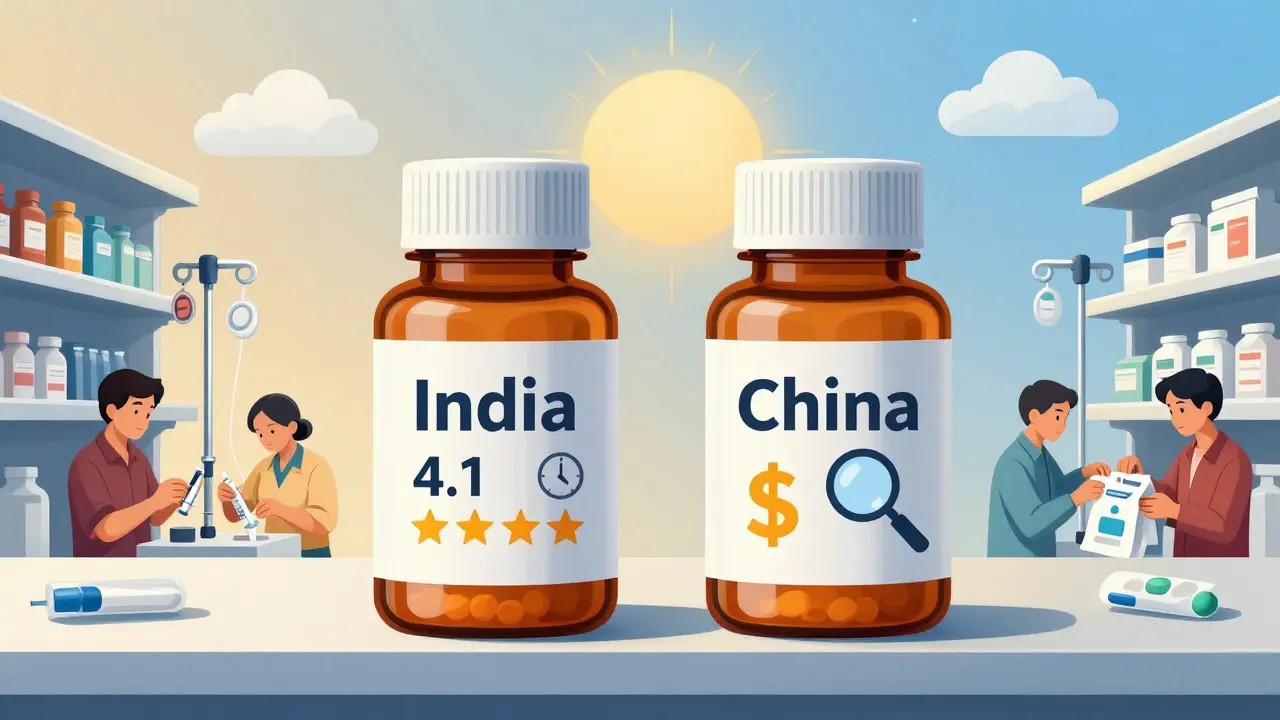
Who Wins? Volume, Value, or Resilience?
India wins on volume. It’s the world’s largest supplier of low-cost generics. Its demographic advantage-65% of its population under 35-means domestic demand is rising fast. More people, more prescriptions, more jobs. By 2030, India’s market could hit $130 billion. China wins on value. It’s not just selling pills anymore. It’s selling biologics, complex formulations, and high-tech APIs. Its exports are 37% non-generic-far higher than India’s 13%. By 2030, China aims for 25% of its exports to be high-value biologics. That’s a massive shift. But the real winner might be the buyers. U.S. and European pharmacies aren’t choosing between India and China anymore. They’re using both. They’re building dual-sourcing models because neither country is reliable alone. India’s communication is better. China’s pricing is lower. But both have quality issues. The smartest companies now require dual testing, dual suppliers, and dual audits.What’s Next? The Race for Self-Sufficiency
Both India and China are trying to cut their dependence on each other. India wants to stop importing 68% of its APIs. China wants to stop exporting so many low-value generics. Both are building new API parks, investing in biologics, and tightening regulations. But here’s the problem: when two giants try to become self-sufficient, they flood the market. S&P Global warns that API overcapacity could trigger a 15-20% price drop between 2026 and 2027. That’s bad for manufacturers. It’s good for buyers. The WHO reported a 27% increase in inspection failures at Asian facilities in 2024. Quality is slipping as production scales up. The next few years won’t be about who makes the most pills. They’ll be about who can make the most pills-without recalls.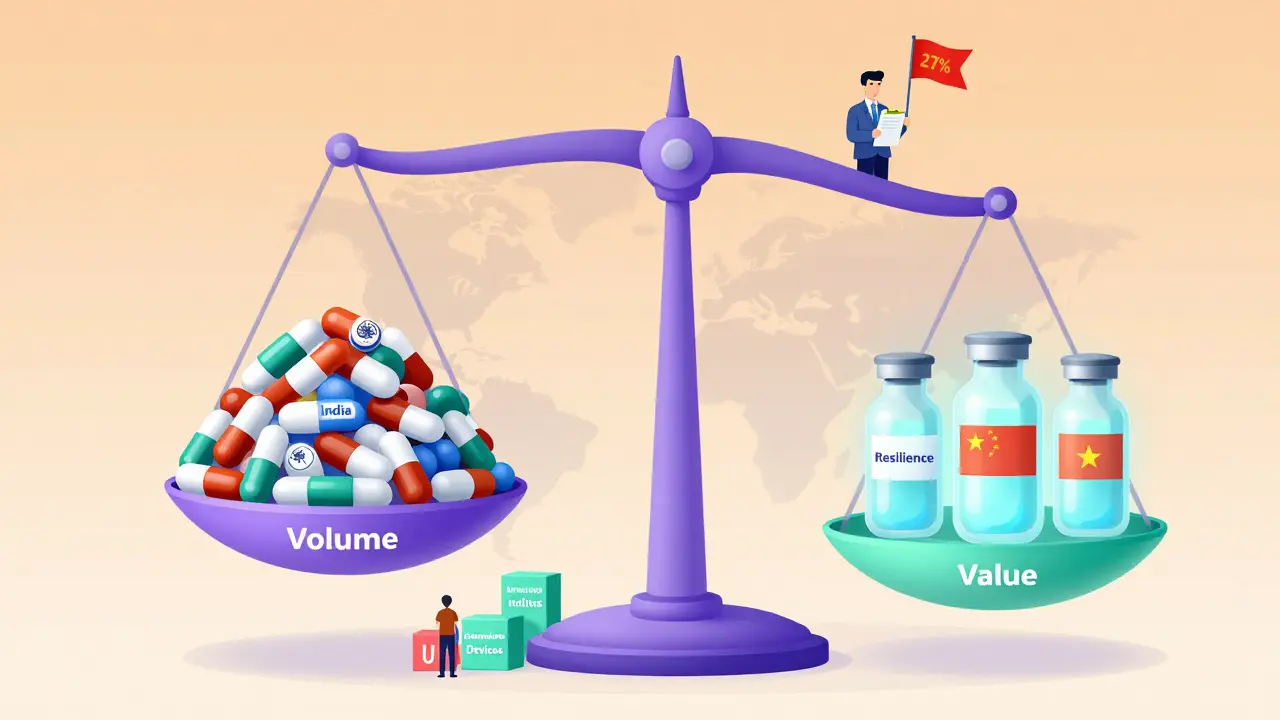
Real-World Trade-Offs: What Buyers Actually Deal With
If you’re a procurement manager, here’s what you’re facing:- India: Slower lead times (22 days longer on average), but better communication, faster custom requests, and higher Trustpilot ratings (4.1/5). You pay more per unit, but you lose less time and stress.
- China: Lower prices (20% cheaper), but higher risk. FDA warnings mean more testing, more paperwork, and more cost. You save on the invoice, but you spend on compliance.
- Vietnam/Cambodia: Smaller volumes, but lower risk of disruption. If you need antibiotics or syringes, these are becoming your safest bets.
Why This Matters to You
Whether you’re a patient, a pharmacist, or a policymaker, this isn’t just about trade numbers. It’s about access. India keeps life-saving drugs affordable for millions in Africa and Latin America. China’s API dominance keeps prices low everywhere. But if either country falters-due to regulation, politics, or quality failures-hundreds of millions could be left without medicine. The global supply chain is more fragile than it looks. And the next big crisis won’t be a pandemic. It’ll be a factory shutdown, a regulatory crackdown, or a raw material shortage. The players in Asia are preparing. The rest of the world better be too.Why is India called the 'pharmacy of the world'?
India earned that title because it produces over 60% of the world’s generic vaccines and supplies 40% of the U.S. generic drug market. Its ability to make low-cost, high-volume medicines-thanks to flexible patent laws and skilled labor-made it the go-to source for affordable drugs worldwide, especially for developing countries.
Does China make more generic drugs than India?
No. India produces more generic drugs by volume, especially simple oral medications. China produces more total pharmaceuticals overall, but a smaller percentage of that is generic. China focuses more on APIs and high-value biologics, while India dominates low-cost, high-volume generics.
Are Indian generic drugs safe?
Yes, most are. Over 3,000 Indian manufacturing sites are FDA-approved, and many meet or exceed global quality standards. However, quality can vary between companies. Some facilities have had compliance issues, which is why many buyers now use dual-sourcing and stricter testing protocols.
Why are Chinese APIs so dominant?
China controls about 70% of the global Active Pharmaceutical Ingredient (API) market because it invested heavily in chemical manufacturing infrastructure over the last 20 years. It produces the raw ingredients for most generic drugs worldwide, including those made in India. This gives China outsized influence over global drug supply chains.
Can emerging economies like Vietnam replace India or China?
Not entirely. But they’re becoming critical niche players. Vietnam excels in antibiotic intermediates, and Cambodia leads in medical device assembly. These countries won’t replace India or China, but they’re making supply chains more resilient by offering alternatives to single-source dependencies.
What’s the biggest risk to the global generic drug supply?
Overproduction and quality erosion. As India and China race to become self-sufficient, they’re flooding the market with APIs and generics. This could trigger price crashes and cut corners on quality. The WHO saw a 27% spike in inspection failures in 2024-signaling that speed and scale are now outpacing safety.

Tori Thenazi
February 10, 2026 AT 03:03THANGAVEL PARASAKTHI
February 11, 2026 AT 07:20Chelsea Deflyss
February 11, 2026 AT 19:31Tricia O'Sullivan
February 11, 2026 AT 23:33Brandon Osborne
February 13, 2026 AT 06:31Marie Fontaine
February 14, 2026 AT 07:44Lyle Whyatt
February 14, 2026 AT 22:23Susan Kwan
February 16, 2026 AT 12:03Ryan Vargas
February 17, 2026 AT 08:14PAUL MCQUEEN
February 18, 2026 AT 13:59glenn mendoza
February 19, 2026 AT 02:06Ashlyn Ellison
February 19, 2026 AT 03:47Scott Conner
February 19, 2026 AT 14:37THANGAVEL PARASAKTHI
February 20, 2026 AT 03:31